
The floor is the one piece of home gym equipment you never think about until it fails you. A 45-pound plate slips off the bar and dents the subfloor. The treadmill drums so hard at 6 a.m. that someone downstairs texts you about it. Or you set up a squat rack on foam tiles and feel the whole platform sway an inch to the left on the first heavy rep. None of that is a training problem — it’s a substrate problem, and it costs a fraction of what a barbell does to solve.
What follows is a practical breakdown of the six flooring types that actually work in garages, basements, and spare bedrooms, ranked by what they cost per square foot and how much of a weekend they’ll eat. I’ve weighted this toward two things: budgets under roughly $500 for a 200-square-foot space, and installs you can finish alone without a wet saw, a trowel, or a contractor’s invoice. If you lift heavy, a couple of these options are non-negotiable. If you’re mostly doing kettlebell flows and Peloton sessions, you can spend a lot less than you think.
Our top picks



As an Amazon Associate we earn from qualifying purchases at no extra cost to you.
Quick Comparison
| Flooring Type | Typical Thickness | Rough Cost / sq ft | Install Effort | Handles Dropped Weight? | Best For |
|---|---|---|---|---|---|
| Interlocking EVA Foam Tiles | 1/2″ – 3/4″ | $1.00 – $2.00 | Under an hour | No | Bodyweight, yoga, light dumbbells |
| Rubber Horse Stall Mats | 3/4″ | $0.60 – $1.25 | Heavy but simple | Yes | Barbell work on a budget |
| Rolled Rubber Flooring | 6mm – 10mm | $2.00 – $3.50 | Moderate, two people | Moderate loads | Seamless wall-to-wall look |
| Interlocking Rubber Tiles | 1/2″ – 1″ | $2.50 – $4.50 | Easy, no adhesive | Yes at 3/4″+ | Odd-shaped or shared rooms |
| Rigid-Core Vinyl Plank | 5mm – 8mm w/ pad | $2.00 – $4.00 | A full weekend | No | Cardio rooms that double as living space |
| Low-Pile Turf Runner | 3/8″ – 1/2″ pile | $2.00 – $4.00 | Cut and lay | No | Sled pushes, sprints, crawls |
How to Choose
- Start with your worst-case impact, not your average workout. If a loaded bar will ever come down from hip height, you need 3/4″ of dense rubber underneath it. Everything else in the room can be cheaper.
- Measure the subfloor, then subtract from your ceiling. Basements with 7-foot ceilings and an overhead press don’t mix well with an extra inch of stacked rubber. Add up mat thickness plus your own standing reach before you buy.
- Know whether you’re fighting impact noise or airborne noise. Rubber kills impact transmission through joists. It does almost nothing for the sound of a fan or a grunting set, so don’t expect acoustic miracles from thickness alone.
- Check the return math on weight. A 4×6 stall mat weighs close to 100 pounds and a 25-foot rubber roll can top 200. If it arrives wrong, you’re paying freight both ways or eating the mistake. Order a sample first when the retailer offers one.
- Plan for off-gassing. Recycled rubber smells strongly for one to three weeks. Unroll it in a ventilated garage before it goes into a closed basement, and budget that time into your build schedule.
Top Picks Reviewed
3/4-Inch Interlocking EVA Foam Tiles
The cheapest legitimate upgrade over bare concrete. Puzzle edges snap together dry, a 24-tile pack covers about 96 square feet, and you can cut them with a utility knife against a straightedge. Foam shines for floor work — planks, mobility, stretching — because it’s warm and forgiving on knees and elbows. Its ceiling is low, though. Rack feet and dumbbell handles emboss it permanently, and it compresses under a treadmill until the belt sits crooked. Treat it as a comfort layer, not a load-bearing one.
Rubber Horse Stall Mats (4′ x 6′, 3/4″)
Pound for pound, still the best value in home gym flooring. These are dense vulcanized rubber built for animals that weigh half a ton, which means dropped bumpers barely register. Six mats cover 144 square feet for what a single branded gym tile set costs. The catch is entirely logistical: they’re brutally heavy, they arrive rolled with a memory curl that takes a week of flat weight to relax, and the factory edges rarely butt together perfectly. Trim with a fresh hook blade and a chalk line and the seams tighten up considerably.
8mm Rolled Rubber Flooring
If you want a floor that looks intentional rather than improvised, rolled rubber is the answer. Four-foot-wide rolls give you long unbroken runs with only a few seams in a typical room, and the color-fleck options read as commercial rather than agricultural. Eight millimeters absorbs treadmill vibration and moderate dumbbell drops nicely, but it isn’t a deadlift platform on its own. You’ll want a second person for handling and, ideally, double-sided seam tape at the joints in high-traffic lanes.
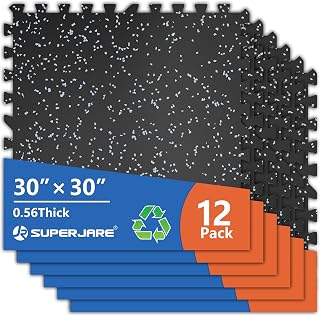
1/2-Inch Interlocking Rubber Tiles
The compromise pick for rooms that aren’t rectangles. Real rubber density with a puzzle edge means no adhesive, no roll wrestling, and the ability to work around a water heater, a support post, or a staircase bulkhead. Many sets ship with straight border pieces so the perimeter looks finished. Cost per square foot is the highest of the rubber options, so it’s most efficient when used as a zone — under the rack, in front of the bench — rather than wall to wall.
Rigid-Core Vinyl Plank with Attached Underlayment
For a spare bedroom that has to look like a room, not a gym. Click-lock planks float over the existing subfloor, resist the sweat and water that ruin laminate, and wipe clean in seconds. Pair it with a pair of equipment mats under a bike or rower and it holds up indefinitely. It will not survive dropped iron, and it’s the most demanding install here — expect underlayment prep, expansion gaps, and a spacer-and-tapping-block rhythm across a full weekend.
Low-Pile Turf Runner (3′ or 4′ Wide)
A niche pick that earns its space fast. A 12- to 15-foot strip of low-pile turf laid over rubber gives you sled pushes, bear crawls, and med ball work without chewing up the mats underneath. The short pile means no infill to vacuum out of your socks, and it rolls up for storage if the space is shared. Line-marked versions help with consistent sprint or lunge distances in a short room.
Frequently Asked Questions
Can I put rubber mats directly on carpet?
Yes, and 3/4″ stall mats are the right choice for it. The carpet compresses unevenly under lighter tiles and makes racks feel tippy, but heavy dense rubber flattens the pile and creates a stable plane. Expect some trapped moisture over years — lift and air the mats occasionally, and skip this over anything with a history of dampness.
How much thickness do I need for deadlifts?
Over concrete, plan on 3/4″ of dense rubber as a baseline, and stack a second layer or build a plywood-and-rubber platform if you’re dropping repeatedly from lockout. Foam thickness is not equivalent thickness; a full inch of EVA transmits more shock to a slab than 3/4″ of vulcanized rubber does.
Will flooring stop my neighbors from hearing my workout?
It will meaningfully reduce impact noise traveling through the structure, which is usually the complaint. It won’t stop airborne sound. A rubber layer plus a rubber-and-plywood platform under the loading zone, and controlled lowering instead of free drops, does far more than any single mat purchase.
What’s the actual lifespan of these options?
Dense rubber, in either mat or tile form, routinely lasts a decade or more in home use. Rolled rubber is similar but can telegraph seam wear in walkways. EVA foam typically shows permanent compression within one to three years of regular use. Vinyl plank outlasts the others cosmetically as long as nothing heavy hits it.
Final Thoughts
Most home gyms don’t need one flooring solution — they need two. Put dense 3/4″ rubber where the weight lands, and spend less on whatever covers the rest. That approach usually lands under $400 for a two-car garage bay and takes an afternoon plus a friend with a strong back. If you’re not lifting barbells at all, foam or vinyl plank will serve you for years at half the cost. Buy for the heaviest thing you’ll ever drop, measure twice before ordering anything that ships by freight, and give recycled rubber a week outdoors before it moves into a finished room. Get that right once and you’ll never think about the floor again, which is exactly the point.




Write Your Review
No reviews yet. Be the first to share your experience!