
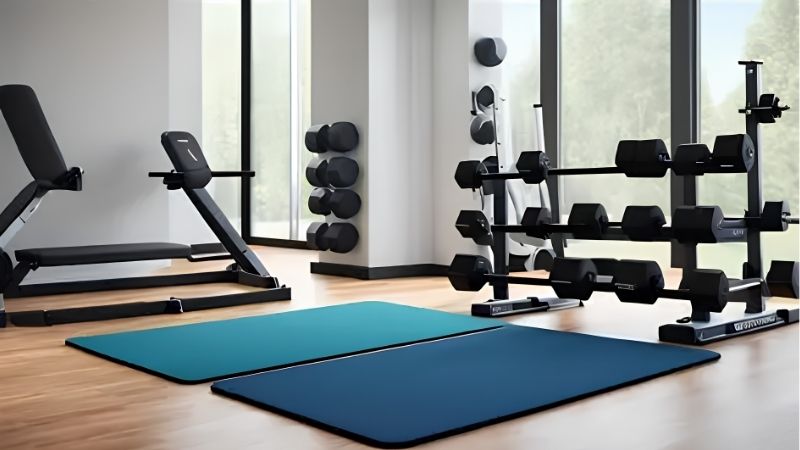
The best gym mat for home depends on which area it serves. A surface for floor exercises, a covering beneath a machine and a weight-handling area have different requirements. Divide the room by task before choosing material or thickness. One continuous visual finish is appealing, but it should not hide differences in how the space will be used.
This guide provides practical selection and use considerations. It does not report hands-on product testing.
Name the job of each zone
Start with the activities and equipment already planned. Identify where somebody lies or kneels, where machine feet rest and where weights are placed down according to their instructions. Keep circulation separate. A mat sold for comfortable floor exercise should not automatically be assigned every equipment-support role in the room.
For each zone, check the equipment maker’s placement requirements and the covering manufacturer’s intended uses. If those do not clearly agree, ask before ordering. A material name alone does not establish suitability under a specific machine or for a particular activity. Compare documented products, not assumptions about all foam or all rubber.
Measure coverage from the complete activity
Draw the area used by the person as well as the equipment. Include permitted access, movement and equipment return. Do not calculate coverage from a machine’s base alone when the activity extends beyond it. Equally, avoid covering every corner of the room before knowing which areas need which surface.
Keep door swings and fixed furnishings on the drawing. Check whether the proposed thickness or edge treatment conflicts with a door or creates a transition in an important route. An attractive layout should remain practical when the room is used for ordinary household tasks between sessions.
Choose the format around the layout
A single mat may define a small independent area. Tiles can be arranged in sections, while a roll presents a different installation and handling task. Read the instructions for joins, edges and any cutting. Do not assume every product can be trimmed, adhered or repeatedly lifted in the same way.
Estimate quantities from the actual product dimensions and permitted layout. Include necessary finishing pieces rather than only the central area. Keep any offcuts or spare pieces identified if the manufacturer recommends retaining them. A purchase is not complete when the center is covered but an essential transition remains unresolved.
Product listings to compare
As an Amazon Associate we earn from qualifying purchases. Compare the selected variant and its current description with the requirements above.
Our top picks


As an Amazon Associate we earn from qualifying purchases at no extra cost to you.
Check the existing floor before adding a layer
Identify the floor finish and its care guidance. Ask about compatibility with the proposed covering, including any underlay or adhesive. A mat should not be assumed to prevent every mark or moisture problem. The supporting floor and the new material need to be considered together.
If the installation raises a structural question, obtain appropriate advice. Adding a covering does not establish the building’s load capacity. Likewise, do not promise that a particular thickness will stop sound reaching neighbors. Treat noise, structural support and surface protection as separate questions with their own evidence.
Keep the design easy to inspect
Plan access to seams, edges and areas around equipment feet. Follow the cleaning requirements for both the covering and the floor beneath where applicable. Avoid sealing a layout behind heavy furniture before understanding how it will be maintained. A serviceable arrangement can be more useful than one that appears seamless but cannot be inspected.
Choose colors and borders after the functional layout is settled. Contrast may help you recognize separate areas, but decorative distinctions do not make an unsuitable surface safe. Keep loose household rugs out of the plan unless they have an appropriate documented role in the specific arrangement.
Install for the planned use
Follow preparation and installation directions, using appropriate assistance for difficult handling or fitting. Confirm that edges and joins are finished as required before putting the area into service. If equipment must be moved, use its documented handling process rather than dragging it across the new surface.
Continue to follow the equipment’s own rules for setting down weights or operating a machine. A gym covering does not grant permission to drop a product that should not be dropped. Inspect the area during normal care and address changes in condition through the relevant instructions.
Let the room explain the choice
A useful mat layout has a reason for each section: appropriate floor practice, documented equipment placement or another defined task. Choose the covering that serves those requirements and integrates with the existing floor. Thickness and appearance become parts of that decision instead of substitutes for it.
Additional product links
- Start 30-Day Prime Free Trial →
- See Today’s Amazon Deals
- ▸ Try Amazon Prime — free 30-day trial
- ▸ Start an Audible Premium Plus free trial
- ▸ Read free with Kindle Unlimited
Related reading
- Best gym mat for home
- Chris Parker
- Best Rowers for Home Gym: Air, Magnetic and Water Compared
- Best Weight Home Gym: 6 All-in-One Machines for Small Rooms
- Best Home Gym Equipment for Beginners: The Starter Setup
- Best Treadmills for Home Gym: 5 Picks by Deck and Motor
- Best Home Gym Compact Setups: 6 Space-Saving Picks Ranked
- Best kettlebell weight for men
- Best grip yoga mat
- Best way to clean a yoga mat
- Best grippy yoga mat
- Best Floor Home Gym Setups: Mats, Tiles and Rubber Rolls
- Home Gym Best Picks: 6 Category Winners for Any Room Size
- Best Non Skid Yoga Mat: 6 That Stay Put on Any Hard Floor
- Best Budget Yoga Mat: 6 Picks by Practice and Floor Type







Write Your Review
No reviews yet. Be the first to share your experience!