
Key takeaways
- Warranty Description: 2 Year
- Tension Supported: 264 lb
- Strap Type: Cable/Pulley straps
Home Smith machines are sold with a footprint number that describes the frame and nothing else. The frame is not the problem. A machine listed at 60 by 50 inches needs a barbell that is 86 inches wide, crossover arms that swing outward, a bench that pulls forward for pressing, and enough space behind it for a lat carriage to travel. Add clearance to walk around the thing and the honest requirement is closer to 9 by 9 feet than the 5 by 4 the listing implies.
Height is the other trap. Most of these stand 84 to 91 inches, and the Smith rails need a few inches above that for the carriage to reach the top of its travel. A garage with the door open frequently loses eight to fourteen inches of usable ceiling to the track and panel, which is precisely the space a tall machine needs. Before comparing features, measure your room three ways: floor area including swing clearance, lowest ceiling obstruction, and the width of the route the boxes have to travel. Those three numbers eliminate most of the field before you ever look at a spec sheet.
Our top picks

 Mikolo Smith Machine with Weight Stack
- Warranty Description: 2 Year
- Tension Supported: 264 lb
- Strap Type: Cable/Pulley straps
Dual 128-pound stacks let two people train at the same time
Combines power rack, lat pulldown, and cable crossover in one footprint
Machine is backed by a 2-year warranty
Dual steel uprights and stacks take up real floor space
Bundled bench and cable attachments need assembly before use
 MAJOR FITNESS Drone2 Advanced Training Smith Machines–
1:1 pulley ratio suits heavy, strength-focused cable exercises
Comes with dip handles, a T-bar, and other included accessories
Backed by lifetime after-sales support from the maker
2000-pound rated cage needs a sturdy, dedicated space
Multiple pulley and accessory setup adds assembly complexity


As an Amazon Associate we earn from qualifying purchases at no extra cost to you.
Quick Comparison
| Product | Best For | Standout Feature | Watch Out For |
|---|---|---|---|
| S1-V4 Smith Machine | Standard spare rooms | Cable crossover on a 2000 lb frame | Crossover arms need side clearance |
| Mikolo Smith with Weight Stack | Rooms without plate storage space | Selectorised stack, no loose plates | Deeper footprint than plate models |
| MAJOR FITNESS Drone2 | Smooth cable feel | Aluminium pulleys, low friction | Premium price point |
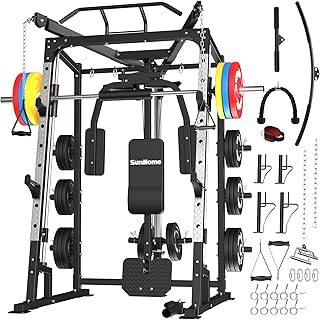
| SunHome Smith Machine | Value per square foot | Full station at a moderate size | Assembly instructions are sparse |
| MAJOR FITNESS Drone3 | Larger garages | 2500 lb frame, dual pulley system | Largest footprint and height here |
| JELENS SR01 Smith Machine | Tighter budgets | 2000 lb frame with lat pulldown | Carriage glide is merely adequate |
How to Choose
- Measure swing clearance, not footprint: Add roughly 30 inches on each side for crossover arms and 40 inches at the front for a bench. That total, not the frame dimension, is what has to fit in your room.
- Check ceiling with the garage door open: Track hardware and the raised door panel typically steal eight to fourteen inches. Measure to the lowest point the machine will sit under, in the door’s open position.
- Verify the delivery route: These arrive in cartons that can exceed 100 lb each and six feet in length. A tight stairwell turn or a narrow basement door has stopped more of these purchases than ceiling height has.
- Weight stack versus plate loaded: A selectorised stack saves the floor space that plate storage and loose plates would occupy, but adds depth to the machine itself. Plate loading is cheaper but needs somewhere to put the plates.
- Bar path angle: Most home Smith machines run at a slight incline rather than perfectly vertical, which better matches a natural press and squat path. Confirm the angle if you are used to a vertical commercial unit, because the feel is noticeably different.
Top Picks Reviewed
Best Overall: S1-V4 Smith Machine
This hits the size and capability balance most home rooms actually need: a 2000 lb rated cage, a Smith carriage, and a working cable crossover, all within a footprint that fits a standard spare bedroom or half a single garage. The carriage glide is smooth enough that you stop noticing it, which is the real test.
The crossover arms are the space constraint. They need lateral clearance to swing, so pushing this into a corner removes a function you paid for. Plan the layout around the arms rather than the frame.
Best for Small Rooms: Mikolo Smith Machine with Weight Stack
The selectorised stack is a genuine space saver in a room where a rack of loose plates would not fit. Changing weight is a pin rather than a plate shuffle, which also makes drop sets and supersets practical without a cluttered floor.
The stack lives inside the frame, which makes the machine deeper front to back than a plate-loaded equivalent. You save floor area elsewhere but the unit itself takes more depth, so measure that dimension carefully.
Best Cable Quality: MAJOR FITNESS Drone2
Aluminium pulleys with proper bearings are the difference between cables that feel like a machine and cables that feel like dragging weight over a stick. The smoothness here is the best in this comparison, and it makes higher-rep cable work far more pleasant.
You pay for that engineering. Against the mid-range options the price gap is significant, and if cable work is a small part of your programme the improvement will be hard to justify.
Best Value: SunHome Smith Machine
A 2000 lb frame with a Smith bar, lat pulldown and crossover system at a moderate price and a manageable size makes this the sensible middle choice for most rooms. Nothing about it is exceptional, and nothing about it is a compromise you will regret.
The documentation is the weak point. Instructions are thin and the diagrams are ambiguous in places, so budget extra time for assembly and expect to work out a step or two by inspection.
Best for Large Spaces: MAJOR FITNESS Drone3
If you have a full garage or a dedicated gym room, the 2500 lb frame and dual pulley system make this the most capable machine here. Independent cable stacks allow unilateral work and true crossovers that single-stack designs cannot replicate.
It is also the largest and tallest, and that is not a small difference. In a room with 84-inch ceilings or under an open garage door, it simply will not fit. Confirm both dimensions before you order.
Best Budget Option: JELENS SR01 Smith Machine
A 2000 lb frame with a Smith carriage and lat pulldown at the low end of the price range is a legitimate entry point, and the core structure is solid enough for normal home training.
The carriage glide is where the savings show. It is functional but not silky, with a small amount of stiction at the extremes of travel that you notice on light warm-up sets more than on working ones.
Frequently Asked Questions
How much floor space does a home Smith machine really need?
Plan for roughly 9 by 9 feet including bench, barbell width, crossover swing and walking clearance. The frame dimension in the listing is typically half of what the working area requires.
What ceiling height is required?
Most units stand 84 to 91 inches, and you want a few inches above that for carriage travel and comfort. In a garage, measure to the lowest point with the door in the open position, not the closed one.
Is a Smith machine bar path vertical?
Most home units run at a slight incline, typically a few degrees off vertical, which matches the natural arc of a press and squat more closely. If you have trained on a vertical commercial unit, expect the feel to differ.
Can one person assemble a Smith machine?
Not realistically. The rails and top members are heavy and need to be held in alignment while bolted, which requires two people. Assembly commonly runs four to six hours even with help.
Final Thoughts
For a typical spare room or half-garage, the S1-V4 Smith Machine offers the best capability within a footprint that genuinely fits. Where floor space is at a premium and loose plates are not an option, the Mikolo Smith Machine with Weight Stack solves that problem cleanly. And if you have a full garage and want the most machine available, the MAJOR FITNESS Drone3 and its dual pulley system is the one to size the room around.
Write Your Review
No reviews yet. Be the first to share your experience!