Key takeaways
- Clean on a dry, low-humidity day — slow evaporation is the main cause of spotting.
- Photograph the fixture from three angles before you start, so you have a reference if a prism comes loose.
- Never mix a drip-dry cleaner with dish soap or vinegar; surfactant residue is exactly what these formulas are engineered to avoid leaving behind.
- For fixtures over a stair or double-height space, hire a lift rather than improvising with an extension ladder on carpet.
What's inside
A crystal chandelier is really a machine for bending light. Every faceted drop, every cut prism and beveled arm exists to take one small filament of illumination and split it into dozens of directional beams that skim across your ceiling, catch the edge of a plaster cornice, and land as those flickering specks on the tabletop. When I walk into a dining room and the fixture reads flat, the bulbs are almost never the problem. The problem is a film of atmospheric grime maybe two microns thick, sitting on the exact surfaces that are supposed to be doing the refracting. Kitchen aerosols, candle soot, forced-air dust, and city particulate settle into a soft haze that scatters light instead of directing it. You lose sparkle, you lose contrast, and the whole room drifts toward a dull, even wash.
The good news is that restoring a chandelier is one of the highest-payoff hours you can spend on a room, and it does not require dismantling anything. Below I’ll walk through how I approach a cleaning as a lighting designer: how to read the fixture before you touch it, why drip-dry sprays have largely replaced hand-wiping every prism, how to protect the parts that genuinely hate moisture, and how to finish so the fixture throws crisp beams again rather than a soft blur. I’ll flag a few products worth keeping on the shelf, but the technique matters far more than the bottle.
As an Amazon Associate we earn from qualifying purchases at no extra cost to you. Product prices and availability are accurate as of the date shown and are subject to change.



🛒 Best Price Today on Amazon
Prime members get fast, free shipping on everything above, plus member-only deals. New members get a 30-day free trial — cancel anytime.
Read the Fixture Before You Spray Anything
Spend two minutes identifying what you’re actually working with, because it dictates everything downstream. Leaded crystal and modern optical crystal are hard, non-porous, and forgiving. Acrylic prisms — common on budget fixtures and on many reproductions — scratch if you rub them and can craze if you hit them with ammonia or solvent-heavy glass cleaner. Antique fixtures often have gilt, ormolu, or painted finishes on the frame that will lift or spot permanently if soaked. Look, too, at how the crystals hang: pinned brass links, wire hooks, or plastic clips. Aging plastic clips go brittle, and a firm poke while cleaning will drop a prism onto a hardwood floor. If you see brittle clips or missing links, order replacements first and clean second.
Why Drip-Dry Beats Wiping Every Prism
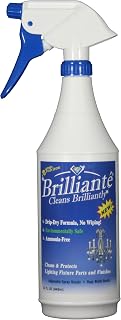
Hand-washing each crystal is how this was done for a century, and on a small fixture with twenty drops it’s fine. On a forty-arm fixture it’s a lost weekend, and every re-hang is a chance to reinstall a prism at the wrong angle, which quietly changes the light pattern. Drip-dry cleaners solve this by flooding the crystal, dissolving the film, and carrying it off the bottom edge as the solution evaporates — no contact, no lint, no streaks. Ammonia-free formulas like BRILLIANTÉ Crystal Chandelier Cleaner are the long-standing choice for antique and mixed-material fixtures because they won’t attack gilt or acrylic. Sparkle Plenty Chandelier Cleaner Drip Dry Spray works the same way and is my default for routine dust on modern crystal. If your fixture sits high above a stairwell, a bottle rated to spray up to 25 feet, like the Chandelier Cleaner Spray 32 oz No-Wipe, saves you the ladder entirely.
Protect What You’re Standing Under
Drip-dry means exactly that: several ounces of liquid will land beneath the fixture. Kill the power at the breaker, not just the switch, and let hot bulbs cool completely — cold spray on hot glass can crack a lamp. Cover the table or floor with a plastic sheet and a layer of old towels on top; plastic alone gets slick and dangerous. Bag each bulb and socket in a small plastic bag secured with a twist tie, and drape the canopy and any fabric shades. Sockets and wiring are the only parts of this job that carry real risk, so give them a proper barrier rather than trusting your aim.
Dust First, Then Flood
Heavy dust turns into gray sludge the moment it gets wet, so dry-remove the bulk of it first with a soft feather duster or a vacuum brush attachment held slightly off the surface. Then spray generously from the top down, saturating the upper arms and letting gravity carry the solution over the lower tiers. Under-spraying is the most common mistake I see — a light misting leaves partially dissolved grime that dries as a visible tide line. For fixtures with baked-on kitchen film or years of neglect, a stronger formula such as the Jaxry Professional Crystal Chandelier Cleaner handles heavy dust better in a single pass. Leave it alone to dry; touching a drying prism is what creates streaks.
Finish for Light, Not for Looks
Once dry, restore power and stand back at the room’s normal viewing distance. You’re checking beam quality: crisp, defined points of light on the walls and ceiling mean the facets are clean. Soft halos mean residual film. While you’re there, confirm every bulb is the same color temperature and that clear bulbs are oriented with filaments pointing the same way — a mismatched bulb undoes a perfect cleaning instantly. If you maintain a large fixture regularly, a gallon refill like the BRILLIANTÉ 1 Gallon Refill is far cheaper per ounce than replacing spray bottles.
Tips
- Clean on a dry, low-humidity day — slow evaporation is the main cause of spotting.
- Photograph the fixture from three angles before you start, so you have a reference if a prism comes loose.
- Never mix a drip-dry cleaner with dish soap or vinegar; surfactant residue is exactly what these formulas are engineered to avoid leaving behind.
- For fixtures over a stair or double-height space, hire a lift rather than improvising with an extension ladder on carpet.
Frequently Asked Questions
How often should a chandelier be cleaned?
Twice a year for a dining room, quarterly for anything within airflow of a kitchen or an open fireplace, and annually for a low-traffic entry. Dust between cleanings with a dry duster and the wet cleanings go much faster.
Can I use these sprays on acrylic crystals?
Yes, provided the formula is ammonia-free — that’s why products explicitly rated for glass, crystal, and acrylic exist. Avoid standard household glass cleaner on acrylic; it hazes the surface over time.
Do I really need to shut off the breaker?
Yes. You’re introducing liquid near live sockets, and a wall switch can be miswired to break the neutral rather than the hot leg. The breaker is the only reliable disconnect.
What if my fixture has water spots already?
Existing mineral spots usually need a second saturating pass, or gentle hand-cleaning of the affected prisms with a lint-free microfiber. Hard-water etching that has actually pitted the glass is permanent.
Conclusion
Treat chandelier cleaning as an optical tune-up rather than a chore. Identify your materials, protect the sockets and the surface below, dry-dust before you wet-clean, then saturate generously with an ammonia-free drip-dry formula and walk away while it dries. Done properly, you’ll get back the thing you paid for in the first place: sharp, directional sparkle that gives a room depth after dark.