When you are updating a space with standard 8-foot ceilings—or even lower 7-foot ceilings found in finished basements, attics, and urban condos—choosing the right overhead illumination is one of the most consequential interior design decisions you will make. Overhead clearance is at a premium, meaning every inch of vertical drop counts. Mounting the wrong fixture can make a room feel cramped and cave-like, while the right selection creates an airy, expansive feel despite limited vertical real estate.
The debate almost always comes down to two contenders: track lighting versus recessed lighting for low ceilings. In 2026, advances in slim-profile LED engineering have transformed both options, eliminating many of the visual and structural drawbacks of older fixtures. However, deciding between track lighting vs recessed lighting for low ceilings requires balancing installation complexity, budget, visual clutter, and how you intend to direct light across your space. Here is an editor-level breakdown to help you make the right investment for your home.
Our top picks

 VANoopee 12-Light LED Track Lighting Kit with
- LED Track Lighting Kits: This set of LED…
- 10%-100% Dimmable: Enjoy full control over your lighting…
- Flicker Free, CRI 90+: VANoopee LED Track Lighting…


As an Amazon Associate we earn from qualifying purchases at no extra cost to you.
Quick Verdict
Choose recessed lighting if your primary goal is maximizing open headroom, achieving a clean architectural look, and delivering smooth, edge-to-edge illumination across an entire room without adding visual bulk to the ceiling plane.
Choose track lighting if you want to avoid cutting into drywall, need directional light to accent art or task zones (like kitchen counters or galleries), are working with a single junction box, or live in a rental property where permanent ceiling alterations are off-limits.
Side by Side
| Feature | Track Lighting | Recessed Lighting |
|---|---|---|
| Comfort & Light Diffusion | Focused spotlighting; high accent potential but can create harsh directional shadows if improperly aimed. | Broad, evenly diffused ambient light; wide beam angles (100°–120°) reduce dark spots. |
| Durability & Longevity | High; modular parts, tracks, and heads can be swapped individually if a unit fails. | High; rated for 30,000–50,000 hours, though driver boxes can occasionally require replacement. |
| Price Range (Upfront Hardware) | $30 – $200 per fixture kit depending on length and number of heads. | $25 – $80 per 4-to-6-pack kit of ultra-thin LED downlights. |
| Maintenance & Bulb Swap | Very easy; twist and replace bulbs (e.g., standard GU10/E26) or snap on new light heads without tools. | Moderate; requires popping the spring-loaded trim down to access integrated drivers or light discs. |
| Space Needed (Clearance & Plenum) | Requires zero drywall depth, but hangs down 3.5 to 8 inches into the room space. | Hangs 0 to 0.25 inches into the room; requires 0.5 to 2 inches of plenum space inside the ceiling. |
| Visual Style & Aesthetics | Industrial, modern, or accent-focused; introduces physical lines and geometric forms to the ceiling. | Minimalist, seamless, and unobtrusive; flush profile blends directly into painted drywall. |
| Resale Value Impact | Neutral; subjective depending on buyer design taste and current home decor trends. | Universally positive; buyers view integrated LED recessed downlights as a modern move-in feature. |
| Best For | Task lighting, art walls, single J-box ceilings, and renters avoiding drywall cuts. | Overall ambient room illumination, ultra-low clearance basements, and open-plan living rooms. |
Where Track Lighting Wins
Track lighting remains a favorite for interior designers dealing with difficult ceiling logistics. Its primary advantage is that it installs directly onto existing electrical junction boxes without requiring you to cut open drywall, run new lines between floor joists, or alter ceiling framing. If your room only has one central wiring point, a single track kit can distribute light across an entire 10-to-15-foot expanse without major demolition.
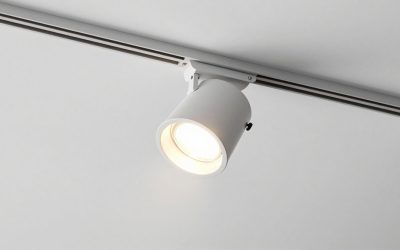
Flexibility is another major strength. Track light heads rotate 330 to 360 degrees and pivot vertically, allowing you to bounce light off light-colored walls to create indirect ambient glow—a smart trick for low-ceiling spaces where direct overhead glare can feel oppressive. Systems like the AUQUEE 8 Light Track Lighting Fixtures Ceiling ($69.99) feature a matte black finish with multiple rotatable light heads on folding arms, providing immense flexibility for broad kitchens or hallways without complicated electrical work. For larger, continuous spaces, modular setups like the VANoopee 12-Light LED Track Lighting Kit with 13FT H Type Track Rail ($199.99) allow you to position multiple high-output heads along a extended rail to highlight specific zones like art displays, reading nooks, or kitchen islands.
Finally, track systems are easy to update. If your lighting needs change or a bulb burns out, you can adjust the head positions, change beam angles, or pop off individual fixtures without touching the ceiling’s interior structure.
Where Recessed Lighting for Low Ceilings Wins
When vertical headroom is your absolute priority, recessed downlights are unbeatable. Traditional recessed “cans” used to require 5 to 7 inches of ceiling depth (plenum space) inside the ceiling cavity, making them difficult to install beneath tight floor joists. However, modern ultra-thin wafer LED technology has completely rewritten the rulebook. Slim recessed lights drop down less than a quarter-inch from the ceiling face while requiring as little as 0.5 to 1.5 inches of depth inside the sheetrock, fitting easily beneath ductwork and joists.
A sleek option like the Amico 4 Pack 4 Inch 5CCT Ultra-Thin LED Recessed Ceiling Light ($27.99) requires minimal ceiling plenum space while offering selectable color temperatures to match your room’s decor. For wider spatial coverage with high output, fixtures like the Amico 6 Pack 6 Inch LED Recessed Light with Junction Box ($39.99) deliver roughly 1050 lumens per light at a modest 12W power draw. This flush design preserves every millimeter of physical clearance, ensuring tall residents or raised arms never bump into a fixture.
Visually, recessed downlights dissolve into the ceiling plane. By keeping the overhead surface clean and uncluttered, they make low ceilings feel higher by eliminating hard visual lines that draw the eye downward. Their broad 100-to-120-degree light distribution floods basements and low-ceiling living rooms with uniform, daylight-quality light that eliminates dark corners.
Cost Over 5 Years
Evaluating track lighting vs recessed lighting for low ceilings requires weighing upfront hardware costs against long-term installation labor and energy expense:
- Track Lighting Initial Investment: Hardware runs between $50 and $200 for a multi-head kit. Because it mounts to a single standard junction box, installation is often a fast $0 DIY project or a standard $150 service call by an electrician. Five-year operating costs with LED bulbs (consuming roughly 6W to 8W per head) average under $15 per year in electricity for normal residential use.
- Recessed Lighting Initial Investment: A 6-pack of wafer thin LED downlights costs between $30 and $60. However, retrofitting a room with 6 to 8 recessed lights requires cutting holes, running wires across ceiling joists, and installing remote junction boxes. Professional electrical labor typically ranges from $300 to $800 depending on attic or floor access above. Operating costs for modern 12W LED downlights run roughly $15 to $25 per year total.
Over a 5-year timeline, track lighting is generally cheaper upfront due to minimal installation costs ($200–$350 total project cost). Recessed lighting carries a higher total initial spend ($350–$900 installed), but it adds measurable equity and permanent value to homes with lower ceiling clearances.
Which One for Your Home
Small Apartment or Condo
If you live in an apartment or condo with concrete slab ceilings or limited electrical access points, track lighting is the winner. A slender, surface-mounted track kit lets you throw light across your living area and kitchen counters without needing to construct a dropped ceiling drywall chase.
Family Home with Kids or Pets
In low-ceiling basements, playrooms, or recreation spaces where kids throw balls or play games, recessed lighting is far safer. Ultra-thin wafer lights sit flush against the drywall, entirely out of reach of impact and eliminating hanging hardware risks.
Rental Property
Track lighting is ideal for rentals. You can swap out a basic, builder-grade surface light for a stylish multi-head track fixture without damaging drywall framing, allowing you to easily reinstall the original fixture and take your track lights when you move.
Long-Term Single-Family Home
If you own a long-term home with low 7.5-to-8-foot ceilings, recessed downlights are the ideal long-term investment. Flush LED downlights open up the room visually, improve overall light coverage, and give your home an upgraded, clean look that appeals to buyers at resale.
FAQ
How much ceiling height do I lose with track lighting vs recessed lighting?
Track lighting hangs down into the room between 3.5 and 8 inches, depending on the rail system and head style. Ultra-thin LED recessed lights sit flush with the ceiling, projecting downward less than 0.25 inches and preserving full clearance in your space.
Can you install recessed lights in low ceilings without a deep joist cavity?
Yes. Ultra-thin wafer LED recessed lights do not require traditional deep metal “cans.” They come with slim, remote-driver junction boxes that fit into shallow ceiling cavities with as little as 0.5 to 1.5 inches of clearance space.
Does track lighting make a low ceiling look lower?
It can. Because track lights hang below the ceiling surface, dark metal rails or bulky fixture heads create a visible horizontal plane that draws the eye down. Using slim white track rails that match your ceiling paint color helps minimize this effect.
Which option provides better overall room lighting for low-ceiling basements?
Recessed lighting typically provides superior, edge-to-edge room lighting in basements. Its wide lens diffusion spreads soft, even light across the entire floor plan, eliminating the dark corners common with directional track spotlights.