
The best home gym cycle is a bike that suits your preferred riding position, offers the adjustments you need and has an appropriate place in the room. Begin with the type of cycle before comparing displays or accessory bundles. A striking design is secondary to whether you can set up and use the actual bike as intended.
This guide provides practical selection and use considerations. It does not report hands-on product testing.
Choose the riding format first
An indoor cycle typically presents a saddle and handlebars arranged for a cycling-focused position. An upright exercise bike offers a different layout, while a recumbent design places the pedals ahead of a seat with a backrest. An air bike may add moving handles. These descriptions narrow the search, but the exact geometry and supported use still vary by model.
Folding is a storage feature rather than a complete description of riding fit. A folding bike still needs to be evaluated for its seat, reach and operating instructions. Likewise, a backrest does not establish that a particular cycle is appropriate for a medical need. Choose based on the documented features and your individual fit requirements, without treating the category name as a guarantee.
Check fit as a set of relationships
Review how the seat moves relative to the pedals and handlebars. Some bikes provide more than one direction of adjustment; others offer a more limited range. Check the actual adjustment information for the model. A broad rider-height statement alone does not describe every person’s reach or proportions.
Look at the pedals and the foot-retention system too. Confirm what is supplied and whether an intended replacement is supported before assuming that a familiar pedal can be fitted. Where possible, try the bike or an equivalent demonstration of the exact model. If you cannot, clear return arrangements become particularly useful.
Understand resistance and basic controls
Read how resistance is adjusted and how the bike is stopped according to its instructions. Different systems should not be compared simply by the number of levels advertised. Find out whether adjustment is manual, electronically controlled or dependent on another function, and what remains available without a connected service.
Separate the basic ride from optional digital features. Check power requirements, account requirements and any ongoing subscription needed for the features you value. A screen can be appealing in a showroom image, but consider whether you want the bike to depend on that screen or whether straightforward controls are the priority.
Create a cycling zone in the room
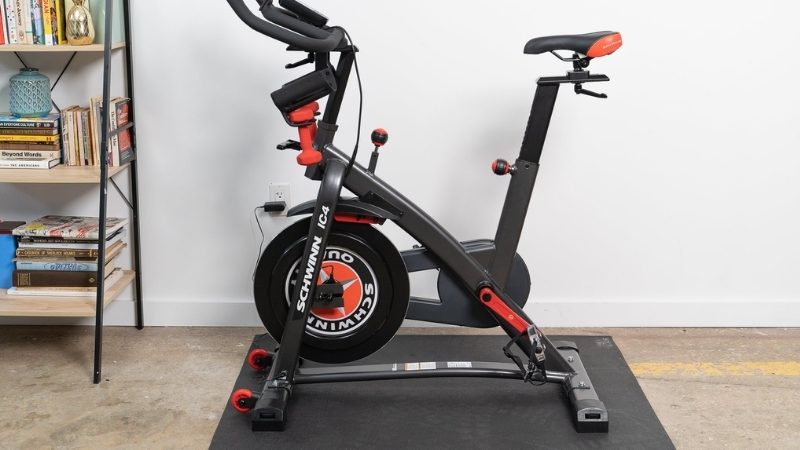
Place the bike using its documented operating clearances, not just the dimensions beneath its stabilizers. Include the space needed to get on and off and to reach adjustments. Keep the route to doors and storage separate from this area. A corner may look tidy but be impractical if it restricts access to the preferred mounting side.
Think about the view and nearby furnishings without crowding the bike. A position facing open space or a suitable screen can feel deliberate, while a crowded arrangement beside a desk may invite cables and loose objects into the operating area. Plan any power lead so it does not cross the walking route or interfere with the equipment.
Check the floor surface and any protective layer against the relevant guidance. A mat should be appropriate for the bike and compatible with the finish underneath. It does not guarantee that vibration or sound will be absent in adjoining rooms. Avoid choosing placement on the assumption that a particular resistance category makes every model silent.
Plan storage only if you will use it
If the bike must move after each session, verify its handling instructions, folded dimensions and permitted storage position. Follow the complete path to storage, including thresholds and turns. Transport wheels and a folding frame do not by themselves establish that the move will be practical in your home.
Product listings to compare
As an Amazon Associate we earn from qualifying purchases. Compare the selected variant and its current description with the requirements above.
Our top picks
 YOSUDA Exercise Bike
- Recommended Uses For Product: Indoor
- Material: Metal
- Handle Material: Aluminum
25-pound flywheel and belt drive keep rides smooth and quiet
Bluetooth app support adds guided riding scenery
Fits riders from 4 feet 8 inches to 6 feet tall
300-pound weight capacity is a hard limit for heavier riders
Full setup takes about 30 minutes even with a video guide
| Product | Key specs | |
|---|---|---|
 pooboo Magnetic Exercise Bike pooboo Magnetic Exercise Bike | Check price | |
 MERACH Exercise Bike MERACH Exercise Bike | Check price | |
| YOSUDA Exercise Bike | Recommended Uses For Product: Indoor Material: Metal Handle Material: Aluminum | Check price |
 MERACH Exercise Bike MERACH Exercise Bike | Recommended Uses For Product: Body Shaping, Indoor, Weight Loss Material: Alloy Steel Handle Material: Rubber | Check price |
 pooboo Folding Exercise Bike pooboo Folding Exercise Bike | Recommended Uses For Product: Indoor Maximum Weight Recommendation: 300 Pounds Resistance Mechanism: Magnetic | Check price |
 YOSUDA Exercise Bike YOSUDA Exercise Bike | Check price | |
 Exercise Bikes Stationary Exercise Bikes Stationary | Check price | |
 NEWBULIG Exercise Bike with APP NEWBULIG Exercise Bike with APP | Recommended Uses For Product: Indoor Power Source: Battery Powered Resistance Mechanism: Magnetic | Check price |
As an Amazon Associate we earn from qualifying purchases at no extra cost to you.
Finish with a model-specific comparison
- Required riding format and documented adjustment range.
- Controls and functions available with and without subscriptions.
- Operating area, power arrangement and any storage requirements.
- Assembly, cleaning, service and return information.
Use those criteria to reduce the shortlist instead of assigning unsupported rankings across unlike bikes. Once a candidate meets the practical requirements, consider its finish and how the surrounding storage and lighting can integrate it into the room. The design should make the cycling area straightforward to approach and maintain, with the bike’s intended use remaining the reason it is there.
Additional product links
- Start 30-Day Prime Free Trial →
- See Today’s Amazon Deals
- ▸ Try Amazon Prime — free 30-day trial
- ▸ Start an Audible Premium Plus free trial
- ▸ Read free with Kindle Unlimited
Related reading
- Best home gym cycle
- Chris Parker
- Best Gym Mat for Home: Rubber vs Foam Picks for Any Floor
- Best Rowers for Home Gym: Air, Magnetic and Water Compared
- Best Weight Home Gym: 6 All-in-One Machines for Small Rooms
- Best Home Gym Equipment for Beginners: The Starter Setup
- Best Treadmills for Home Gym: 5 Picks by Deck and Motor
- Best changeable dumbbells
- Best rated yoga mat
- Best mat yoga
- Best home gym equipmen
- Best fitness equipment for home gym
- Best Home Gym Set Ups: 6 Builds by Room Size and Budget
- Best Home Gym Cardio Machine: 6 Compared on Space and Noise
- Best Exercise Bike Home Gym Owners Can Fit Around Weights
Write Your Review
No reviews yet. Be the first to share your experience!