Key takeaways
- Learn why dorm windows sweat, how to reduce condensation safely, what not to do, and when recurring water needs a campus maintenance inspection.
Dorm-room window condensation forms when moist indoor air touches glass or framing cold enough to reach its dew point. A light film during unusually cold weather may be temporary. Water that returns every morning, pools on the sill, wets drywall, or appears between sealed panes needs documentation and a campus maintenance request. Students can reduce ordinary moisture and improve safe airflow, but they should not alter windows, drill drainage paths, or treat a building defect with an appliance alone.
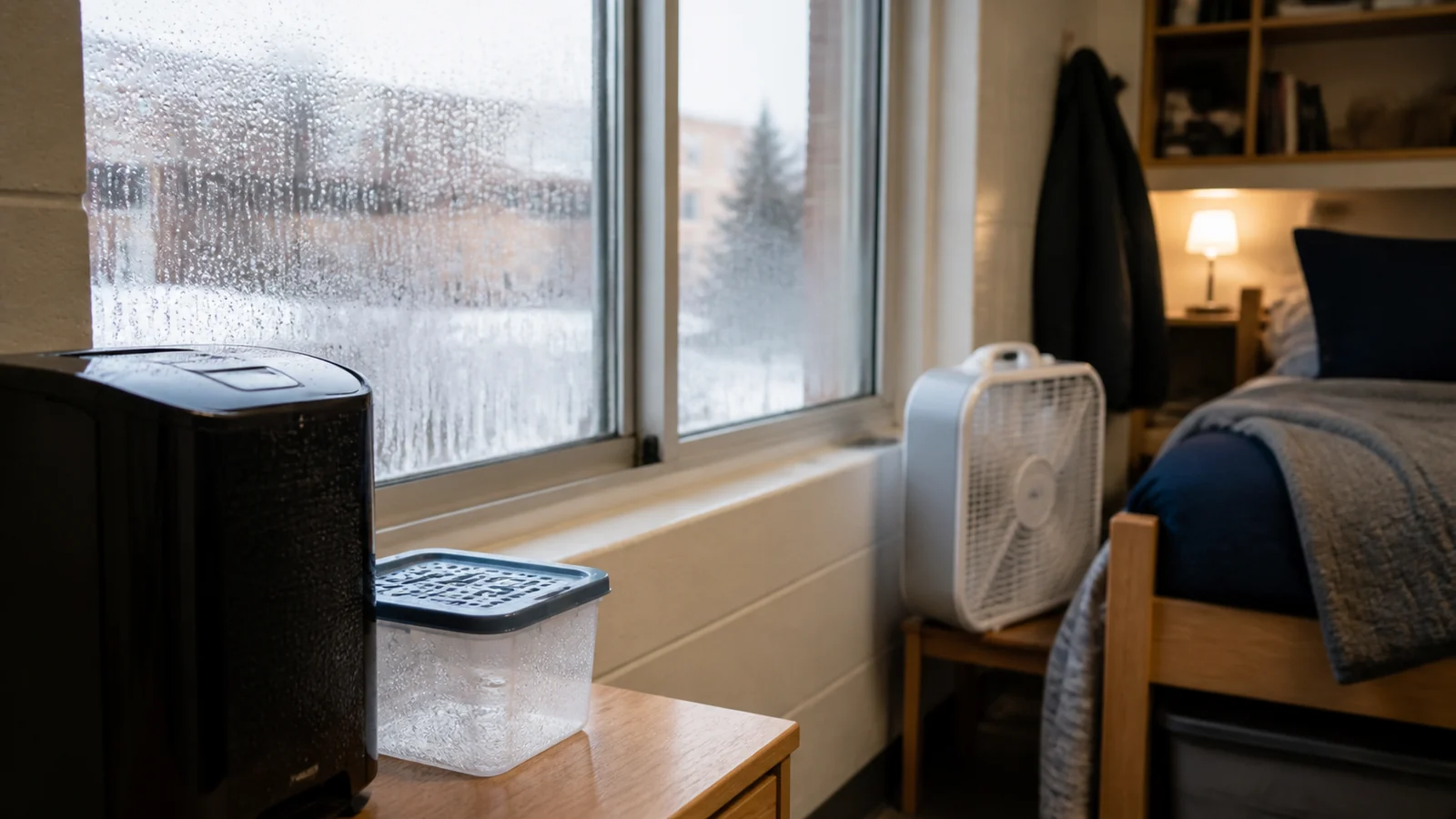
Editorial illustration; it is not evidence from a building inspection.
Our top picks


As an Amazon Associate we earn from qualifying purchases at no extra cost to you.
Why a dorm window “sweats”
Warm air can hold more water vapor than cool air. When that air reaches a cold window, the thin layer beside the glass cools. If it reaches the dew point, water vapor becomes liquid droplets. The same process can occur on metal frames, uninsulated wall corners, or other cold surfaces.
Three conditions usually interact:
- indoor moisture from showers, wet laundry, breathing, plants, cooking, or outdoor air;
- a sufficiently cold glass or frame surface;
- limited air movement around the window.
Heavy curtains, boxes, or furniture can trap humid air against the glass. A radiator covered by belongings may no longer warm the window area as designed. However, removing an obstruction does not repair failed glazing, missing weather seals, or water entering from outdoors.
Identify where the water is
Before wiping it away, observe the location without taking the window apart.
On the room-side surface: droplets you can touch from indoors usually indicate indoor air meeting a cold surface. Moisture-source control and appropriate ventilation may reduce it.
Between panes: fog or droplets sealed inside an insulated glass unit can indicate a failed edge seal. Residents cannot dry or repair that cavity. Photograph it and report it.
Around the frame during rain: staining or water tracks that appear with wind-driven rain may indicate exterior leakage rather than simple condensation. Report the timing and weather.
On the outside surface: exterior condensation can occur when outdoor air is humid and the exterior glass is cool. It does not necessarily mean indoor humidity is high.
Do not open covers, remove glazing beads, puncture seals, or probe the wall. Those actions may damage university property and can expose sharp edges or hidden electrical components.
Measure humidity and temperature together
Place a digital hygrometer a few feet from the window, away from a radiator or supply vent. Log room temperature and relative humidity morning and night for several days. Add notes for showers, wet clothing, open windows, cooking, rain, and outdoor cold snaps.
The EPA generally recommends indoor relative humidity below 60% and ideally about 30% to 50% where practical. A winter dorm may need to stay toward the lower portion of that range to prevent condensation on very cold glass. The correct target is not one universal number; it depends partly on the window surface temperature.
Read our small-room dehumidifier technology comparison before changing equipment settings. One meter in the center of a warm room may understate conditions inside a cold, closed curtain pocket.
Dry the immediate area safely
Wipe ordinary surface condensation from clean glass and sill material with an absorbent cloth. Dry the cloth in an approved ventilated location rather than leaving it wet in the room. Move books, bedding, power strips, chargers, and electronics away from the wet zone.
If water is near an outlet, plugged device, or damaged cord, do not touch wet electrical equipment. Follow campus emergency or maintenance procedures. Do not run an extension cord across the window area for a fan or dehumidifier.
Avoid spraying bleach, fragrance, or mixed household cleaners onto the frame. Cleaning requirements depend on the material and campus rules. Never mix cleaning products. Visible growth, damaged porous material, or a persistent musty odor should be reported rather than repeatedly painted or perfumed over.
Reduce avoidable moisture sources
Move wet towels, coats, shoes, and sports equipment to approved drying facilities. Use the laundry dryer properly; hanging a load in a small room releases moisture into the same air that reaches the glass. Keep an attached bathroom door closed during steamy showers when residence guidance recommends it, and operate the exhaust fan as directed.
Covering a radiator, fan-coil unit, supply grille, or return grille can interfere with designed airflow. Remove only personal belongings that block the opening. Do not adjust dampers, remove filters, or open an HVAC cabinet unless housing staff specifically authorizes it.
Our broader guide explains how to reduce dorm-room humidity through measurement, source control, ventilation, and maintenance reporting.
Improve airflow without creating hazards
Open curtains or blinds during occupied hours so room air can reach the glass, provided doing so does not compromise privacy or violate instructions. Leave safe space between furniture and an exterior wall. Do not place bedding against a wet sill.
A small permitted fan can help mix air, but it does not remove moisture. Do not aim a fan at suspected mold or damaged material, because airflow could spread particles. Keep fan blades guarded, cords dry, and exits clear.
Opening a window is useful only when outdoor conditions are drier in practical terms and the residence permits it. Hot, humid outdoor air may worsen the room. During freezing weather, leaving a window open can damage pipes or building systems and may violate policy. Never defeat a window limiter or security device.
Check bathroom and building ventilation
If the room or suite has a bathroom exhaust fan, use it during and after showers for the period recommended by housing. Without removing the grille, check whether air appears to move toward it. Report a fan that is silent, unusually noisy, visibly blocked, or unable to clear normal steam.
Observe whether condensation coincides with scheduled HVAC shutdowns or a room that is consistently too cold. Provide maintenance with dates and readings. Students should not attempt to balance a central system themselves.
Corridor doors are often fire-rated and must not be propped open for ventilation. Smoke detectors and sprinklers must remain unobstructed. Moisture control never overrides life-safety requirements.
Would a dehumidifier solve it?
A permitted dehumidifier may help when room RH remains elevated and ordinary moisture sources have been addressed. It is less likely to solve condensation caused primarily by a failed insulated-glass seal, exterior water intrusion, or an HVAC fault. It also cannot dry concealed wet building materials reliably.
Before buying, review housing rules for wattage, compressor appliances, unattended operation, drainage, and electrical certification. Select by measured moisture load and current standardized capacity rather than a broad square-foot slogan. Use a unit with automatic full-tank shutoff and place it on a hard, level surface with all manual clearances.
The dorm dehumidifier buying guide provides a cautious selection process. If a small approved machine runs continuously while the window and wall remain wet, stop treating that as a sizing challenge and escalate the building concern.
Avoid common “fixes” that cause new problems
Do not apply permanent adhesive film, caulk weep holes, install weatherstripping, or paint the frame without written permission. Windows are part of the building envelope and may have designed drainage or ventilation paths. An improvised seal can trap water or impede emergency egress.
Do not place a portable heater against the glass. It can overheat nearby fabric, overload circuits, or create thermal stress. Residence halls often restrict space heaters entirely.
Do not collect condensate in an open container beneath the sill. It can spill, become contaminated, and create another moisture source. Do not route a dehumidifier hose across a walkway or out a window.
Do not assume that visible droplets prove mold or a specific health risk. Conversely, do not ignore repeated wetting simply because no visible growth appears. Moisture duration and material damage matter.
Build a useful maintenance report
Campus maintenance can respond more effectively when the report is specific. Include:
- room and exact window location;
- whether moisture is on the inside surface, between panes, or around the frame;
- dates, times, and weather conditions;
- room temperature and RH readings;
- photographs before wiping;
- nearby staining, soft material, odor, or wet belongings;
- whether the bathroom exhaust and room HVAC appear to operate normally.
Report active leaks immediately. A slower recurring pattern should still be submitted promptly, because repeated wetting can damage finishes and personal property. Keep copies of the request and follow campus escalation procedures if conditions continue.
A one-week condensation check
For seven days, wipe and dry ordinary droplets, log the conditions, keep vents and the glass area unobstructed, and remove avoidable moisture sources. Do not make permanent alterations. Compare mornings after showers, rainy days, and cold nights.
If condensation stops after laundry and curtain changes, continue the improved routine and monitor during weather shifts. If it returns under ordinary use, appears inside the glazing, or wets surrounding construction, provide the log to housing. The aim is not merely clearer glass; it is preventing repeated moisture from reaching materials that cannot dry.
Sources
- U.S. EPA: A Brief Guide to Mold, Moisture and Your Home
- U.S. EPA: Mold and Your Home
- ENERGY STAR: Dehumidifiers
- U.S. Department of Energy: Consumer Guide to Home Ventilation