Key takeaways
- Size a dorm dehumidifier using measured humidity, room conditions, current capacity ratings, temperature, noise, tank handling, and campus rules.
To size a dehumidifier for a dorm room, start with measured relative humidity and the actual moisture source, then consider room volume, temperature, ventilation, tank handling, noise, and campus appliance limits. Do not buy from square footage alone. For many dorms, a large whole-basement unit is impractical, while a miniature thermoelectric unit may be unable to manage persistent humidity. The right size is the smallest permitted unit that can maintain a reasonable moisture range without running continuously.
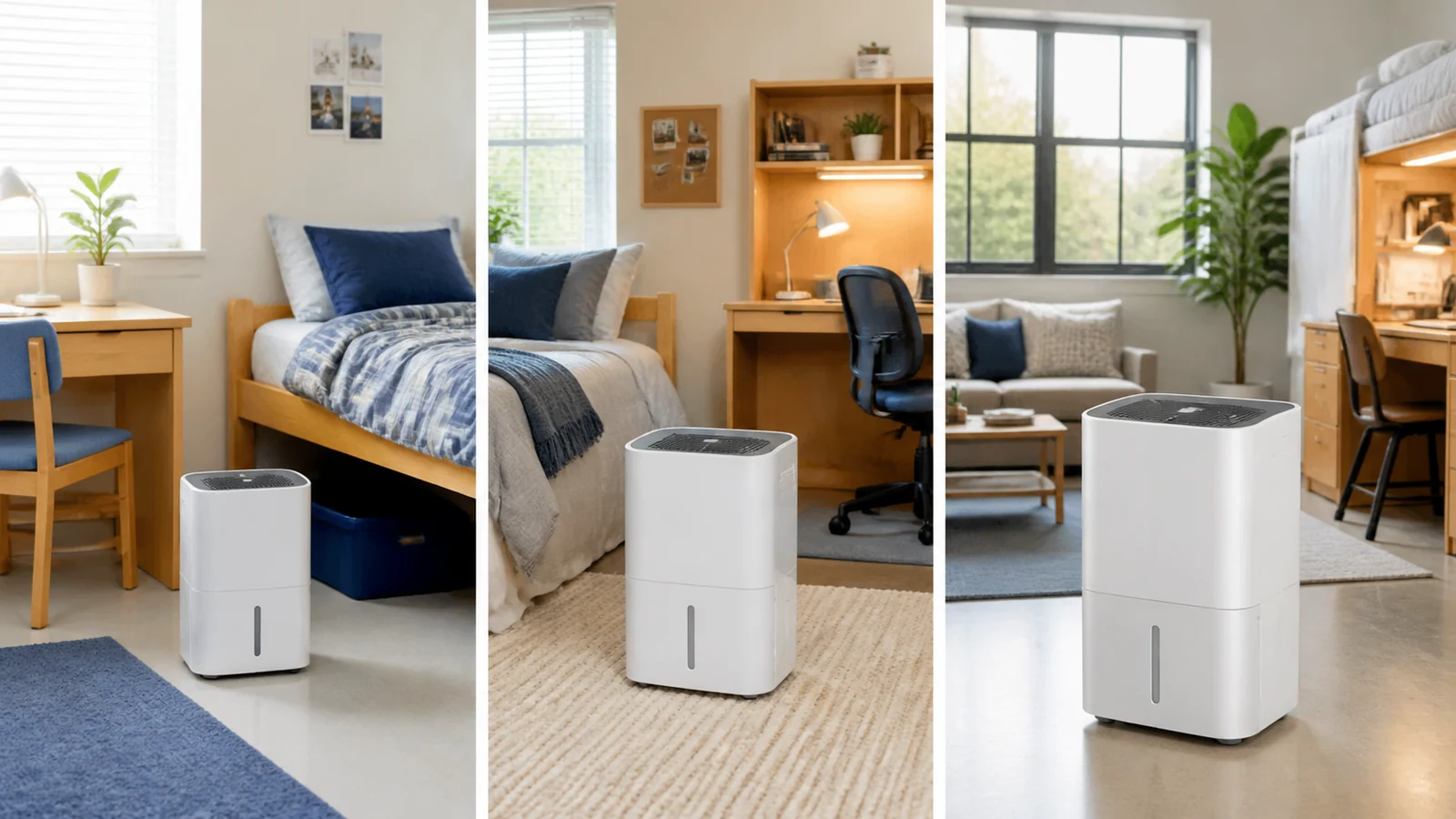
Editorial illustration; no product performance or detailed research is claimed.
Our top picks


As an Amazon Associate we earn from qualifying purchases at no extra cost to you. Ratings are shown as listed on Amazon.
First decide whether sizing is the real problem
A dehumidifier should not be the first response to an active leak, wet carpet, failed bathroom exhaust, or water entering around a window. Those conditions need a campus maintenance report. An appliance may remove some airborne moisture while building materials continue to get wet, masking rather than repairing the source.
Measure room RH and temperature at least morning and evening for several days. The EPA commonly recommends indoor RH below 60% and ideally around 30% to 50% where practical. Record showers, wet laundry, open windows, rain, and HVAC schedules. If peaks disappear after ordinary source control, buying a machine may be unnecessary.
Read the guide on how to reduce dorm-room humidity for a measurement and source-control method. Size equipment only after the log shows a persistent load.
Check residence rules before capacity charts
Housing policies may prohibit compressor appliances, continuous drainage, unattended operation, or devices above a wattage threshold. They may require a recognized electrical safety certification. A product that appears technically suitable is not suitable if it violates those rules.
Ask the housing office about:
- maximum input wattage or amperage;
- whether compressor dehumidifiers are allowed;
- direct wall-outlet requirements;
- operating hours and unattended use;
- tank or hose drainage restrictions;
- placement and required clearance;
- registration or inspection.
Keep written confirmation. Never plan to use an extension cord or overloaded power strip to reach a convenient corner.
Understand current capacity ratings
Portable compressor dehumidifiers are commonly labeled by pints of water removed per day under a specified test procedure. The U.S. Department of Energy has updated test conditions over time, so an older “70-pint” label may not compare directly with a newer rating. ENERGY STAR advises consumers to consider room size and dampness while using the current rating and product documentation.
Always identify:
- the stated daily capacity;
- the temperature and RH or test standard behind it;
- the unit’s operating-temperature range;
- whether the figure describes compressor extraction or a small thermoelectric device under unusually warm, humid conditions.
A collection claim without conditions is not a reliable comparison. Actual dorm performance may be lower because the room is cooler or less humid than the rating environment.
Use room volume, not area alone
Measure length, width, and ceiling height. Multiplying them provides approximate volume. Two rooms with the same floor area can differ meaningfully if one has a high ceiling. Still, volume is only a starting input.
Moisture load rises with an attached bathroom, frequent showers, wet sports gear, indoor laundry, humid outdoor air, many occupants, air leakage, or poor exhaust. A shaded ground-floor room may behave differently from a sunny upper-floor room in the same building.
Do not interpret a manufacturer’s maximum square-foot number as a guarantee. Such labels may refer to broadly defined conditions and do not capture noise, electrical policy, or drainage. A compact dorm needs a balanced choice, not the highest coverage claim.
Match the unit to dampness severity
Classify the room from evidence rather than sensation.
Mild or occasional moisture: RH rises after a known event but returns to the desired range; no materials remain wet. Source control or a modest permitted unit may be enough.
Persistent dampness: RH stays elevated for long periods, windows regularly condense, or fabrics feel damp. Confirm that maintenance has ruled out leaks and ventilation faults. A compressor model may be more appropriate if rules and temperature allow it.
Wet conditions: water pools, walls or carpet are wet, or stains expand. This is not an invitation to buy a bigger dehumidifier. Report the water source promptly and follow institutional remediation procedures.
The dorm dehumidifier buying guide explains when “no machine” is the responsible shortlist decision.
Compressor versus thermoelectric sizing
A compressor dehumidifier circulates air over a refrigerated coil. It generally has materially greater extraction capacity in warm, humid conditions. It also has a compressor cycle, more weight, higher power demand, and clearance requirements. In a small shared room, acoustic and physical fit matter as much as the rating.
A thermoelectric, or Peltier, unit uses a solid-state cooling module. It can be compact and may avoid compressor cycling, but water collection is commonly modest and declines in cooler or less humid conditions. Calling one “mini” does not establish that it can control room-wide humidity.
Use a thermoelectric unit only for a mild load with realistic expectations and transparent published test conditions. Choose a permitted compressor unit when logged conditions show that meaningful extraction is needed. Our technology comparison examines this decision in depth.
Avoid deliberate oversizing
Buying the largest model “for future proofing” introduces trade-offs. It may exceed electrical limits, dominate scarce floor space, create more noise, and require lifting a larger tank. A machine with a high minimum fan speed may be disruptive even if it reaches the target quickly.
Excess capacity is not automatically harmful when a humidistat controls operation, but a physically inappropriate appliance can still create dorm hazards. Avoid units that force the intake against a wall, place the cord in a walkway, or require moving a heavy tank over electronics.
If an appropriately sized permitted unit cannot maintain the range, investigate air exchange and building moisture. Adding a second machine is rarely the right first escalation in a residence hall.
Consider temperature before choosing capacity
Compressor coil performance declines in cool air, and frost may form. Some models include automatic defrost, but defrost does not make every unit suitable for every temperature. Check the manufacturer’s operating range.
A room that is persistently too cold or too warm may have an HVAC problem requiring housing staff. Do not use an unapproved heater to improve dehumidifier performance, and do not place the unit near a radiator or supply vent where its sensor will misread the room.
Record temperature alongside RH because a nighttime RH increase can result partly from cooling. Capacity should respond to the daily pattern, not just the highest isolated reading.
Tank capacity and removal capacity are different
Daily extraction capacity describes potential water removal under rating conditions. Tank capacity tells you how much condensate the container holds before shutoff. A high-capacity machine can have a relatively small tank and need frequent emptying.
For a dorm, the best tank is one the resident can remove, carry, and empty without spilling. Check for automatic full-tank shutoff, a secure handle, and a clear level indicator. Do not defeat the shutoff or drain into an open bucket.
Continuous drainage requires a permitted destination and a hose that maintains the manufacturer’s required slope or pump arrangement. Dorm rooms rarely offer a safe path that avoids walkways. Confirm every drainage detail before treating it as a sizing advantage.
Noise and operating cycle
Published sound figures are meaningful only with the test mode, distance, and method. A low-speed value from one brand should not be compared with a maximum-speed value from another. Compressor start-stop sound can be more noticeable than steady fan noise.
Consider roommate schedules and where the unit can stand with full clearance. A smaller unit that runs at maximum continuously may be more irritating than a somewhat more capable model cycling under humidistat control. Conversely, a larger compressor can create a sharper cycle that disturbs sleep.
Campus rules determine whether the machine may operate while the room is unoccupied. Never disable alerts to reduce noise.
Energy and safety checks
Compare input power and, for eligible products, ENERGY STAR certification. Energy efficiency matters, but certification does not override fit, policy, or moisture-source correction. Plug the unit into the wall receptacle as directed and keep water away from the cord and outlet.
Search the CPSC recall database using the exact model and serial number, including for secondhand appliances. Dehumidifiers have been recalled for serious overheating and fire hazards. Stop using a unit with unusual heat, burning odor, damaged housing, leaks into electrical areas, or repeated breaker trips.
Clean the filter and tank as the manufacturer specifies. Restricted airflow reduces performance and can contribute to overheating. Do not spray cleaner into the intake.
A practical sizing worksheet
Write down these answers before comparing models:
- room length, width, ceiling height, and usable floor area;
- three to seven days of RH and temperature readings;
- whether moisture is mild, persistent, or linked to wet construction;
- attached bathroom, occupant count, wet-item habits, and ventilation status;
- campus wattage, appliance type, placement, and drainage rules;
- expected operating temperature;
- acceptable tank carry weight and emptying frequency;
- available hard, level location with manual clearances;
- roommate noise constraints;
- current standardized capacity and test conditions.
Reject any candidate that fails policy, electrical safety, placement, or recall checks. Among the remaining units, choose the lowest practical capacity that is credible for the measured load and can cycle to an adjustable target.
Verify after installation
Keep the separate hygrometer in a representative location. For the first week, record RH, temperature, operating hours, and tank emptying. Confirm that the unit cycles and that condensation or dampness decreases.
If it runs continuously without improving the room, first check placement, filter, closed windows, and published operating range. Then contact housing about ventilation or moisture sources. Do not conclude automatically that a bigger machine is needed.
Once the room stays within a reasonable range and surfaces remain dry, avoid pushing the setpoint lower. Proper sizing is demonstrated by stable control, safe operation, and manageable noise—not by the largest pint number on the box.
Sources
- ENERGY STAR: Dehumidifiers
- U.S. Department of Energy: Consumer dehumidifiers
- U.S. EPA: A Brief Guide to Mold, Moisture and Your Home
- U.S. Consumer Product Safety Commission: Recalls