Key takeaways
- Shade type sets the mood: Clear glass gives you sparkle, visible filament, and crisp highlights, but every bulb becomes a hotspot you’ll see in the mirror. Frosted or milky glass trades that jewelry-like glint for even, forgiving light across the face — the better choice if the mirror is small or you sit close to it.
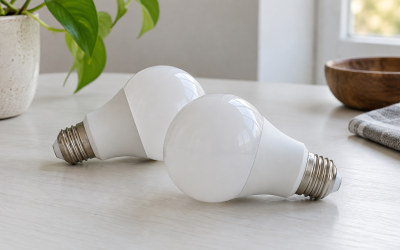
- Aim for 2700K–3000K, or go dimmable: Warm white flatters skin and keeps a bathroom feeling like part of the home. Cooler 4000K–6000K light reads sharper and more clinical, which some people genuinely prefer for grooming detail. If you want both, buy dimmable and pair it with a compatible dimmer.
- Mount at eye level, not above it: Sconces flanking the mirror at roughly 65–66 inches from the floor deliver true cross-lighting. If your layout only allows a bar above the mirror, mount it around 75–80 inches and choose shades that throw light downward and outward rather than into a tight pool.
- Scale the fixture to the mirror: A three-light bar should span roughly 60–75% of the mirror’s width. Too short looks apologetic; too wide crowds the trim. Measure before you fall in love with a finish.
- Match metal to hardware, not to trend: Brushed gold warms a room and pairs beautifully with cream tile and unlacquered brass taps. Matte black adds graphic weight and holds its own against white subway tile. Brushed nickel is the diplomat — cool-neutral, low-glare, and forgiving of mixed fixtures.
What's inside
Most bathrooms are lit like storage closets: one glaring fixture overhead, casting shadows straight down into the hollows of your face. You lean in, tilt your head, chase the light — and still can’t tell whether your foundation matches your jaw. The fixture isn’t necessarily bad. It’s in the wrong place, aimed the wrong way, and almost certainly the wrong color temperature for skin.
Vanity lighting solves this by working horizontally instead of vertically, filling shadows from the sides of the mirror rather than dropping them from above. This guide looks at six current fixtures through a designer’s lens — beam behavior, shade diffusion, finish temperature, and how each one behaves once the bulbs are in and the room is actually dark outside. Specs matter less than what the light does to the wall, the mirror, and you.
As an Amazon Associate we earn from qualifying purchases at no extra cost to you. Product prices and availability are accurate as of the date shown and are subject to change.


🛒 Best Price Today on Amazon
Prime members get fast, free shipping on everything above, plus member-only deals. New members get a 30-day free trial — cancel anytime.
How to Choose a Bathroom Vanity Light (2026)
- Shade type sets the mood: Clear glass gives you sparkle, visible filament, and crisp highlights, but every bulb becomes a hotspot you’ll see in the mirror. Frosted or milky glass trades that jewelry-like glint for even, forgiving light across the face — the better choice if the mirror is small or you sit close to it.
- Aim for 2700K–3000K, or go dimmable: Warm white flatters skin and keeps a bathroom feeling like part of the home. Cooler 4000K–6000K light reads sharper and more clinical, which some people genuinely prefer for grooming detail. If you want both, buy dimmable and pair it with a compatible dimmer.
- Mount at eye level, not above it: Sconces flanking the mirror at roughly 65–66 inches from the floor deliver true cross-lighting. If your layout only allows a bar above the mirror, mount it around 75–80 inches and choose shades that throw light downward and outward rather than into a tight pool.
- Scale the fixture to the mirror: A three-light bar should span roughly 60–75% of the mirror’s width. Too short looks apologetic; too wide crowds the trim. Measure before you fall in love with a finish.
- Match metal to hardware, not to trend: Brushed gold warms a room and pairs beautifully with cream tile and unlacquered brass taps. Matte black adds graphic weight and holds its own against white subway tile. Brushed nickel is the diplomat — cool-neutral, low-glare, and forgiving of mixed fixtures.
The Best Bathroom Vanity Lights (2026) Reviewed
3-Light Brushed Gold Vanity Light with Clear Glass Shades
The warmest-feeling fixture here: brushed gold picks up a candlelit quality from warm bulbs, and the clear cylinders let that glow spill onto the wall instead of trapping it. Choose frosted or amber-tinted bulbs so the filament doesn’t reflect as three bright spikes in the mirror.
FonmYim Brushed Nickel 3-Light with Frosted Glass
The most practical daily-use option in the group. Milky white shades diffuse the source completely, which means soft, wraparound light with almost no glare — ideal for shaving, contact lenses, or anything requiring an honest look at your own face.
Ascher 3-Light Brushed Nickel Sconce Lighting
A clean, quietly detailed fixture that reads as intentional rather than builder-grade, with the clear glass giving it more visual lift than most nickel bars. The E26 sockets accept whatever you like, so you can tune brightness and warmth after installation.
Zarbitta 17.23″ Black 3-Light Vanity Fixture
At just over 17 inches, this suits a standard 24- to 30-inch mirror without overpowering it, and the black frame draws a confident line across pale tile. It’s the fixture I’d reach for in a small powder room that needs one graphic gesture.
LED Dimmable Matte Black 22″ with Rotatable Heads
The most flexible fixture reviewed: 360° rotatable acrylic heads let you push light onto the mirror, the wall, or the ceiling to soften the whole room. It ships at 6000K, which is bright and cool — dim it down at night, or skip this one if you prefer warm ambience.
Frequently Asked Questions
Should the fixture face up or down?
Shades facing up bounce light off the ceiling for softer, more ambient fill. Facing down puts more light on the countertop and face. Above a mirror, down-facing generally wins; flanking a mirror, either works.
How many lumens do I need?
Roughly 1,600–2,400 total lumens for an average bathroom. Three 800-lumen bulbs land comfortably in that range without turning the room into an examination suite.
Can I put a vanity light in a wet area?
Not unless it’s rated for damp or wet locations. Standard vanity fixtures belong outside the shower spray zone — check the listing before installing anywhere humid or exposed.
Are crystal fixtures practical in bathrooms?
Yes, if you accept the maintenance. Something like the Modern Crystal Brushed Gold vanity light adds real refraction and glamour, but hard-water mist means periodic wiping to keep the sparkle.
Final Thoughts
For the most flattering everyday light, the FonmYim frosted brushed nickel bar is the safest bet — diffuse, glare-free, and easy to live with. If you want atmosphere over neutrality, the brushed gold clear-glass fixture delivers genuine warmth, while the LED matte black rotatable model is the pick for anyone who wants to redirect and dim their light as the day changes.