Picking a battery-powered work light sounds straightforward until you realize the category is a minefield of inflated lumen claims, batteries that die mid-project, and tripods that buckle under their own weight. Whether you’re detailing a living room built-in or staging a dining nook in a space with zero overhead wiring, the right portable light changes everything.
I’ve spent years specifying lighting for residential and studio environments, and the portable work-light segment has gotten genuinely interesting. This guide covers six standouts across budget, output, and form factor — with a focus on color accuracy, battery endurance, and real-world usability rather than spec-sheet bragging rights.
Our top picks



As an Amazon Associate we earn from qualifying purchases at no extra cost to you.
🛒 Best Price Today on Amazon
Prime members get fast, free shipping on everything above, plus member-only deals. New members get a 30-day free trial — cancel anytime.
How to Choose a Battery Powered Work Light (2026)
- Lumen output vs. beam spread: A raw number like “21,000 lumens” means little without context. Look at how wide the beam throws — a 3,500-lumen flood covering 180 degrees often outperforms a narrow 6,000-lumen hotspot in actual task illumination.
- Color temperature range: Fixed 6500K panels feel clinical. Lights offering a switchable range (4000K–6500K) let you judge paint tones and wood grain under neutral-to-cool light, which matters more than most buyers expect.
- Battery chemistry and capacity: Lithium-ion packs in the 5,000–8,000 mAh range deliver consistent brightness through most of their discharge cycle. AA-powered options trade runtime for convenience and zero-charge-readiness.
- Mechanical versatility: Magnetic mounts, telescoping stands, and remote controls aren’t luxuries — they free both your hands. Evaluate how quickly the light transitions between floor-standing, hanging, and surface-attached modes.
- Weather and impact resistance: An IP66 rating means serious dust and rain protection for outdoor staging or garage work. Anything IP44 or lower belongs strictly indoors.
The Best Battery Powered Work Light (2026)s Reviewed
GoGonova Rechargeable Triple LED Work Light
Eight amp-hours of battery behind three independently switchable LED modules give this unit a depth of control most panel lights lack. The 4000K/6500K dual-temperature output is a genuine advantage when you’re matching finishes to adjacent rooms rather than working in a vacuum of blue-white glare. The detachable tripod stows flat for transport.
LETOUR Magnetic LED Tube Light
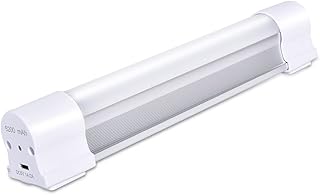
The tubular form factor is underrated in a category dominated by boxy panels. LETOUR’s stick-style body distributes light along its length, reducing harsh shadows on vertical surfaces — ideal for inspecting cabinet faces or upholstery seams. Sixty hours of endurance at lower settings and dual magnets make it a grab-and-go problem-solver.
LUTEC 3500LM Rechargeable Magnetic Work Light
At 3,500 lumens with a 5000K neutral-white output, the LUTEC sits in a sweet spot: bright enough for automotive detail work yet not so overpowering that it washes out surface textures. Three distinct modes let you dial from task to ambient, and the integrated handle doubles as a hanging hook.
21000Lumens Heavy-Duty Tripod Work Light
This is the brute-force option, and it earns its size. Three independently angled heads with individual switches let you sculpt coverage across a two-car garage without moving the tripod. IP66 sealing means rain isn’t a conversation — it just keeps working. The weight is a trade-off, but stability follows.
Tresda Rechargeable Telescopic Camping Light
Extending to 8.4 feet on its tripod, the Tresda places light where almost nothing else in this class can reach — overhead and angled downward, mimicking a ceiling fixture. A remote control and three color temperatures make it the closest thing to a temporary architectural light source for outdoor gatherings or emergency coverage.
What to Look For in a Battery Powered Work Light
Lumens, Lux and How Far the Light Travels
Lumens measure the total light a fixture emits, while lux measures how much of it lands on a surface. The relationship is simple: lux equals lumens divided by the area covered in square meters. A light rated at 3,000 lumens that spreads evenly across a 10 square meter area (about 108 square feet) would give at best 300 lux, and real fixtures deliver less because of reflector loss and uneven spread. For reference, one foot-candle equals roughly 10.76 lux, and the US construction illumination rules list minimums of 5 foot-candles for corridors, 10 for shops and 30 for first-aid stations and offices. A single compact light will not meet the shop or office figure over a large room, so size the output to the space, not to the biggest number on the box.
Battery Capacity and the Runtime Math
Marketing runtimes assume the lowest brightness. To estimate honestly, convert the battery to watt-hours by multiplying voltage by amp-hours. A 3.7 V pack rated 10,000 mAh holds about 37 Wh. If the light draws an assumed 10 W on high, and about 85 percent of the energy reaches the LEDs, runtime is roughly 3 hours (37 x 0.85 / 10). The same pack on a 3 W low setting stretches to around 10 hours. When a listing gives no capacity, expect the runtime claim to refer to the dimmest mode.
Color Temperature and Color Rendering
Color temperature near 5000 K looks like neutral daylight and suits inspection and detail work, while 3000 K to 4000 K is gentler for rooms where people will stay. Color rendering index, or CRI, shows how accurately colors appear; a value of 80 is a common baseline, and 90 or higher matters when you are matching paint, stain or wire colors. Many budget lights omit CRI altogether, which is worth knowing if you work with finishes.
Mounting, Weather Protection and Build
Think about where the light will sit. Magnets hold only to ferrous steel, so they will not grip aluminum, drywall or most stainless steel. Hooks and telescopic poles suit overhead hanging, and tripods lift light above shadows. An IP code tells you about dust and water: IP44 resists splashes, IP65 is dust-tight and withstands water jets, and unrated lights should stay out of rain. Heavy lights on tall stands need a stable base or a weighted bag in wind.
Which Battery Powered Work Light Should You Buy?
| If you… | Choose… |
|---|---|
| need a general-purpose rechargeable light for garage and repair jobs | GoGonova Rechargeable Triple LED Work Light |
| work under a hood, along a shelf or inside a cabinet where a slim shape fits | LETOUR Magnetic LED Tube Light |
| want a magnetic light that sticks to steel beams, doors and tool boxes | LUTEC 3500LM Rechargeable Magnetic Work Light |
| need to light a large room or outdoor area from a stand | 21000Lumens Heavy-Duty Tripod Work Light |
| camp, hang light in a tent or want a telescoping pole | Tresda Rechargeable Telescopic Camping Light |
Common Mistakes When Buying a Battery Powered Work Light
- Picking by the biggest lumen figure. Very high lumen claims are often peak values that drain the battery quickly or drop after the light heats up. Check whether the listing shows runtime at each brightness level.
- Ignoring the spread. A narrow spotlight gives glare in a small area, while a wide flood beam fills a room more evenly. Choose the beam to suit the task.
- Assuming magnets fit every surface. A magnet that is fine on a steel toolbox may slide on a painted or curved panel.
- Skipping the charging details. Check the port type and whether the light can run while charging, because a dead light on a deadline is a common complaint among owners.
- Charging in extreme cold or heat. Lithium cells are generally rated for charging only within a moderate temperature range, so bring the light indoors before charging after a freezing night.
- Buying one light for every job. A tube light for tight spots and a tripod light for wide areas often outperform a single compromise fixture.
A Worked Example: Lighting a Small Workshop Corner
Suppose you want about 10 foot-candles, roughly 108 lux, over a 3 by 3 meter bench area. That is 9 square meters, so you need about 970 lumens actually reaching the surface (108 x 9). Because reflectors, diffusers and distance waste a share of the output, a common planning assumption is that only half of the rated lumens arrive where you need them, which points to a light of around 2,000 lumens or more. The same math shows why a small tube light is fine for a car engine bay but weak for a full room, and why a high-output tripod light suits a space measured in tens of square meters.
Battery Care and Safe Use on the Job
Lithium packs last longer when treated gently. Avoid leaving a light in a hot vehicle, and store it with a partial charge if it will sit unused for months. Use the supplied cable or a charger with a matching specification, and stop using any unit whose housing swells or becomes unusually hot. Keep cords and tripod legs out of walkways so the light does not become a trip hazard, and wipe dust from the lens periodically, since a film of grime can noticeably cut output.
Spec Comparison at a Glance
The guide above covers five lights plus a two-pack flood pair mentioned in the closing, yet the numbers sit in separate sections, which makes side-by-side shopping slow. The table below gathers the five lights in the guide and the three new picks in one place, so a buyer can match output, power, runtime, mounting, and weather protection before reading the detail. Treat the lumen figures as maker claims, and read runtime beside output, since a high number on a dim setting says little about a full evening of work.
| Light | Output | Power | Runtime note | Mounting | Weather rating |
|---|---|---|---|---|---|
| GoGonova Triple LED | 700 / 1,200 / 2,200 lumens | 8Ah built-in pack | Long sessions on low | Detachable tripod | Not stated |
| LETOUR Magnetic Tube | Not stated | Built-in pack | Up to 60 hours on low | Dual magnets | Not stated |
| LUTEC 3500LM | 3,500 lumens | 4,000 mAh built-in pack | 4 to 6 hours | Magnetic base, stand, hook | Not stated |
| 21000Lumens Tripod | 21,000 lumens claimed | Built-in pack | Not stated | Tripod, three heads | IP66 |
| Tresda Telescopic | Not stated | Built-in pack | Not stated | Telescopic tripod to 8.4 ft | Not stated |
| DEWALT DCL050 | 500 lumens | DEWALT 20V MAX pack, bare tool | Varies with pack size | Hook, pivoting head | Not stated |
| Makita DML809 | 10,000 / 4,000 / 2,000 lumens | Two 18V LXT packs or AC | About 1.7 hours on high with two 6.0Ah packs | Tripod mount | Dust and water resistant |
| WORKPRO 2500LM, 2-Pack | 2,500 lumens per light | 5,200 mAh built-in pack per light | 4 hours high, 15 hours low | Four magnets, 180-degree stand | Not stated |
Sizing and Compatibility Checklist
Work through this list before ordering, and the right light usually picks itself.
- Room size: a bench corner of about 3 by 3 meters needs roughly 2,000 lumens reaching the surface; a single garage bay needs about 3,500; a two-car garage or an outdoor area needs 5,000 or more, split across two lights rather than one blinding unit.
- Battery platform: list the packs already owned. A bare-tool light such as the DEWALT or Makita above is a bargain only inside its own system; outside it, add the cost of a pack and a charger.
- Mount surface: magnets grip flat ferrous steel only, so check the bench, the car, and the shelf first. Aluminum, drywall, and most stainless steel need a hook, a clamp, or a tripod instead.
- Charging: confirm the port type and whether the light can run while plugged in. A USB-C port charges from a car, a laptop, or a power bank; a proprietary charger ties the light to one cable.
- Weather: match the rating to the job. Unrated lights stay indoors, splash-rated lights handle a damp garage, and only a sealed unit such as the IP66 tripod light belongs out in rain.
- Color: for paint, stain, and wire work, look for a color rendering index of 80 or higher, with 90 or better for finish matching, and a neutral 5000K tone for inspection.
Setup and Care
A new light earns its keep with a little setup. Charge the pack fully before the first job, since a half-charged pack gives a weak first impression and a short first session. Wipe the lens clean before each use, because a film of dust and sawdust can cut output more than a lower brightness setting does. Spread tripod legs fully and lock them before raising the head, and weigh the base down outdoors, since a tall light with a small footprint tips easily in a gust. Keep cords and tripod legs out of walkways so the light never becomes a trip hazard. Store the light with a partial charge in a cool, dry place when it will sit unused for months, and bring a cold pack indoors before charging after a freezing night. Retire any unit whose housing swells, smells hot, or holds a charge for only a few minutes.
Who Should Skip a Battery-Powered Work Light
Battery lights are the wrong tool for some jobs, and naming those jobs saves a bad purchase. Anyone lighting a workshop every day should wire in permanent LED shop lights and keep a rechargeable unit as a backup, since daily deep cycling wears built-in packs out fast. A buyer who needs light for a full eight-hour shift should choose a hybrid or corded light, because even a large pack fades before the day ends. Very large areas suit two or three fixed flood lights better than one portable unit moved around all evening. A buyer with no cordless tool packs should skip bare-tool lights, since the pack and charger can cost as much as the light itself. Finally, anyone working in rain without a sealed rating should pick a corded light with proper protection or wait for dry weather.
More Buying Mistakes to Avoid
The guide above covers the classic errors, and these five catch the buyers who read it and still go wrong.
- Buying a bare-tool light with no battery in the house. The light looks cheap until the pack and charger join the cart, so price the whole system, not the tool alone.
- Trusting a peak lumen figure. A headline number often applies to a short burst or the highest mode, so check runtime at each brightness level before judging a light.
- Ignoring color rendering for finish work. A bright light with a low color rendering index can hide a paint mismatch until daylight exposes it, so check the index when matching finishes.
- Mixing color temperatures in one room. Two lights at different tones make one side of a bench look warm and the other look cold, which confuses paint and stain choices, so match the tone across lights.
- Forgetting a spare power source. A single built-in pack means a dead light ends the job, so keep a second light, a spare pack, or a power bank within reach on long evenings.
Buyer Questions
Can I use a battery work light while it charges?
Some models allow it and some do not, so check the listing before buying. A light that runs while plugged in doubles as a corded light for long sessions, while one that cannot will go dark the moment the pack runs dry, even with a cable attached.
Do magnetic mounts stick to aluminum?
No. Magnets grip ferrous steel, such as a toolbox, a car frame, or a steel beam, and they will not hold to aluminum, drywall, or most stainless steel. For those surfaces, use a hook, a clamp, or a tripod.
How long does a built-in battery last before the light needs replacing?
It depends on how often the light cycles and how it is stored, with careful use stretching a pack across years of weekend jobs. The catch is that a built-in pack cannot be swapped, so a tired pack means replacing the whole light, while a tool-battery light only needs a fresh pack.
Can I charge a work light from a car or a power bank?
USB-C models usually can, since the same cable that charges a phone works for the light, though charging is slower from a low-output port. Lights with a proprietary charger or an AC-only input cannot, so check the charging spec when off-grid use matters.
What weather rating do I need for outdoor work?
An unrated light belongs indoors. A splash-rated light handles a damp garage and light spray, while only a dust-tight, jet-resistant unit is safe out in rain. When in doubt, keep the light under cover and wipe it dry before storage.
Frequently Asked Questions
Can I use these lights for permanent workshop lighting?
They’re designed for portability, not continuous operation. Running any battery-powered light for eight-plus hours daily will degrade the cells faster. For permanent installations, consider hardwired LED shop lights instead and keep a rechargeable unit on hand as a backup.
How long does a typical battery charge last?
Expect two to six hours at maximum brightness depending on battery capacity, with some tube-style lights like the LETOUR stretching to sixty hours at their lowest setting. Always check mAh ratings — higher capacity correlates directly with endurance under load.
Are higher lumens always better?
No. Context determines value. A 3,500-lumen flood at 5000K gives you cleaner color rendering for furniture work than a 21,000-lumen spike of uncontrolled brightness. Match output to the space and the task.
Do magnetic mounts damage painted surfaces?
Strong neodymium magnets can mar fresh paint or delicate finishes if slapped on carelessly. Use a microfiber cloth as a buffer, or look for units with rubberized magnet housings that distribute pressure more evenly.
Final Thoughts
For most home and furniture projects, the GoGonova Triple LED offers the best balance of output, color flexibility, and runtime. The Tresda Telescopic earns a strong recommendation when overhead positioning matters, and the Sunzone 2-Pack punches above its price if you just need reliable flood coverage without a tripod commitment. Pair any of these with your existing workspace and you’ll wonder how you tolerated shadows before.