Most fan-and-light combos were designed for a lighting philosophy nobody follows anymore: one bright source, dead center, aimed straight down. That single point of glare flattens texture, throws hard shadows under cheekbones and countertops, and — because it lives inside a spinning fixture — often flickers or strobes just enough to feel unsettling at night. Buyers who have carefully built a layered scheme with lamps, sconces, and cove or track lighting suddenly find the ceiling fan is the one element fighting them, and it can’t be dimmed to match anything else in the room.
A ceiling fan without a light kit solves that by getting out of the way. You get air movement where you need it and total freedom over where the light comes from, what color temperature it is, and how low it dims. This guide covers how to size a fan for your room, why motor type matters more than blade count, when you need a damp or wet rating, and which control method suits your existing wiring — followed by picks for bedrooms, living rooms, and covered outdoor spaces.
Our top picks

 Ohniyou 60'' Industrial Ceiling Fan No Light
- Features 5 Aluminum blades, this 60 inch ceiling…
- Engineered with an advanced DC motor, this ceiling…
- Enjoy effortless operation via the phone App or…


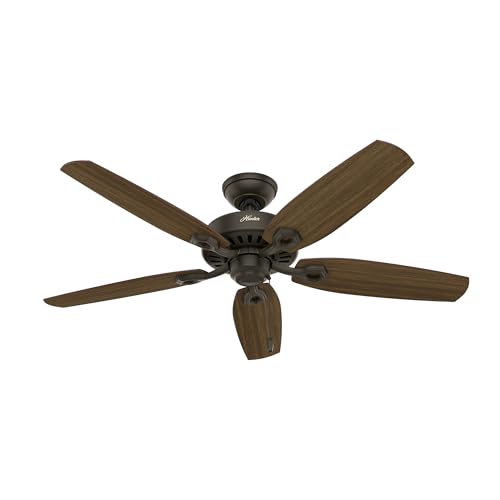 Hunter Builder Elite
- The Builder Elite includes a 3 inch downrod…
- This 52 inch ceiling fan helps maintain airflow…
- Featuring a warm bronze finish and classic design…
As an Amazon Associate we earn from qualifying purchases at no extra cost to you.
🛒 Best Price Today on Amazon
Prime members get fast, free shipping on everything above, plus member-only deals. New members get a 30-day free trial — cancel anytime.
How to Choose a Ceiling Fan Without Light (2026)
- Blade span vs. room size: Match span to the longest wall, not the square footage alone. Rooms up to 12 ft wide do well at 44–52 inches; open-plan living areas and covered patios benefit from 60–65 inches, which move more air at lower, quieter speeds.
- Motor type: DC and BLDC motors draw roughly 60–70% less power than AC, run in the 30–40 dB range, and reverse for winter circulation. AC motors are cheaper and perfectly serviceable, but you will hear them in a quiet bedroom.
- Rating for the location: Damp-rated fans handle covered porches and screened rooms. Wet-rated fans tolerate direct rain. Indoor-only fans will corrode and sag outdoors, even under an eave.
- Control method: Remote and app control keeps your wall switch free for a dimmer serving the room’s real lighting — a genuine advantage when planning scenes. Pull-chain fans cost less and never lose a remote, but they force you to reach up.
- Finish as a ceiling element: Without a glowing lens to draw the eye, the fan becomes a shape and a shadow. Natural wood blades warm up plaster and white ceilings; matte black reads as a graphic line against pale tongue-and-groove; bronze quietly disappears against warmer paint.
The Best Ceiling Fans Without Light (2026) Reviewed
52″ Solid Wood 3-Blade Fan with Remote
Three natural wood blades and six speeds make this the most design-friendly pick for bedrooms and dining rooms, where you want the fan to read as millwork rather than hardware. The flat and sloped ceiling mounting options are a practical bonus in older homes with pitched ceilings.
Ohniyou 60″ Industrial Fan, Black
At 6,800 CFM and roughly 35 dB, this five-blade aluminum fan is the airflow leader here, which is what a wide covered patio actually needs. Remote and app control mean you can leave the porch switch wired to a warm dimmable sconce instead.
52″ Solid Wood Outdoor Fan, Dark Walnut
A damp-rated BLDC fan with a three-blade propeller profile that suits screened porches and rustic interiors equally well. The dark walnut finish holds up visually against natural cedar or exposed beams, where a black fan can look like a hole in the ceiling.
ZMISHIBO 65″ Fan with Remote
The largest span in this group, pushing 6,116 CFM from a quiet reversible DC motor — a strong choice for great rooms, garages, and long patios where two smaller fans would be overkill. Indoor/outdoor rating gives you flexibility if you relocate it later.
Obabala 52″ Outdoor Fan, White
A clean white DC fan that essentially vanishes against a white ceiling, which is exactly what you want when track lighting or a pendant is the visual focus. Six speeds and reversibility cover year-round use in living rooms and covered patios.
Frequently Asked Questions
Can I install a fan without a light on wiring that fed a light kit?
Yes. The fan uses the same hot, neutral, and ground. If your old fixture had a separate switch leg for the light, cap it or repurpose it for a lamp outlet or sconce circuit.
Will my room feel too dark?
Only if the fan light was doing all the work. Plan two or three layers instead: recessed or track fixtures for general light, a table or floor lamp at seating height, and something low and warm for evening.
Is a DC motor worth the premium?
In bedrooms and offices, yes — the noise floor is noticeably lower and the extra low speeds are genuinely usable. In a garage or open patio, an AC motor is fine.
Can an indoor fan go on a covered porch?
No. Humidity and temperature swings warp blades and rust bearings. Choose damp-rated for covered areas, wet-rated for exposure.
Final Thoughts
For bedrooms and dining rooms where the ceiling should feel calm, the 52″ Solid Wood 3-Blade fan is the pick. For covered outdoor living, the Ohniyou 60″ delivers the most air for the least noise, and the ZMISHIBO 65″ is the better answer for genuinely large open spaces. All three leave your lighting design entirely in your hands.