Key takeaways
- Coverage volume vs. CFM: Calculate your bathroom’s cubic footage, then look for a fan rated to exchange that volume at least once per minute. A 120 CFM unit handles rooms up to roughly 120 sq ft with standard 8 ft ceilings; anything larger benefits from 130 CFM or a unit with variable-speed settings.
- Acoustic floor (sones): Anything under 1.5 sones fades behind running water. Models at 1.0 sone or below are genuinely inaudible to most people once a shower is on—critical if the bathroom sits adjacent to a bedroom.
- Light output and color temperature: Look for at least 800 lumens for general illumination, ideally with selectable CCT (correlated color temperature). A 3000K setting renders skin tones warmly; 4000K reads clean and modern on white tile. Dimmable drivers let you dial the mood from task-bright to ambient-low.
- Moisture and safety ratings: An HVI or ETL listing confirms independent testing. For fan units installed directly above a shower pan, ensure the light fixture carries a wet-location rating, not just damp.
- Sensor and smart features: Humidity sensors auto-purge steam without manual switching, extending motor life and protecting drywall. Some models also include nightlight modes at sub-50 lumen output—useful for late-night navigation without blast-bright overhead light.
Few bathroom fixtures pull double duty quite like a ceiling fan with an integrated light. They sit in the one spot where airflow matters most, yet they also dictate how your tiles, grout lines, and fixtures look at 6 a.m. versus 11 p.m. The trouble is that most shoppers scan spec sheets without thinking about how lumen output, color temperature, and dimming curves interact with steam, reflective surfaces, and the human eye. Pick wrong, and you get a fan that either drones through your morning routine or casts a flat, clinical glow over everything.
This 2026 roundup approaches the category from the perspective of light quality, acoustic comfort, and installation practicality rather than spec-sheet bragging rights. Each fan below was evaluated for how well its integrated luminaire performs in real bathroom conditions—wet air, mixed materials, and all. You will also find a concise buyer’s guide after the cards to help you match a unit to your specific room.
Our top picks



As an Amazon Associate we earn from qualifying purchases at no extra cost to you. Ratings are shown as listed on Amazon.
🛒 Best Price Today on Amazon
Prime members get fast, free shipping on everything above, plus member-only deals. New members get a 30-day free trial — cancel anytime.
How to Choose a Bathroom Ceiling Fan With Light (2026)
- Coverage volume vs. CFM: Calculate your bathroom’s cubic footage, then look for a fan rated to exchange that volume at least once per minute. A 120 CFM unit handles rooms up to roughly 120 sq ft with standard 8 ft ceilings; anything larger benefits from 130 CFM or a unit with variable-speed settings.
- Acoustic floor (sones): Anything under 1.5 sones fades behind running water. Models at 1.0 sone or below are genuinely inaudible to most people once a shower is on—critical if the bathroom sits adjacent to a bedroom.
- Light output and color temperature: Look for at least 800 lumens for general illumination, ideally with selectable CCT (correlated color temperature). A 3000K setting renders skin tones warmly; 4000K reads clean and modern on white tile. Dimmable drivers let you dial the mood from task-bright to ambient-low.
- Moisture and safety ratings: An HVI or ETL listing confirms independent testing. For fan units installed directly above a shower pan, ensure the light fixture carries a wet-location rating, not just damp.
- Sensor and smart features: Humidity sensors auto-purge steam without manual switching, extending motor life and protecting drywall. Some models also include nightlight modes at sub-50 lumen output—useful for late-night navigation without blast-bright overhead light.
The Best Bathroom Ceiling Fan With Light (2026) Reviews
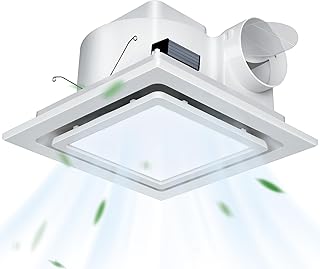
Ultra Quiet 120 CFM Exhaust Fan with LED Light
This 120 CFM unit runs at a whisper-thin 1.0 sone while pushing enough air for a standard full bath. The 1000-lumen LED module lands in a comfortable neutral-white range that flatters both warm wood vanities and cool quartz counters. For builders and remodelers who want a reliable spec without paying a premium, it is the quietest option per dollar in this lineup.
Panasonic WhisperFit FV-0511VFL1
Panasonic’s multi-speed CFM selector (50, 80, or 110) gives you control over airflow matched to room size, and the dimmable LED integrates with most standard wall dimmers. Build quality is noticeably a tier above: tighter housing tolerances translate to less vibration noise through ceiling joists. If your bathroom layout demands a low-profile install and you value engineering pedigree, this is the reference model.
80 CFM Round Exhaust Fan with Brushed Nickel Shower Light
The brushed-nickel trim ring and acrylic diffuser read more like a decorative ceiling fixture than utilitarian HVAC hardware. The 3CCT LED lets you choose between warm, neutral, and cool output from a single junction box, and the wet-location rating means it sits safely inside a walk-in shower. At 80 CFM it suits smaller baths, but its finish-to-performance ratio is unmatched in compact spaces.
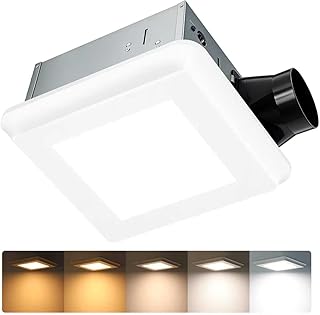
130 CFM Exhaust Fan with Humidity Sensor and 5CCT Light
Five selectable color temperatures—from warm 2700K to daylight 6500K—make this the most tunable luminaire in the roundup. The built-in humidity sensor ramps the fan automatically when moisture spikes, then powers down once conditions normalize. At 1.0 sone and 130 CFM it handles large master baths without drama, and the ETL/FCC certifications cover both North American electrical and electromagnetic standards.
Broan-NuTone Exhaust Fan with Heater and 3-Level CCT Lighting
Combining a 1.5-sone ventilation motor with a built-in heater element addresses two bathroom discomforts at once: stagnant humid air and cold floors in winter. The three CCT steps let you preset brightness to match the heater cycle—warm light during a heated warm-up feels intentional rather than accidental. It is the only unit here that actively raises room temperature, making it the top comfort pick for colder climates.
Frequently Asked Questions
How many sones should a bathroom fan be?
For most households, anything under 1.5 sones is considered quiet. Models at or below 1.0 sone approach the threshold of background noise, meaning the fan will not compete with conversation or the sound of running water.
Do I need a fan rated for wet locations if it is inside a shower?
Yes. A damp-location rating covers splash exposure but not direct water streams. If the fan-light combo mounts within a shower enclosure or directly above a shower pan, verify a wet-location listing on both the fan housing and the light fixture.
Can I run the light without the fan?
Most modern units allow independent operation via dual switches or a multi-function wall control. Check the wiring diagram before installation—some budget models tie the light relay to the fan circuit, requiring a rewiring workaround for independent use.
What CCT is best for a bathroom ceiling light?
Between 3000K and 4000K is the versatile sweet spot. 3000K adds warmth that flatters skin tones and wood finishes; 4000K reads crisper on white tile and stone. Selectable CCT models let you experiment before committing, which is why they dominate this list.
Final Thoughts
For most homeowners the Panasonic WhisperFit strikes the best balance of engineering, quiet operation, and light quality. Shoppers prioritizing smart automation will find the 130 CFM humidity-sensor model the most future-proof, while the Broan-NuTone with heater earns its keep in cold-climate bathrooms where comfort extends beyond ventilation alone. Whichever you choose, prioritize acoustics and light color over raw CFM numbers—the difference you notice daily is how the room sounds and feels, not how many cubic feet per minute the motor moves.