Key takeaways
- For occasional backup: choose a battery indicator and leave the lantern stored at about half to three-quarters charge.
- For regular camping: choose USB-C charging and a panel large enough to provide meaningful daytime top-up.
- For phone charging: look for a stated USB output and remember that transferring power leaves less energy for the lantern itself.
- For long outages: buy two moderate-capacity lanterns rather than depending on one oversized unit.
The best solar lanterns for most campers and emergency kits are rechargeable LED models with at least 300 lumens, a 2,000–4,000 mAh battery, USB backup charging, a stable hanging handle, and an IPX4 or higher water-resistance rating.
The right choice depends on whether you need a lightweight tent light, a bright campsite lantern, or dependable room lighting during a power outage. Solar charging is valuable when electricity is unavailable, but it is usually a backup rather than the fastest everyday charging method. Use the comparison below to match brightness, battery capacity, durability, and emergency functions to your situation.

Collapsible Portable LED Camping Lantern XTAUTO Lightweight Waterproof Solar USB Rechargeable LED Flashlight Survival Kits for Indoor Outdoor Home Emergency Light Power Outages Hiking Hurricane 4-Pack
Included for 'Best Solar Lanterns for Camping and Emergencies' as a relevant option in this category; details come from the product listing.
View on Amazon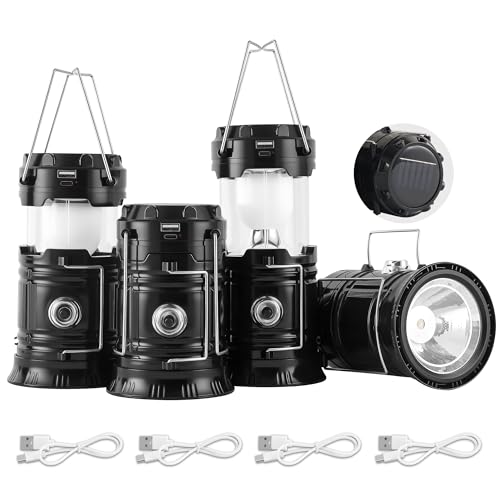
Lichamp Collapsible Portable Solar Camping Lantern, USB Rechargeable LED Flashlight - Survival Kits for Power Outages Hurricane Supplies Emergency, Indoor & Outdoor, 4-Pack
Included for 'Best Solar Lanterns for Camping and Emergencies' because the listing specifies USB Rechargeable LED Flashlight and Survival Kits for Power Outages Hurricane Supplies Emergency, details this guide uses to compare options.
View on AmazonBest solar lanterns by situation
| Situation | Best specification | Why it fits | Typical market range |
|---|---|---|---|
| Backpacking or minimalist camping | 50–150 lumens, 500–2,000 mAh, under 1 lb | Small enough for a pack and sufficient for a tent or cooking area | Usually $20–$60 |
| Family campsite | 300–600 lumens, 2,000–5,000 mAh, wide diffuser | Lights a picnic table and several people without needing multiple lamps | Usually $40–$120 |
| Power-outage emergency kit | 300+ lumens, USB output, battery indicator, flashing mode | Can light a room and recharge a phone or small device | Usually $35–$100 |
| Flood-prone or wet conditions | IPX6 or IP67, sealed controls, floating construction | Handles heavy rain, splashes, and accidental immersion better | Usually $35–$130 |
| Children’s room or bedside use | 20–150 lumens, warm-white or dimmable output, cool LED housing | Provides usable light without excessive glare or heat | Usually $20–$70 |
Brightness: choose usable light, not the largest number
Lumens measure the total amount of visible light. A lantern rated at 50–100 lumens is generally adequate inside a tent, where reflective fabric makes a small light seem brighter. For reading at a camp table, look for roughly 100–250 lumens. A 300–600-lumen lantern is more suitable for a family campsite, porch, hallway, or small room during an outage.
Maximum brightness is only part of the comparison. A frosted diffuser spreads light widely and reduces harsh glare, while a directional flashlight beam reaches farther but leaves nearby areas darker. For an emergency room, a lantern with several brightness levels is more practical than one powerful setting. On low mode, it can run overnight; on high mode, it can help people move safely through a 10-by-12-foot room.
Check whether the advertised brightness is the highest short-term output or the sustained output. Some lanterns automatically reduce brightness as the battery warms or loses charge. This is normal, but a product with a stated runtime at each brightness level gives you a more useful basis for comparison.
Battery capacity and solar charging speed
Battery capacity is commonly listed in milliamp-hours, or mAh. A 1,000–2,000 mAh battery is reasonable for a compact lantern. For a brighter camping lantern or emergency light, 2,000–5,000 mAh provides a better balance between runtime and weight. Models with 5,000 mAh or more may also include USB output, but they are heavier and can take longer to recharge from a small built-in solar panel.
Solar charging speed varies widely. A compact panel integrated into the lid may need a full sunny day, or several days of weaker light, to restore a depleted battery. Cloud cover, winter sun, shade, dusty panels, and the angle of the lantern all reduce charging speed. A useful lantern should therefore also accept USB-C or another wired charging method. Treat solar power as a way to extend readiness outdoors rather than assuming it will quickly refill the battery after every night.
- For occasional backup: choose a battery indicator and leave the lantern stored at about half to three-quarters charge.
- For regular camping: choose USB-C charging and a panel large enough to provide meaningful daytime top-up.
- For phone charging: look for a stated USB output and remember that transferring power leaves less energy for the lantern itself.
- For long outages: buy two moderate-capacity lanterns rather than depending on one oversized unit.
Head-to-head: inflatable solar lanterns versus rigid lanterns
| Feature | Inflatable lantern | Rigid rechargeable lantern |
|---|---|---|
| Typical weight | About 4–15 oz | About 12 oz–3 lb |
| Packability | Deflates nearly flat | Occupies its full shape |
| Brightness | Often 50–150 lumens | Commonly 150–1,000 lumens |
| Durability | Flexible body can be punctured | Hard shell resists knocks but can crack |
| Best use | Backpacking, tent lighting, children’s emergency kits | Camp tables, garages, outages, and group use |
Inflatable designs from brands such as LuminAID and MPOWERD Luci are attractive when storage space matters. They are light, easy to hang, and comfortable inside a tent because the diffuser softens the light. Their limitations are lower peak brightness on many models and a greater risk of puncture from sharp gear, pets, or rough ground.
Rigid lanterns from brands such as Goal Zero and BioLite generally offer brighter output, more substantial handles, and larger batteries. They are better for a shared campsite or emergency room, but check the handle and base before buying. A lantern that is bright but difficult to carry or hang can be less useful than a dimmer model with a stable design.
Weather resistance and construction details
Look for an IP rating rather than a vague claim such as “waterproof.” IPX4 protects against splashing water, which is usually adequate for a covered campsite. IPX6 offers protection against powerful water jets, while IP67 adds temporary protection against immersion. No rating protects a charging port that is left open, so close rubber covers fully before rain reaches the lantern.
Examine the material around the solar panel and diffuser. Clear plastic panels can scratch and reduce light transmission over time. Soft silicone bodies tolerate small drops and pack efficiently but may attract dust. Hard polycarbonate housings resist crushing better, although their seams and hanging loops deserve attention. For a lantern kept in an emergency bin, a replaceable or well-protected charging cable is a practical advantage.
Hanging options matter more than they appear
A top handle is useful for carrying but may not fit over a thick branch or tent pole. A wire bail handle gives more placement flexibility, while a built-in loop works with a carabiner or cord. Some inflatable lanterns include a top strap and a bottom strap, allowing them to hang upright or attach to a backpack.
For a tent, aim the light toward the ceiling or hang it from the center point so the diffuser distributes light evenly. At a campsite, keep the lantern at least 2–3 feet above the table when possible; this reduces shadows from plates, hands, and cookware. Do not hang a lantern from a weak interior tent seam or place it where wind can swing it into a stove, tree trunk, or person.
Emergency features worth paying for
- USB output: Useful for an emergency phone call, but expect slow charging compared with a wall charger.
- Battery-level display: Prevents the surprise of discovering an empty lantern during an outage.
- Flashing or SOS mode: Helpful for signaling, but avoid unnecessary flashing around children or people sensitive to strobing light.
- Red-light mode: Preserves night vision and is less disruptive in a shared tent or bedroom.
- Power-failure activation: Some rechargeable lights switch on when mains power fails, though this feature is more common in dedicated emergency lamps.
- Replaceable batteries: Less common in modern solar lanterns, but useful when long-term repairability matters.
How to choose in five steps
- Decide whether the primary area is a tent, table, porch, or room. This sets the brightness target.
- Choose the smallest battery that meets your runtime needs. More capacity adds weight and charging time.
- Require wired charging if the lantern will support emergency use. Solar-only models are best for low-demand lighting.
- Match the IP rating to your exposure: IPX4 for ordinary rain and at least IPX6 or IP67 for consistently wet conditions.
- Inspect the handle, hanging loop, base, diffuser, and charging-port cover before comparing extra modes.
Bottom line
Choose a 50–150-lumen inflatable lantern for backpacking and compact storage, a 300–600-lumen rechargeable lantern for family camping, and a USB-equipped model with a battery indicator for emergencies. Prioritize diffused light, a dependable hanging point, and an appropriate IP rating over an impressive peak-lumen number. The best solar lantern is the one that remains easy to find, charge, carry, and position when the conditions are inconvenient.