Key takeaways
- Create a leftover-paint record linking the original label, exact coating, sheen, opening date and room surface before your next touch-up.
What's inside
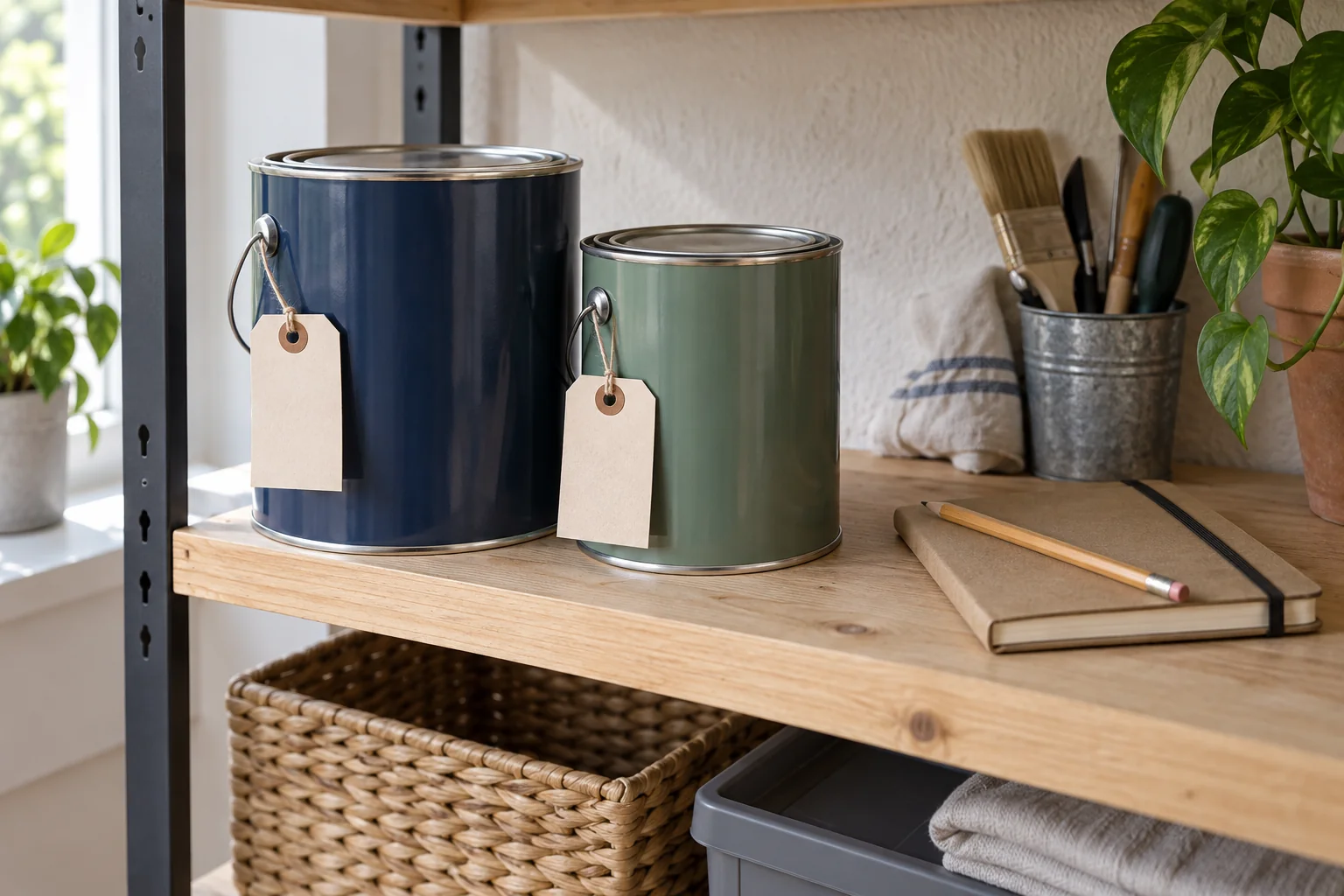
Label leftover paint with its exact product, color code, sheen, opening date and the surface where it was used. Keep the original label readable and give the can a short reference code that also appears in your room records. “Living room white” is rarely enough when the ceiling, trim and walls use different coatings.
The aim is to identify the right leftover before opening it or touching the wall. A clear label cannot guarantee usable paint or an invisible repair, but it can prevent choosing a similar-looking can from a different project.
Preserve the original identity first
Before adding anything, photograph the product label and tint sticker while they are readable. Include the full product line, color name and number, sheen, base information shown and any batch details. Save the receipt if available. A photograph of the front color name alone may omit the information a paint store needs.
Keep the manufacturer’s instructions and warnings uncovered. Put your project note in a separate clear area or use an appropriate attached record that does not interfere with the closure. Do not transfer paint to an unmarked food container to make the shelf look tidier. Identification should improve the original packaging, not replace it with a guess.
Sherwin-Williams recommends recording the month and year a paint can was opened and explains that storage conditions matter. Its guide also notes that disposal arrangements vary by region. Use the directions for your actual coating and local disposal service rather than treating the date on your new label as an expiry calculation.
Connect each can to a specific surface
Give the can a simple identifier, such as P07. Then name the room and surface precisely: “living room, window wall” or “hall, door frames.” Use stable landmarks rather than “left wall,” which changes depending on where someone stands. A small room sketch can carry the same reference code.
Record whether the can is the final coating, a sample or a primer. A sample bought during color selection can remain on the shelf beside the final paint and look equally plausible months later. Mark rejected samples clearly so they cannot be mistaken for touch-up stock.
| Field | What to write | Why it helps |
|---|---|---|
| Can ID | Short unique code | Connects label, photos and room map |
| Exact coating | Brand, line, sheen and label details | Separates similar products |
| Color | Full name, code and tint-label photo | Avoids relying on memory |
| Use location | Room plus named surface | Separates wall, ceiling and trim |
| Dates | Opened and applied | Distinguishes purchase from use |
| Application record | Preparation, tool and coats if known | Provides context for later repair |
| Status | Retained, identity uncertain or disposal planned | Prevents accidental use of unknown stock |
Record application without inventing missing details
If you know the roller type or brush used, note it. Add whether the surface was primed and whether the paint came from a combined batch of cans. These are records of the completed job, not directions to mix unrelated leftovers later. If a contractor painted the room, ask for the final product schedule rather than reconstructing it from a color photograph.
Write “unknown” for missing information. A confident but incorrect sheen is worse than an acknowledged gap. Keep an unanswered-question line for the store or painter: “Was this used on the ceiling?” or “Does this code refer to the original color or a custom match?”
When two cans belong to the same project, label both separately. They may have been opened at different times or stored differently. Their shared room reference does not establish that their contents remain interchangeable.
Worked example: three whites on one shelf
Imagine a fictional hallway project with a flat ceiling coating, an eggshell wall coating and a satin trim coating. All three were casually called “hall white.” The new record gives them P11, P12 and P13, attaches each code to the correct label photograph and identifies the surface on a small sketch.
A scuff appears beside a door. The map identifies the damaged surface as the wall, so P12 is the relevant record. P13 is excluded even though its color name sounds similar. Before using P12, the owner still checks its condition and the manufacturer’s touch-up guidance. The label solved identification; it did not prove that the old paint will blend invisibly.
If P12 has no readable product label, the next action is a question for the supplier, not opening every can and choosing whichever looks closest. A new matching decision may be necessary. Recording that uncertainty prevents another household member from repeating the same guess.
Keep the record useful after the project changes
Store the closed paint according to its own label, away from children and unsuitable heat or freezing conditions. Keep your digital or paper index separate from the cans so a damaged sticker does not erase the only record. Do not describe any storage location as suitable without checking the product’s requirements.
When a room is repainted, mark the old surface reference as superseded. When a can is emptied or disposed of appropriately, update its status but retain the product record if it may help identify the existing finish. The result is a small history of what is actually on the house, rather than an expanding shelf of mystery cans.