Key takeaways
- Plan wallpaper repeat on a short feature wall using match type, motif position and edge cuts, with a layout worksheet before ordering or cutting paper.
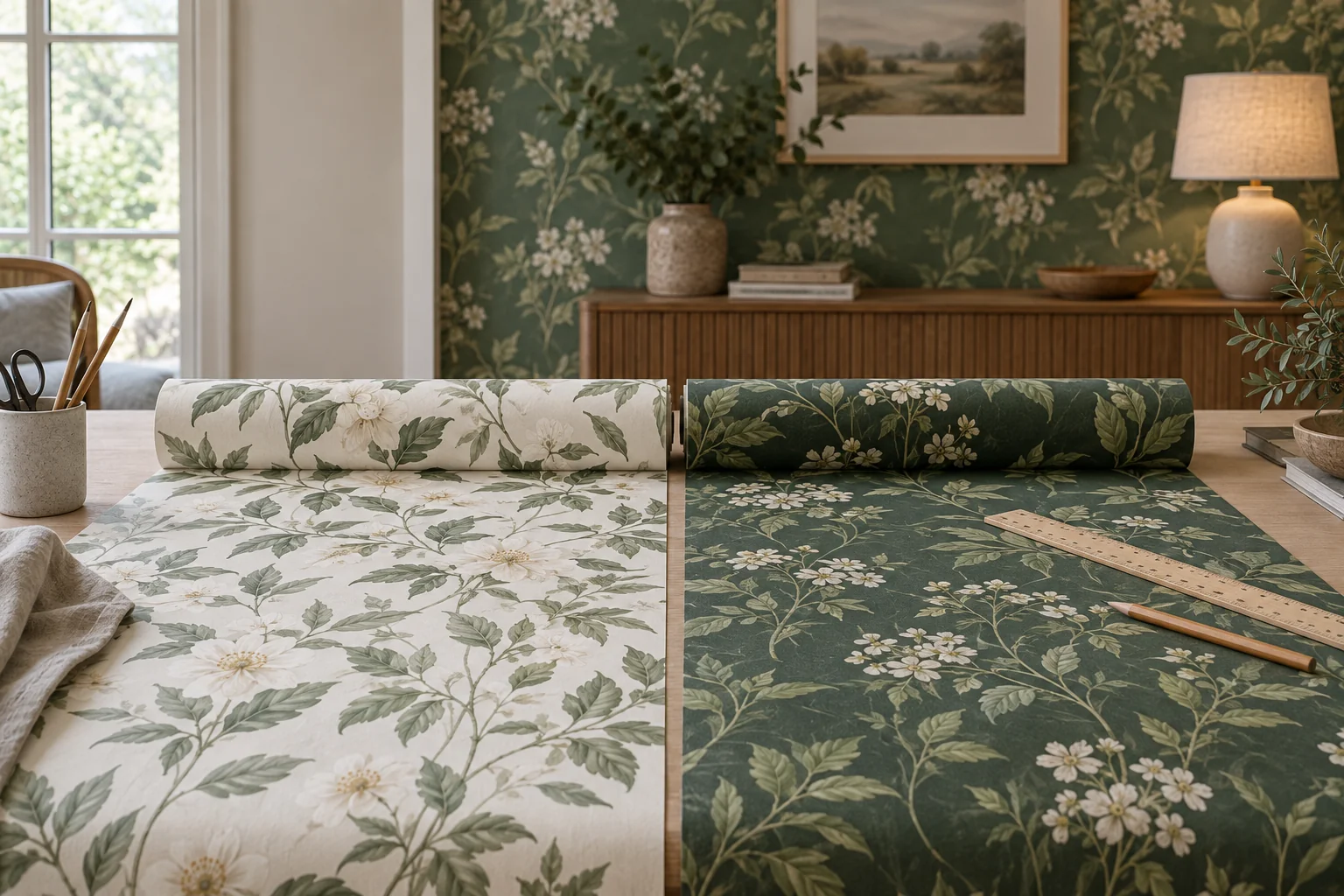
Choose wallpaper repeat for a short feature wall by mapping where the pattern will fall at the top, bottom and side edges. The repeat dimension alone does not tell you whether an important flower, geometric shape or scene will be cut awkwardly. You also need roll width, match type and enough of the design to see neighboring strips.
This is a visual planning exercise before ordering or cutting wallpaper. It does not replace the product’s hanging instructions, wall preparation requirements or an installer’s quantity calculation. A short wall can still need substantial paper when a large pattern must be aligned.
Distinguish repeat from match
Graham & Brown’s wallpaper FAQ describes repeat as the vertical distance between identical points in the pattern. Match describes how adjacent strips join. Free, straight and offset matches therefore answer a different question from the number printed beside “repeat.”
Copy the exact product’s repeat, match and roll width into your notes. Do not transfer the values from a similar colorway or a coordinating design without checking. If the pattern uses paired rolls or another special arrangement, obtain that layout before making a simple one-roll mock-up.
A small sample helps assess color and surface, but may not show a complete repeat. Ask for a full-repeat image or a diagram with scale when the sample cuts off the main motif. An attractive fragment is not enough to predict the completed wall.
Record the actual visible wall
Sketch the wall’s width and height above its skirting or other boundary. Add the outlines of furniture, shelving, door trim and fixed features that will remain. Distinguish a wall that is physically short from one whose lower portion is hidden by a cabinet; the visible pattern problem differs.
Mark the normal viewing position and any obvious visual center, such as the centerline of a console. Keep that separate from the wall’s geometric midpoint. A design centered on the whole wall may look off-center above furniture that stands to one side.
Record interruptions as shapes without removing electrical fittings or investigating behind them. This draft plan concerns the image on the wall. Installation around outlets and other services requires the appropriate product instructions and competent handling.
Make two layouts before choosing
On paper, draw vertical strips at the selected scale. Add the pattern’s repeated reference point using the manufacturer’s match information. For a first option, place the main motif where you prefer it visually. For the second, shift the starting position and see what happens at both edges.
Do not judge only the central strip. Check the left and right cuts, the top boundary, the lower visible edge and the relationship between adjacent motifs. A small adjustment that improves the center can create a distracting narrow fragment at the side.
| Planning question | Layout A | Layout B |
|---|---|---|
| Main motif position | Record preferred center and height | Record shifted alternative |
| Left and right edges | Whole motifs or fragments | Which fragments change? |
| Top and lower boundaries | Important shapes cut here? | Improvement or new compromise? |
| Furniture relationship | What remains visible? | Does focal point move? |
| Quantity question | Ask supplier using exact layout | Check before ordering |
Worked example: three repeats are not the whole answer
Suppose a fictional wall is 120 centimeters high and the selected design has a 40-centimeter vertical repeat. Dividing gives three repeats within that height. That arithmetic does not tell you whether the top begins halfway through a leaf or whether the most recognizable motif lands behind a shelf.
Now imagine the design is shifted vertically by ten centimeters. The repeat count over the same height remains three, but the fragments at the top and bottom change. The better arrangement depends on the actual artwork and what the furniture conceals.
These figures explain placement only. They are not a roll-order calculation and do not include trimming, matching losses, wall irregularities or the maker’s installation allowances. Have the supplier or installer check quantity against the exact product and measured wall.
Compare pattern scale at a realistic viewing distance
View a scaled mock-up from the room’s usual approach and seating positions. If using a screen image, note that its color and apparent scale may differ from the physical sample. Combine the layout with a real sample instead of asking one preview to answer both questions.
Look for the compromise you can accept: a centered main motif with partial edges, a more even edge distribution, or a smaller repeat with less emphasis on individual shapes. There is no universal maximum repeat for a short wall.
Before ordering, retain the product code, match information, measured sketch and chosen starting arrangement. Confirm whether samples accurately represent the supplied design and check the seller’s ordering and return conditions. A clear layout makes the final conversation specific: not “will this pattern work,” but “can this exact design produce these visible edges on this wall?”