Key takeaways
- Confirm fabric face, selvage direction and the intended upright motif before ordering curtains, with clear questions for your supplier or workroom.
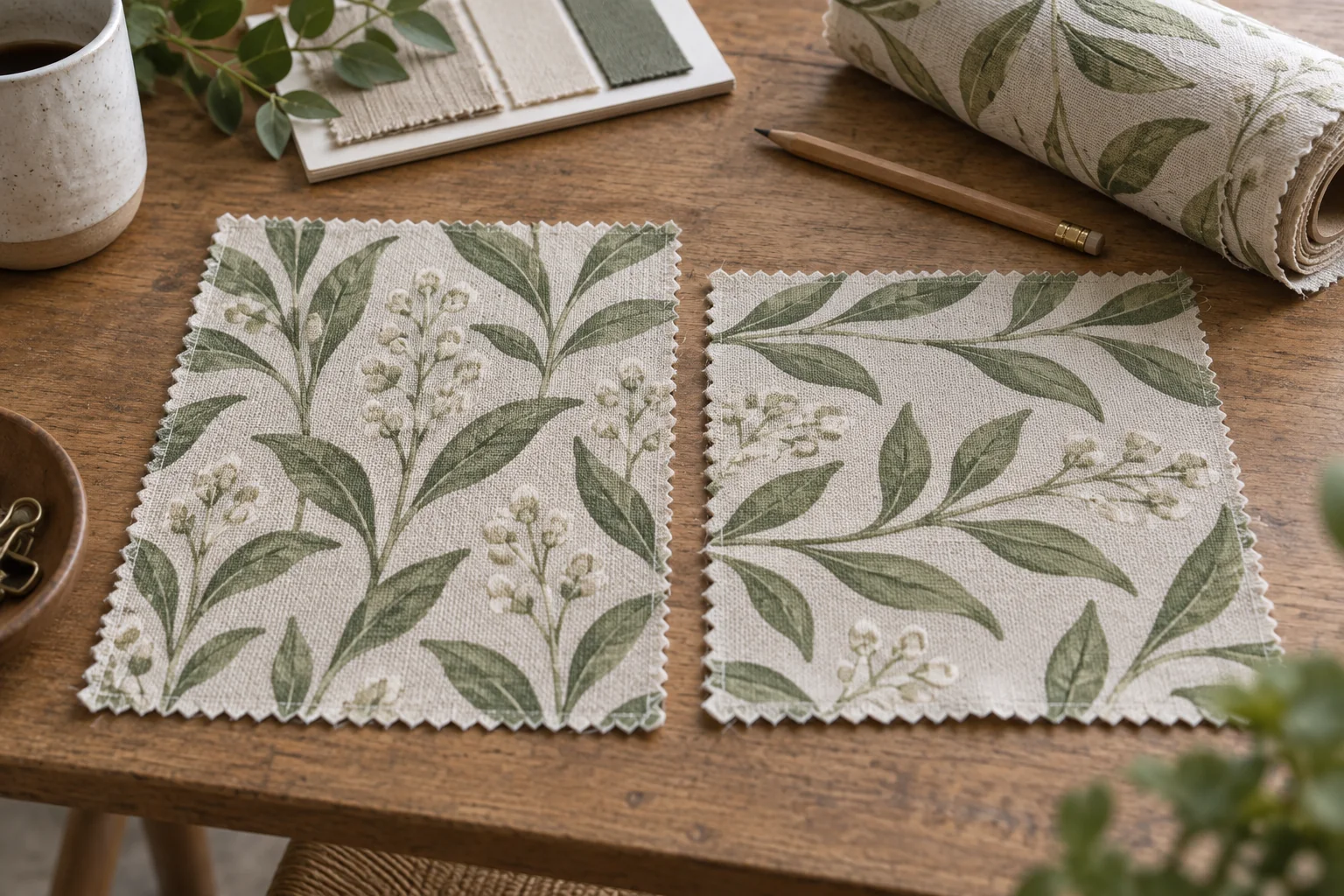
Check curtain fabric pattern direction by identifying the fabric’s finished face, the direction of the design on the roll and the direction the supplier intends to hang it. A beautiful website photograph can be rotated or tightly cropped. It does not necessarily show which way the motif will face on a finished curtain.
Resolve orientation before calculating an order or approving cutting. Pattern size, repeat spacing and pattern direction are related but different questions. This guide addresses direction: whether a stripe, leaf, figure or woven texture will run the way you expect after the fabric becomes a vertical panel.
Find the roll direction and the selvages
The selvages are the finished lengthwise edges of a fabric roll. A loose square sample may not include either edge, making its original orientation unclear. Ask for a sample marked by the supplier with the face side, selvage direction and intended top. Keep those markings with the sample rather than relying on memory after rotating it several times.
Sailrite’s explanation of railroaded fabric distinguishes designs running along the roll from designs running across it, from selvage to selvage. The article primarily discusses upholstery. Use its terminology to ask a clearer curtain-ordering question; do not assume that an upholstery fabric or a possible rotation is suitable for drapery.
The supplier or workroom should confirm the intended use of the exact fabric. A listing’s “railroaded” field identifies an orientation characteristic; it is not a blanket instruction to turn every fabric sideways or a guarantee that the result will hang appropriately.
Describe the result in plain words
Write what should be upright in the room. For example: “The stems should rise from the floor toward the ceiling,” or “The stripes should run horizontally across the finished panel.” This sentence is easier to verify than an unexplained arrow on a cropped image. Include the fabric name, colorway and supplier reference beside it.
If the pattern has no obvious top, examine its directional texture or shading with the supplier. A visually simple fabric can still have an intended orientation. Do not decide that it is reversible or nondirectional merely because its printed design looks similar after rotation.
| Question | Evidence to request | What remains unconfirmed without it |
|---|---|---|
| Which side faces the room? | Supplier-marked face sample | A photograph may show the reverse or a folded edge |
| Which way is the roll? | Selvage direction on sample or specification | The sample may have been rotated |
| Which way will the motif hang? | Finished-panel orientation confirmation | Roll direction alone does not show the planned cut |
| Is this use permitted? | Exact fabric’s drapery suitability | An attractive upholstery sample may not be appropriate |
Ask for an orientation view, not another styled photo
Request a simple image showing the proposed top and bottom of the finished curtain, with the actual sample orientation identified. A room photograph may hide that information in folds or perspective. You want a confirmation of the cutting intention, even if the illustration is visually plain.
Keep orientation separate from the question of how much fabric to buy. The workroom still needs to determine seams, fullness, repeat allowances and cutting requirements. An approved direction should be an input to that calculation. It should not become a reason to reuse yardage calculated for a different orientation.
A fictional ordering mix-up
Imagine a buyer choosing a leaf fabric from a square online thumbnail. The leaves point upward in the image, so the buyer assumes they will point upward in the curtains. The delivered sample has no edge markings and looks equally plausible after a quarter turn.
Instead of approving the sample immediately, the buyer sends two photographs: one in each possible orientation. The workroom identifies the roll direction and marks which photograph matches its intended curtain layout. The buyer then confirms the desired upward stems in writing. The value of this exchange is the removed ambiguity, not any guarantee about fabric performance.
If the workroom cannot produce the desired orientation with that fabric and panel design, choose another fabric or revise the design before purchase. Do not solve an unresolved direction problem by instructing someone to rotate pieces without considering the material’s construction and intended use.
Make paired panels part of the same approval
For two curtains, confirm whether both panels will face the same way and whether their motifs should relate at the meeting edge. “Matching pair” can leave room for different interpretations when a design contains animals, branches or other directional elements. Ask the workroom to describe its interpretation in the order.
Store the marked sample, approved view and final reference together. If the supplier substitutes a fabric, colorway or construction, repeat the direction check rather than treating the old approval as transferable. A similar product name is not evidence of identical orientation.
Close the decision before cutting
Your approval should answer three things clearly: this is the exact fabric, this is its room-facing side, and this is the intended direction on every panel. Leave technical cutting and fabrication decisions with the responsible supplier. You can then evaluate pattern scale on the window without accidentally comparing samples that will hang differently.