The Short Answer
Yes, you should buy a low profile ceiling fan with a light, provided your ceiling height is under 8.5 feet. If you are dealing with low ceilings, standard downrod-mounted fans are a safety hazard and can make a room feel claustrophobic. A low profile ceiling fan—often called a “hugger” fan—is the single best solution to achieve active air circulation and overhead illumination without sacrificing precious vertical headroom. However, if your ceilings are 9 feet or higher, you should skip the low profile design, as the blades will sit too close to the ceiling to circulate air efficiently throughout the room.
What You Actually Get
When you purchase a low profile ceiling fan with a light, you are buying a fixture specifically engineered to minimize vertical drop. While standard ceiling fans hang from a downrod and extend 12 to 24 inches from the ceiling, low profile models mount flush against the ceiling junction box. A typical modern hugger fan drops only 7 to 10 inches from the ceiling to the bottom of the light kit.
Our top picks
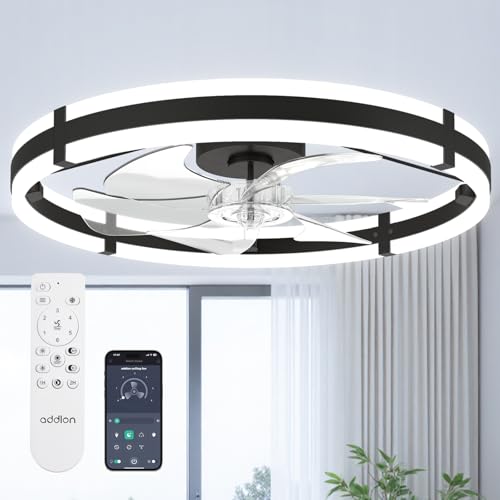 addlon 24" Low Profile Fandelier Ceiling Fans
- Wider Airflow for Larger Rooms:Upgraded from our 20″…
- Dimmable LED Light with 3 Color Temperatures:This ceiling…
- Remote & APP Control with Memory Function: Control…
 Amico 42 Inch Black Low Profile Ceiling
- Ceiling Fan with Light: Decorate your home with…
- Ceiling Fans with Remote: All operations can be…
- Low Profile Flush Mount: We provide very detailed…
As an Amazon Associate we earn from qualifying purchases at no extra cost to you.
In terms of physical design, these fixtures generally fall into two categories:
- Traditional Multi-Blade Huggers: These feature blade spans ranging from 42 to 52 inches (such as the Amico 42-inch model). The motor casing is anchored directly to the ceiling bracket, and the wide blades sweep across a large radius close to the ceiling plane.
- Compact “Fandeliers” and Caged Fans: These are highly compact units, usually measuring 20 to 24 inches in diameter (such as the addlon 24-inch model). They feature small, high-velocity blades enclosed within a protective cage, surrounded by integrated LED light strips or exposed vintage-style bulbs.
Mechanically, these units weigh between 8 and 15 pounds, making them light enough to install on standard ceiling joists without heavy-duty bracing. Modern units are powered by either traditional AC motors (drawing 50 to 70 watts) or highly efficient, whisper-quiet brushless DC motors (drawing just 15 to 35 watts). The integrated light kits typically feature LED boards outputting 1,200 to 2,200 lumens of brightness while drawing only 15 to 24 watts of electricity.
Pros
- Maximized Vertical Safety: The primary benefit of a low profile fan is safety. Standard building codes require fan blades to hang at least 7 feet above the floor. In a room with an 8-foot ceiling, a standard downrod fan can hang dangerously low. A flush-mount fan keeps the spinning blades 7.5 feet or more above the floor, protecting tall family members, bunk-bed occupants, and anyone raising their arms to put on a shirt.
- Visually Streamlined Aesthetic: As we evaluate home design trends heading into 2026, maximizing vertical space has become a priority for modern homeowners. Hugger fans sit tightly against the ceiling, which draws the eye upward and makes low rooms feel larger and less cluttered. Compact fandelier models can even pass as high-end flush-mount light fixtures when the blades are stationary.
- All-in-One Multi-Functionality: These fixtures solve two problems at once for rooms with only one central ceiling junction box. You get targeted, dimmable overhead lighting and active air circulation controlled by a single electrical connection.
- Advanced Control Options: Most low profile fans in the $50 to $150 price range come standard with multi-functional remote controls. These remotes allow you to adjust wind speed across 6 distinct levels, set sleep timers (typically 1, 2, or 4 hours), change the direction of the motor for seasonal rotation, and adjust the color temperature of the LED light from a warm 3000K to a cool 6000K.
- Quiet Operation: Because these fans mount directly to the ceiling joists, there is no downrod to wobble or sway. This rigid mounting style eliminates the annoying clicking and squeaking sounds common in older, poorly balanced downrod fans.
Cons
- Reduced Airflow Efficiency (The “Hugger” Effect): The physics of air movement work against low profile designs. To create a strong breeze, fan blades need to draw air down from the space above them. Because hugger blades sit just 6 to 8 inches from the ceiling, they operate in a pocket of low air pressure, reducing their overall cubic feet per minute (CFM) output by 15% to 20% compared to an identical fan mounted on a 12-inch downrod.
- Narrower Air Dispersion: Standard fans disperse air outward in a wide, cone-shaped pattern. Compact low profile fans, especially 24-inch caged fandeliers, push air in a tight, vertical column directly beneath the unit. While this is great if you are sitting directly under the fan, the corners of the room will receive very little air movement.
- Difficult LED Maintenance: Many budget-friendly flush-mount fans utilize integrated LED arrays rather than standard screw-in lightbulbs. If the LED driver or diode board fails after a few years, you cannot simply swap in a new bulb; you must source a proprietary replacement board from the manufacturer or replace the entire light kit assembly.
- Tedious Cleaning Processes: Caged fandelier models are excellent for keeping fingers away from moving parts, but they are notoriously difficult to clean. Dust naturally accumulates on the small plastic blades inside the cage. To clean them, you must either use compressed air cans or meticulously thread a thin microfiber duster through the narrow gaps in the metal cage.
Who Should Buy It
You should buy a low profile ceiling fan with a light if you are retrofitting a room with a ceiling height between 7.5 and 8.5 feet. It is the perfect addition to kids’ bedrooms with bunk beds, finished basements with low drop-ceilings, attic bedrooms with sloped low-clearance walls, and small home offices (under 120 square feet) where space is tight. It is also an excellent option for renters who want to replace an ugly, basic dome light with a functional fixture that can be easily uninstalled and packed away when they move.
Who Should Skip It
You should skip this style of fan if your ceilings are 9 feet or taller. In high-ceiling rooms, a flush-mount fan will trap the cool breeze too close to the ceiling, rendering it useless at floor level. You should also skip compact caged fandeliers if you rely on your ceiling fan as the primary cooling source for a large living room or open-concept space (greater than 200 square feet), as they simply do not have the blade span or CFM capacity to cool large areas.
Cheaper Alternatives
If you need to manage airflow and light in a low-ceiling room but want to explore options outside of a flush-mount ceiling fan, consider these alternatives:
| Option | Estimated Cost | Trade-off |
|---|---|---|
| Flush-Mount Light + Pedestal Fan | $35 – $65 total | Saves money but consumes valuable floor space; creates a cord tripping hazard in small rooms. |
| Wall-Mounted Oscillating Fan | $30 – $55 | Excellent targeted airflow at head level, but leaves a visible power cord hanging down the wall and provides no overhead light. |
| Low Profile Fan (No Light Kit) | $40 – $80 | Slightly cheaper and sleeker than models with lights, but requires you to rely entirely on floor lamps or recessed cans for room illumination. |
FAQ
How low does a ceiling fan need to hang to be safe?
For optimal safety, the bottom edge of the ceiling fan blades should be at least 7 feet (84 inches) above the floor. Low profile ceiling fans are specifically designed to meet this safety requirement in rooms with standard 8-foot ceilings, as they typically project only 7 to 10 inches downward from the ceiling junction box.
Can I install a low profile ceiling fan on a sloped ceiling?
Generally, no. Most flush-mount and low profile ceiling fans require a completely flat ceiling because the motor housing must sit flush against the mounting bracket. If you have a sloped or vaulted ceiling, you will need a fan that supports a downrod mount with an angled canopy adapter, which allows the fan to hang vertically despite the ceiling’s angle.
Do low profile ceiling fans move as much air as standard fans?
No. Because the blades of a flush-mount fan sit very close to the ceiling, they cannot draw in air from above as efficiently as a fan suspended on a downrod. You can expect about a 15% to 20% reduction in total airflow (CFM) compared to a standard downrod-mounted fan of the same blade span and motor size.
Can I control the light and the fan speed separately?
Yes. Almost all modern low profile ceiling fans equipped with remote controls allow you to operate the light and the fan motor completely independently. You can run the fan on high with the light turned off during the night, or use the light at full brightness with the fan turned off during the day.