When your ceilings sit below eight feet, finding a fixture that delivers real illumination without turning your room into a cave—or your head into a target—becomes surprisingly difficult. Most standard ceiling lights are engineered for nine- or ten-foot clearances, which means they either protrude awkwardly or fail to distribute light evenly across the room’s full footprint. The result is a half-lit, visually compressed space that no amount of paint color can rescue.
As someone who designs lighting plans for compact living spaces daily, I evaluate flush-mount fixtures on three non-negotiable criteria: vertical profile, lumen output relative to wattage, and color temperature flexibility. The selections below pass all three filters while representing distinct use cases—from budget multi-packs to statement pieces that double as ceiling jewelry. Use the comparison cards to compare current pricing, then read on for the full breakdown.
Our top picks


As an Amazon Associate we earn from qualifying purchases at no extra cost to you.
🛒 Best Price Today on Amazon
Prime members get fast, free shipping on everything above, plus member-only deals. New members get a 30-day free trial — cancel anytime.
How to Choose a Light For Low Ceiling (2026)
- Mount Type Matters: True flush mounts sit within an inch of the ceiling surface and work below 8-foot ceilings. Semi-flush designs drop 4–8 inches—still viable in bedrooms and hallways, but measure before you commit.
- Look Beyond Wattage: Lumens tell you actual brightness, not watts. A well-designed 17W LED can rival an old 60W incandescent at 1,500+ lumens. Prioritize the lm/W ratio when comparing models.
- CCT Selectability Is Non-Negotiable: Fixtures offering 3000K/4000K/5000K switches let you tune the room’s mood without swapping hardware. Warm tones flatter living spaces; cooler settings serve kitchens and bathrooms where task clarity counts.
- Consider the Footprint-to-Output Ratio: A 32-inch oval panel distributing 3,000 lumens across a broad surface reads as softer and more ambient than a compact 10-inch fixture pushing the same output through a concentrated hotspot.
- Dimming Compatibility Saves Ambiance: Verify your fixture works with standard dimmer switches. Even the best-rated panel becomes oppressive in a bedroom at full blast during a Tuesday evening—dimming control is essential.
The Best Lights For Low Ceilings (2026) Reviewed
Diodesy 32-Inch Oval LED Flush Mount
This oval panel is the closest thing I’ve found to recessed lighting without cutting into your ceiling. At just 35W pulling 3,000 lumens across its broad brushed-nickel surface, it throws an even wash that eliminates the harsh center-point shadows smaller fixtures create. The three-way CCT switch (3000K/4000K/5000K) lets you dial warmth for evening living-room mode or crisp daylight for weekend cleaning. Ideal as a primary light source in rooms up to 200 square feet.
24-Inch Black Large LED Flush Mount
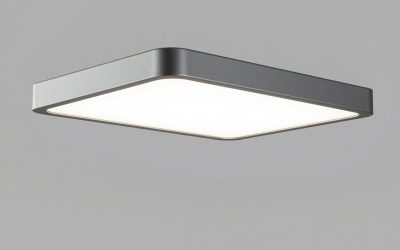
At 50W and nearly 5,500 lumens, this is the workhorse of the group—purpose-built for large bedrooms and open-plan living areas where a single fixture needs to shoulder the entire lighting load. The matte-black frame reads contemporary without skewing industrial, and the super-slim profile keeps it visually quiet against the ceiling. Note that 6000K maxes out at a very cool white, so reserve that setting for utility spaces rather than relaxation zones.
Diodesy Semi-Flush Double Ring 12-Inch
The oil-rubbed-bronze double-ring design brings genuine architectural character to a price bracket that usually offers nothing but flat discs. At 15W and 1,050 lumens, this fixture leans decorative over task-heavy—it’s a hallway statement or a bedroom accent rather than a kitchen’s primary light. The semi-flush drop is modest enough for 7.5-foot ceilings, and the three-way CCT switch is a welcome inclusion at this scale.
6-Pack 15.8-Inch LED Flush Mount Set
When you need to outfit an entire floor—hallways, bedrooms, kitchen, laundry—this six-pack delivers consistency at roughly $15–20 per fixture. Each 34W unit pushes 3,060 lumens through a slim flat panel, and the selectable CCT range matches pricier single-unit competitors. The real advantage here isn’t individual performance; it’s visual uniformity across multiple rooms, which reads as intentional design rather than a patchwork of mismatched afterthoughts.
3-Light Gold Flush Mount With Ribbed Glass
This is the fixture you reach for when you want the ceiling light to function as a design object, not just a light source. The ribbed clear glass shades refract light into subtle prismatic patterns across the ceiling plane, creating texture that flat panels simply cannot replicate. At 11.8 inches, it’s compact enough for entryways and small dining areas. The gold finish pairs beautifully with warm-toned interiors, though the three exposed sockets mean bulb selection (and maximum wattage) becomes part of the design conversation.
Frequently Asked Questions
How close to the ceiling should a flush-mount fixture sit?
I recommend a maximum protrusion of 4 inches for ceilings below 7.5 feet and up to 6 inches for 8-foot ceilings. Anything beyond that begins to compress headroom visually and physically, especially in high-traffic areas like hallways and entryways.
Can I use these fixtures in bathrooms?
Check the IP rating before installing any LED flush mount in a bathroom. Fixtures rated IP44 or higher handle the humidity and occasional splash exposure that bathrooms create. Standard indoor-rated fixtures can fog, corrode, or fail prematurely in wet zones.
Is 3000K warm enough for bedrooms?
3000K sits right at the warm-white boundary and works well for bedrooms, living rooms, and any space designed for wind-down routines. If you prefer a candlelit, amber-leaning atmosphere, look for fixtures that dip to 2700K or pair a 3000K fixture with a compatible dimmer to reduce intensity at night.
How many lumens do I need per square foot?
General living spaces call for 20–30 lumens per square foot; kitchens and bathrooms benefit from 40–50. For a 150-square-foot bedroom, a single 3,000-lumen fixture covers the baseline comfortably. Add task lighting—desk lamps, reading sconces—for focused activities rather than expecting the ceiling fixture to do everything.
Final Thoughts
For most low-ceiling scenarios, the Diodesy 32-Inch Oval offers the best balance of output, profile, and ambience tuning—its broad diffusion pattern genuinely mimics the soft overhead quality of recessed lighting. If sheer brightness is the priority in a large room, the 24-Inch Black Large LED dominates at nearly 5,500 lumens. And for spaces where the fixture needs to earn its place as a design element, the 3-Light Gold Flush Mount brings a level of visual warmth that no flat panel can match.