Key takeaways
- Compare sheer and opaque curtain patterns using a four-state swatch worksheet before choosing fabrics, linings and a layered arrangement.
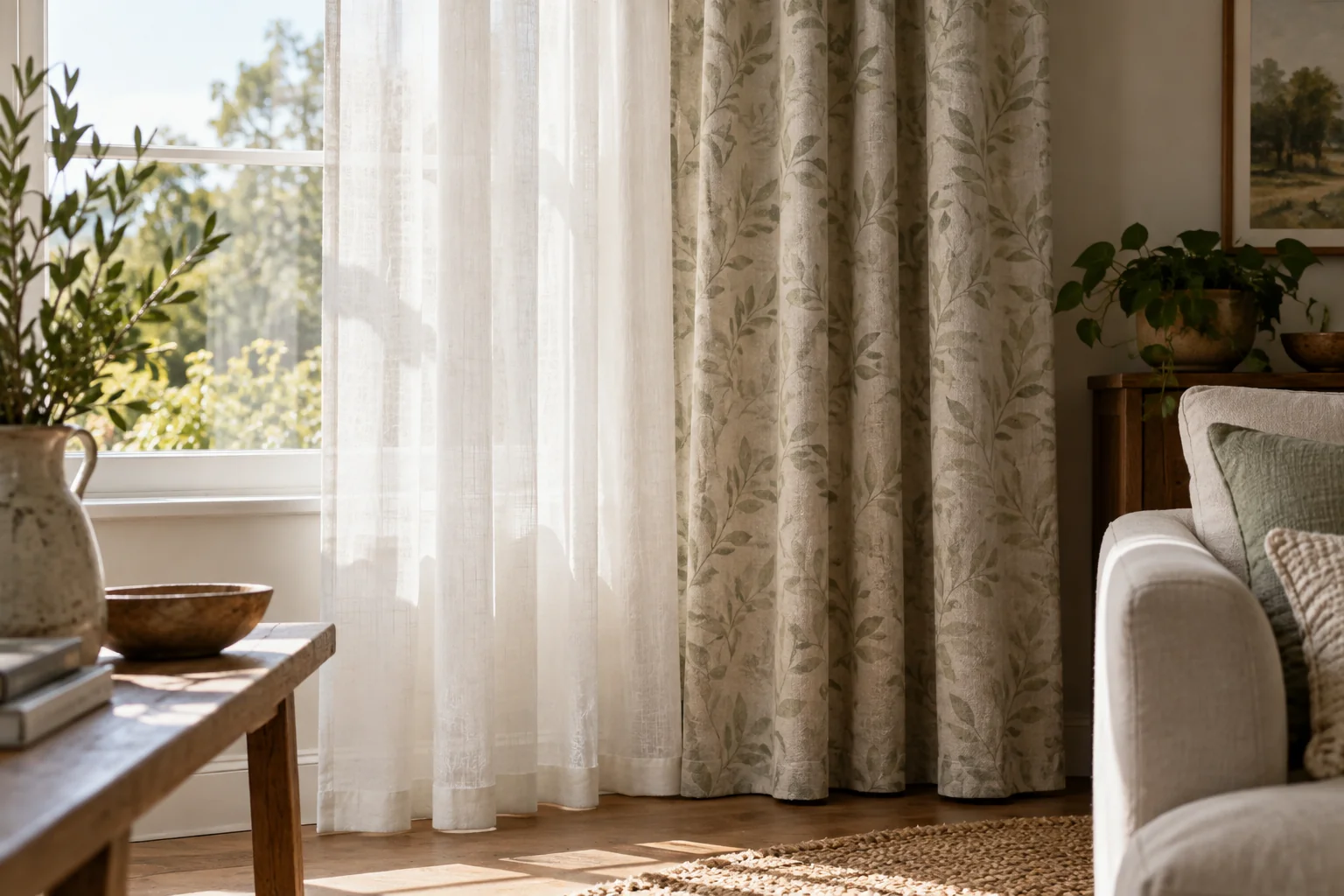
Coordinate sheer and opaque curtains by comparing the two fabrics in the positions in which you will actually use them. A pleasing pair laid flat on a table can look different when the sheer is backlit, the opaque panel is gathered, or both layers overlap. Start with a small set of labelled samples and four operating states, rather than choosing two patterns from separate product photographs.
This is a visual selection exercise. It cannot establish blackout, heat control, durability or nighttime privacy. Confirm those requirements through the supplier’s specifications and, where necessary, an appropriate full-size sample before ordering.
Decide which layer should carry the pattern
Write down the window’s everyday job. Perhaps the sheer stays closed during the day while the heavier curtain sits at the sides. In that arrangement the sheer occupies most of the view for many hours, so its pattern deserves attention even if the opaque fabric looks more dramatic in the shop. If both layers normally remain open, the visible gathered edges matter more than a flat panel.
Choose an initial hierarchy: patterned sheer with quieter opaque fabric, quiet sheer with patterned opaque fabric, or two patterns with visibly different roles. These are starting options, not rules about good taste. Keep one combination with only one pattern in your comparison so you can judge whether the second pattern actually adds something you want.
Build a sample set with traceable labels
The Shade Store’s swatch catalogue separates drapery materials into categories including sheers, solids and patterns. Use the supplier’s exact material and colour names when requesting samples; similar names across collections do not establish that the fabrics match. Keep the label attached to each sample and record any proposed lining separately.
Ask whether the sample shows a complete motif and what the horizontal and vertical repeat dimensions are. A small cutting containing only the background cannot show how a large botanical design will appear across a curtain. Request a larger view or a marked full-repeat image when needed, while keeping the physical sample for colour and texture decisions.
Make each pair easy to reconstruct. Put a letter on a paper card beside the fabric rather than marking the cloth. Record which face is intended to face the room. Do not hold two samples directly together if the finished curtains will hang on separate tracks with a gap.
Use this four-state comparison worksheet
| State | Arrange the samples | Record an observation |
|---|---|---|
| Daytime, sheer closed | Sheer against the window; opaque beside it | Which motif is noticeable from the main seat? |
| Both layers partly closed | Overlap in their intended front-to-back order | Does the background pattern show through? |
| Opaque closed | Opaque sample facing the room, with intended lining represented | Does its colour relate to the wall and furniture? |
| Evening, room lights on | Repeat the arrangements under usual lamps | Which combination still feels coherent? |
Complete a separate copy for each candidate pair. Use observations such as “the stripe disappears from the sofa” or “the floral outline competes with the sheer grid,” rather than giving an unexplained score. Someone else should be able to understand your choice from the notes.
Compare folds as well as flat fabric
Gently gather a sample without creasing or damaging it. A broad motif may be partly hidden within folds; a narrow stripe may alternate between visible bands and shaded channels. Change only one variable at a time: first the fabric pairing, then the order of layers, then the approximate gathering. This makes a rejected combination easier to diagnose.
Look from the normal seated position and from the doorway, not only at arm’s length. Include the wall, a furniture finish and the nearest large textile in your view. A phone photograph can help record the arrangement, but automatic exposure and colour processing make it a reference image, not a reliable measurement of the fabric’s colour.
A worked comparison
In this illustrative example, a household compares a sheer with a small woven grid against two opaque options: a large leaf print and a plain textured fabric. The grid and leaf pair looks attractive flat. At the window, however, the leaf outline remains visible through the sheer when both layers overlap, creating a busier view than the household wants.
They keep the grid sheer and choose the plain opaque fabric. Their worksheet records the reason as “clearer overlapping view,” not “better quality.” Another household might deliberately choose the layered pattern. The method helps make that preference explicit; it does not rank one style as universally superior.
Turn the preferred pair into an order brief
List both material codes, colour names, room-facing sides, intended lining, heading and front-to-back order. Include the four-state notes and any unresolved repeat question. Ask the supplier how pattern placement, seams and matching between panels are handled for the actual order.
Keep the approved samples until the finished curtains arrive. Compare the delivery against the agreed details before altering or installing anything. If the samples were too small to answer an important question, resolve that limitation before purchase instead of treating a decorative mockup as proof of the finished result.