
The best kettlebell routines are organized around movements you can perform with control. For a home practice, a short sequence with deliberate rest can be more useful than a complicated circuit whose transitions you have not learned. Choose the purpose of the session first, then arrange the exercises and the room to support it.
This guide provides practical selection and use considerations. It does not report hands-on product testing.
Choose a format that matches the task
A technique session gives one movement your attention before you move to another. A repeatable practice session uses a familiar sequence so you can compare notes afterward. A coached program may combine additional movements according to your experience. These are different formats, and a faster clock does not automatically improve any of them.
For a simple starting framework, use a warm-up followed by deadlift practice, a pause, goblet-squat practice if already appropriate for you, and a written review. Treat it as an example of organization rather than a complete personal training prescription. An instructor can adapt exercise selection and workload to your starting point.
Give the first movement a clear beginning
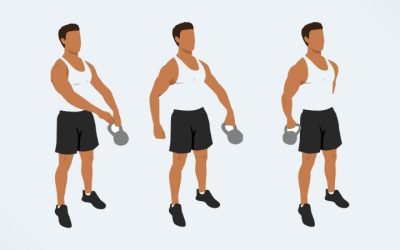
Set the bell between your feet. Hinge at your hips, bend your knees slightly and take a two-handed grip with a neutral back. Brace your torso, stand through hip extension, then hinge again to return the bell under control.
Make the return part of the repetition. Once the bell is down and secure, decide whether to continue or rest. This gives the practice a defined ending instead of encouraging a rushed handoff to the next exercise. If the starting position is unfamiliar, get instruction before adding loaded repetitions.
Keep a squat block separate
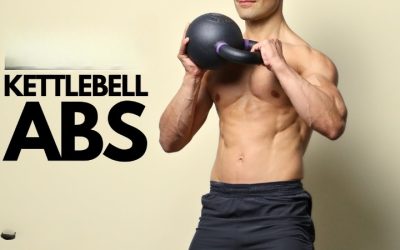
Hold the bell close to your chest with both hands. Brace, lower by bending your hips and knees while keeping your back neutral, and keep your knees following your toes. Use a depth you control, then press through your feet to stand.
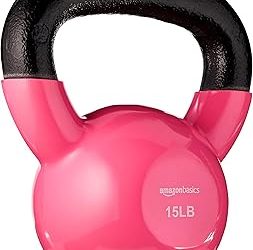
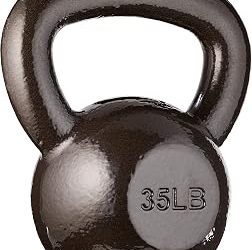
Do not force the same bell to suit every movement. A weight that is manageable in one exercise may not be appropriate in another position. Choose the load for the exercise rather than for the convenience of using only one piece of equipment. Leave a movement out while its setup or loading remains unresolved.
Use rest to preserve the sequence
Warm up before the loaded practice. Work in small groups of controlled repetitions, with rest between efforts. Give technique priority over a fixed total, and postpone advanced movements until the basics are established.
Your written plan can simply name the movement, the selected bell and the point at which you will reassess. Record the repetitions actually completed rather than treating a printed target as a debt. This makes it easier to distinguish a useful practice session from an attempt to finish numbers at any cost.
Product listings to compare
As an Amazon Associate we earn from qualifying purchases. Compare the selected variant and its current description with the requirements above.
Our top picks
 Palace Learning QUICKFIT Kettlebell Workout Exercise Poster
- Orientation: Landscape
- Item Shape: Rectangular
- Theme: Workout
3 MIL lamination resists tearing and moisture in a home gym
Large 18 by 24 inch size is easy to read from a distance
Illustrated guide covers a full kettlebell routine at a glance
Static poster cannot demonstrate movement or pacing like video
Limited to the specific routine printed, not customizable


 Kettlebell Cards for Women & Men-50 Kettlebell
- Target Audience: Adult
- Format: Organizer
- Paper Size: 3.15 x 4.72 inches
59 cards come with a built-in 4-week challenge structure
Dry-erase card lets you build and track a custom routine
Compact 3.15 by 4.72 inch size travels easily
Paper card material is less durable than plastic alternatives
Small card size limits how much illustration detail fits


 Kettlebell Workout Cards
- Educational Objective: Physical Fitness and Motor Skills
- Age Range Description: Adult
- Set Name: Kettlebell Workout Cards
50 exercise cards cover a wide range of kettlebell moves
Moisture-resistant plastic holds up better than paper cards
Blank card lets you write in a custom routine
Compact 3.5 by 5 inch cards show limited illustration detail
Deck covers kettlebell moves only, not other equipment
As an Amazon Associate we earn from qualifying purchases at no extra cost to you.
Keep training references in their proper role
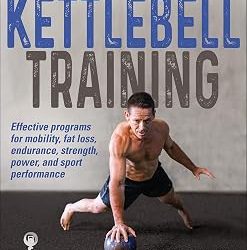
A chart or book can help you remember a session, but it is not the kettlebell itself and cannot observe your movement. Look for clear starting and finishing instructions and a progression that fits your experience. A long exercise list is not automatically a suitable routine.
If following a video, read or watch the sequence before picking up the weight. Establish where pauses occur and how to stop playback without carrying equipment across the room. You should not have to improvise a new transition merely because the screen has moved on.
Arrange one clear practice area
Choose a suitable supporting surface and keep furniture outside the space required for the movements. This example uses stationary exercises; it does not require adding swings to make the routine feel complete. Clear loose objects from the place where the bell begins and ends.
Place the reference screen where it can be read while resting. Avoid turning toward it during a loaded movement to check the next instruction. Keep storage separate from the practice position, and use an appropriate place for the weight after the session rather than an ordinary decorative shelf.
Review the session before expanding it
- Which setup could you reproduce without searching for instructions?
- Where did you need extra rest or coaching?
- Did the selected load suit each exercise?
- Was the room clear throughout the sequence?
Use those answers to shape the next practice. Progress can begin with a clearer setup and more consistent control; it does not have to mean another exercise or a heavier bell. The useful routine is one you understand well enough to repeat and adapt with appropriate guidance.
Additional product links
- Start 30-Day Prime Free Trial →
- See Today’s Amazon Deals
- ▸ Try Amazon Prime — free 30-day trial
- ▸ Start an Audible Premium Plus free trial
- ▸ Read free with Kindle Unlimited
Related reading
- Best kettlebell routines
- Chris Parker
- Best Kettlebell Weight for Men: How to Pick the Right Size
- Best Kettlebell Ab Exercises: 6 Adjustable and Fixed Picks
- Best Kettlebell Core Exercises: 6 Picks for Floor Space
- Best Kettlebell Exercise for Abs: 5 Bells for Long Holds
- Best Kettlebell Ab Workout: 6 Bells Sized for Circuit Work
- Best home pull-up bar
- Best at home pull up bar
- Best in house pull up bar
- Best rated ab roller
- Best kettlebell routine
- Best Workout Kettlebell: 6 Bells Matched to Your Training
- Best Kettlebell Training: 6 Bells to Build a Progression
Write Your Review
No reviews yet. Be the first to share your experience!