Key takeaways
- Match curtain headings to an existing pole, compare attachment types, and record the correct drop before ordering new panels.
Choose a curtain heading for a visible pole by matching the attachment first, then deciding how much of the pole you want to see. A heading that looks right in a photograph may require different rings, a removable pole end or a dedicated track. Make one compatibility record before comparing fabric colors.
Describe the pole you actually have
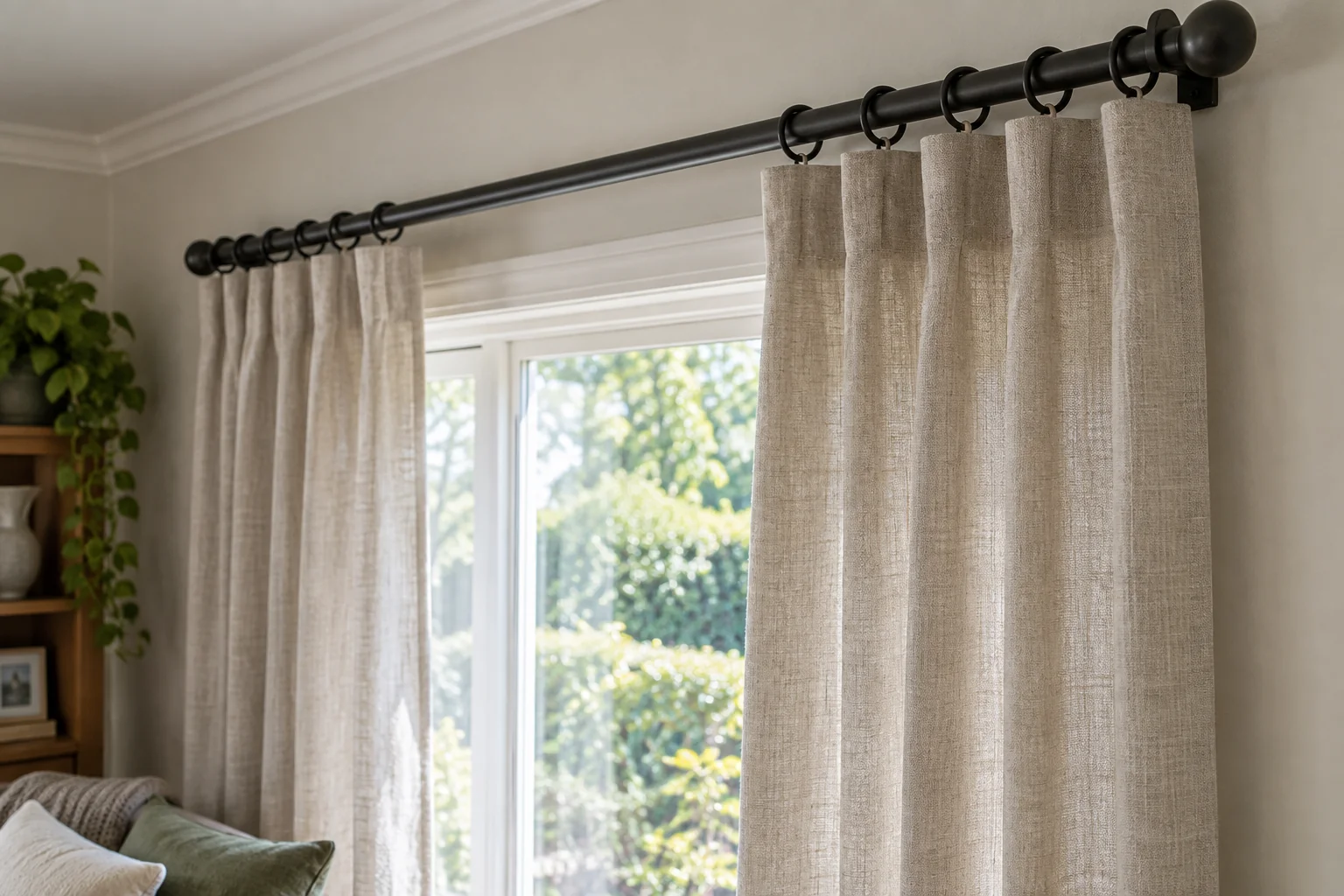
Record the pole diameter, usable span between end stops, bracket positions and whether the finials can be removed as intended by the manufacturer. Photograph a bracket and a joint as well as the whole window. A long pole may have a center support that divides the travel path, so an attractive one-way opening arrangement might not work with its existing fittings.
Write down the hardware brand or model if known. If it is unknown, do not translate a visual resemblance into a load rating. The heading decision cannot establish whether an old installation will support heavier lined panels. Have unsuitable, loose or unidentified fittings assessed before buying fabric around them.
Next, decide what “visible” means. You might want the entire rod above the fabric, short sections between folds, or only the decorative ends. These produce different silhouettes, even when the metal finish and curtain color stay the same.
Compare attachment families, not just style names
The Shade Store’s guide to drapery types distinguishes pleated styles attached to rods and rings from grommet and rod-pocket styles threaded directly onto a rod. Its Ripple Fold and Cubicle styles use a different system. Those are details of that manufacturer’s range, not evidence that every similarly named curtain accepts the same hardware.
For ring-hung pleats, identify the connection between curtain and ring: a hook, pin or clip specified for that heading. A photograph showing rings does not reveal whether hooks are included. For eyelets, compare the manufacturer’s permitted pole diameter with your actual pole; the eyelet’s outside decorative diameter is not the useful opening.
For tabs or pockets, establish whether the pole must come down to put the panel on. That matters when access is awkward or the panels will be removed regularly. Do not plan to cut tabs, enlarge eyelets or substitute clips to rescue an incompatible purchase.
Use this original heading decision sheet
| Candidate | Attachment evidence | Pole appearance | Unresolved check |
|---|---|---|---|
| Pleats with rings | Named compatible hook and ring | Pole sits above fabric | Ring travel at brackets and joints |
| Eyelet panel | Permitted pole diameter | Pole appears between folds | Finial removal and opening clearance |
| Tab-top panel | Tab opening and pole instructions | Fabric loops surround pole | Removal access and intended daily use |
| Rod pocket | Pocket specification | Fabric covers much of pole | Whether the gathered appearance meets your goal |
Add a column for the actual model name and mark each fact as confirmed, measured or unanswered. Leave an unanswered box visible. A compatibility table is useful precisely because it stops an appealing heading from becoming an assumed fit.
Recalculate the drop from the attachment point
A pole height is not automatically a curtain length. A ring and hook suspend the fabric below one reference point, while an eyelet can leave fabric above the rod. Ask where the seller measures the finished panel: top edge, hook position or another specified point. Then draw that point in a simple side view.
In an illustrative example, a homeowner measures 94 inches from a chosen pole reference to the desired hem line. One approved ring-and-hook combination places the curtain’s measured top 2 inches below that reference. The corresponding top-to-hem distance is 92 inches. Those two inches are hypothetical hardware geometry, not a standard deduction for curtain rings.
If the second candidate uses a different heading, start its calculation again. Carrying the first deduction across can produce a tidy-looking order sheet with the wrong drop. Have the supplier confirm the reference point before ordering a made-to-measure panel.
Check the open and closed views
Draw or photograph the window from the position where you usually see it. Mark the bracket locations and where the two panels meet. Then compare a closed view with an open view. Visible rings may be a desirable detail when the curtains are closed but visually crowded when the panels gather at the ends.
For curtains operated daily, ask the supplier about the intended operation of the particular heading and hardware combination. A showroom sample can help you judge the motion and appearance, but it does not reproduce the weight or span of a different installation. Keep those differences in the decision record.
Finish with three confirmed lines: compatible attachment, correct finished-drop reference and acceptable open-panel position. Save the supporting model details with the order. You can then choose the fabric knowing that the visible pole is part of a workable arrangement, rather than a decorative detail that forces an expensive hardware change later.