Key takeaways
- 8–12-inch mirrors: Best for compact clusters, narrow hallways, and decorative rather than full-face reflection.
- 14–20-inch mirrors: The most versatile range for bedrooms, entryways, and above medium-sized furniture.
- 22–30-inch mirrors: Better for a principal wall, fireplace surround, or large sofa, particularly when the set contains only three pieces.
The best mirror sets are the ones whose combined size, frame depth, and spacing suit your wall—not simply the set with the most pieces—so compare the number of mirrors, each mirror’s usable glass area, mounting method, and layout options before buying.
Best mirror sets by decorating situation
| Situation | Best set format | Why it works | Useful target size |
|---|---|---|---|
| Small apartment or narrow hallway | Three to five small mirrors | Creates light and depth without making the wall feel crowded | 8–14 inches wide per mirror |
| Above a sofa or console | Three large mirrors or a symmetrical six-piece set | Provides enough visual weight for wide furniture | 18–28 inches wide per mirror |
| Rental home | Lightweight framed mirrors with D-rings or a rail system | Easier to install and remove with fewer wall repairs | Under 5 pounds per mirror where possible |
| Home with children or pets | Small, rounded-edge mirrors with shatter-resistant backing | Reduces sharp corners and limits the consequences of accidental contact | 10–16 inches wide, mounted securely |
| Large blank dining or living-room wall | Five to nine coordinated mirrors | Fills a broad area while allowing an adaptable gallery arrangement | 24–40 inches total display height |
Piece count: more mirrors are not always better
Mirror sets commonly range from three to nine pieces. A three-piece set is usually the easiest to balance and gives a clean, intentional appearance above a dresser, console, or sofa. It also provides enough repetition to look like a collection without requiring a large wall.

Cityelf 3 Set Sunburst Round Mirrors for Wall Decor Bedroom Bathroom
Included for 'Best Mirror Sets for Creating a Stylish Wall Display' as a relevant option in this category; details come from the product listing.
View on Amazon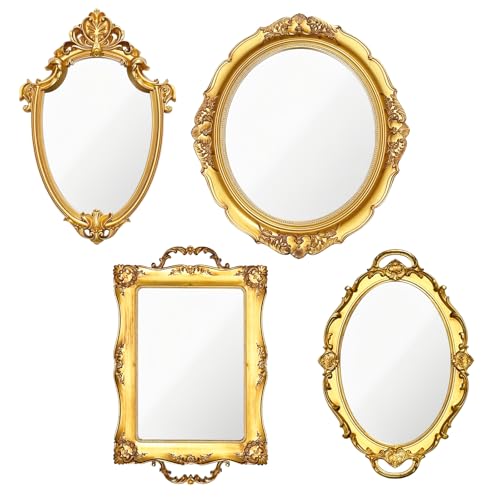
4 PCS Vintage Gold Mirror Set Vintage Mirrors for Wall Antique Shield Shape Square Oval Decorative Mirror Jewelry Dresser Organizer Tray for Living Room Bedroom Wedding Desktop Photography Decoration
Included for 'Best Mirror Sets for Creating a Stylish Wall Display' as a relevant option in this category; details come from the product listing.
View on Amazon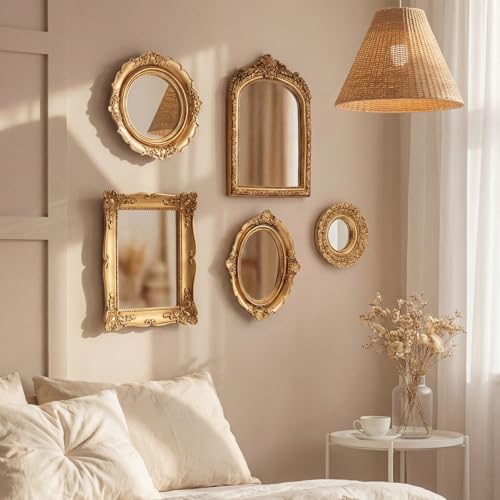
BrightRow Vintage Mirror Set,10in/8in/7in/4in,Stylish Style,5 Pcs
Included for 'Best Mirror Sets for Creating a Stylish Wall Display' because the listing specifies 10in/8in/7in/4in and Stylish Style, details this guide uses to compare options.
View on Amazon
HMANGE Boho Sunburst Wall Mirror Set of 3, 12 Inch Round Antique & Modern Metal Wall Art, Hanging Over The Door Mirrors for Wall Decor in Living Room, Bedroom, Bathroom, Entryway(Gold)
Included for 'Best Mirror Sets for Creating a Stylish Wall Display' because the listing specifies 12 Inch Round Antique & Modern Metal Wall Art and Hanging Over The Door Mirrors for Wall Decor in Living Room, details this guide uses to compare options.
View on AmazonFour- and five-piece sets offer more flexibility. You can arrange them in a row, stagger them vertically, or create a loose cluster around a central mirror. These sets are particularly useful when your wall dimensions are unusual, because one mirror can be moved slightly to avoid a switch plate, picture rail, or corner.
Six- to nine-piece sets create a stronger gallery effect, but they demand more planning. Small individual mirrors may look lost on a wide wall unless the gaps between pieces are controlled. They also take longer to level and install. Choose a larger set when you want an organic display or need to cover a wall at least 6 feet wide; choose fewer, larger pieces when you prefer visual calm.
Calculate the display footprint before ordering
For a horizontal arrangement, multiply the mirror width by the number of mirrors, then add the gaps. For example, four 12-inch mirrors with 3-inch gaps require 57 inches of wall space. Allow at least 4 inches of clearance from the furniture below and keep the complete arrangement at least 6 inches from adjacent corners or door casings.
Above a sofa, the display should generally be about two-thirds to three-quarters of the sofa’s width. A 72-inch sofa, for example, suits a mirror arrangement roughly 48–60 inches wide. Above a 48-inch console, a 30–40-inch arrangement will usually look more proportional than a wall-filling installation.
Individual mirror size and usable reflection
Check the glass dimensions rather than relying on the outside dimensions. A 16-inch mirror with a 2-inch frame on every side has only about 12 inches of visible glass. Thick frames can make a set look substantial, but they reduce reflective area and add weight.
- 8–12-inch mirrors: Best for compact clusters, narrow hallways, and decorative rather than full-face reflection.
- 14–20-inch mirrors: The most versatile range for bedrooms, entryways, and above medium-sized furniture.
- 22–30-inch mirrors: Better for a principal wall, fireplace surround, or large sofa, particularly when the set contains only three pieces.
For a practical entryway display, position the center of at least one mirror around eye level—approximately 58–64 inches from the floor for many adults. If the mirrors are mainly decorative above a console, leave 6–10 inches between the console top and the lowest frame. Above a dining table, a lower arrangement can work, but leave enough room that seated diners do not see distracting reflections at eye level.
Frame materials: appearance versus installation reality
| Frame material | Advantages | Trade-offs | Typical weight and care |
|---|---|---|---|
| Solid wood | Warm grain, repairable finish, substantial appearance | Heavier and more vulnerable to seasonal movement or moisture | Often 3–8 pounds per medium mirror; dust with a dry or barely damp cloth |
| Engineered wood or MDF | Consistent shape, lower cost, smooth painted finishes | Edges can swell if water enters; screw-holding strength depends on the backing | Often 2–6 pounds; keep away from persistent bathroom condensation |
| Metal | Thin profile, crisp modern lines, resistant to minor humidity | Can feel cold visually and may show fingerprints or scratches | Often 2–7 pounds; check welds and hanger attachment points |
| Resin or molded composite | Lightweight, detailed finishes, useful for ornate shapes | Can look less natural and may chip if knocked against a hard surface | Often 1–4 pounds; avoid abrasive cleaners |
Frame depth also affects the final appearance. A shallow frame of about 0.5–1 inch sits close to the wall and suits modern rooms. A 1.5–3-inch profile creates more shadow and presence but may require a stronger anchor, especially when several pieces are installed close together.
Layout flexibility: the most useful designs
Symmetrical row
Use identical mirrors with equal spacing for a polished look above a console, sideboard, or sofa. A 2–4-inch gap is usually enough to separate the frames without breaking the composition. This is the safest choice if you want a display that is easy to measure and difficult to make visually uneven.
Grid arrangement
A two-by-two or three-by-two grid gives a structured, architectural effect. Keep both horizontal and vertical gaps consistent, ideally within a half-inch of one another. This layout needs a relatively clear wall because an outlet, thermostat, or nearby artwork can make the grid appear off-center.
Organic cluster
An irregular cluster is the most adaptable layout. Start with the largest mirror near the center, place smaller pieces around it, and maintain roughly 2–6 inches between frames. Trace each mirror on paper and tape the shapes to the wall before drilling. This method is particularly helpful with round, oval, or asymmetrical mirrors.
Plan for weight, wall type, and moving
Do not assume that a lightweight-looking mirror is lightweight. Add the listed weight of every frame and hardware, then choose anchors for the wall material. A plaster or drywall wall may need a rated hollow-wall anchor; a stud or masonry wall requires the appropriate screw or masonry fixing. When a mirror has two hanging points, use both rather than relying on one central nail.
For a set of five medium mirrors weighing 4 pounds each, the total is 20 pounds before packaging. That matters when carrying the box, navigating a staircase, or moving through a 30-inch doorway. Large sets can arrive in one long carton, so measure the narrowest doorway, elevator opening, and hallway turn before ordering.
Inspect the back of each piece before installation. The hardware that wears or fails first is often the hanger, sawtooth plate, adhesive pad, or thin backing—not the glass itself. Replace questionable hardware with appropriately rated D-rings, wire, or cleats. Adhesive-only mounting is best reserved for very light decorative pieces on smooth, clean surfaces, and it is less dependable in humid rooms or homes with vibration from doors and appliances.
How to create a balanced wall display
- Measure the furniture and wall. Record the width of the furniture, the available height, nearby doors, outlets, and corners.
- Choose the visual center. Mark the centerline of the sofa, console, bed, or wall section—not necessarily the center of the entire room.
- Arrange paper templates. Cut templates to the outside frame dimensions and test rows, grids, and clusters with painter’s tape.
- Set consistent gaps. Use a ruler or spacer block so the distance between mirrors remains deliberate.
- Check reflections. Avoid aiming every mirror directly at a cluttered area, bright window, or television screen.
- Install from the center outward. Level the first mirror, then use it as the reference for the remaining pieces.
Which of the best mirror sets should you choose?
Choose a three-piece set of 18–24-inch mirrors for a refined display above a sofa or console. Choose four or five medium mirrors if you want the flexibility to adapt the layout to an apartment wall, hallway, or future move. Choose six or more small mirrors for a creative gallery effect, but only after confirming that the combined display will have enough width and that you are comfortable installing multiple anchors.
In most homes, the best mirror sets balance three things: enough total glass to reflect light, frames light enough for the wall and household, and a piece count that matches the amount of space you can arrange without crowding it. Measuring the full footprint and planning the mounting hardware first will produce a more polished result than choosing by frame style alone.