Key takeaways
- Compare three curtain fullness ratios with a simple paper exercise, then translate the preferred look into clear ordering questions.
A paper mockup can help you compare curtain fullness by showing how different amounts of material occupy the same width. Use it to understand the proportions of folds, not to predict the weight, softness, light control or open stack of real fabric. Keep the covered width constant while changing the length of paper.
Separate flat width from covered width
Flat width is the material spread out before gathering. Covered width is the span occupied after gathering or pleating. The ratio of the two describes the amount of material assigned to that span. A pre-pleated panel may already be sold by its finished coverage, so multiplying its listed width again can count the fullness twice.
Check the terminology on the exact product. IKEA’s UK SILVERLÖNN 504.939.76 listing states that each curtain is 145 centimeters wide and that a pair contains two curtains. It suggests rod-width multipliers of 1.5, 2 and 2.5 for different fullness levels. Those choices provide a useful labeled example; they are not a specification for every heading or fabric.
Write “flat,” “finished coverage” or “unclear” beside the seller’s width before making the model. If unclear, resolve it with the supplier. A convincing paper sample cannot correct an ambiguous ordering dimension.
Build three samples with one common span
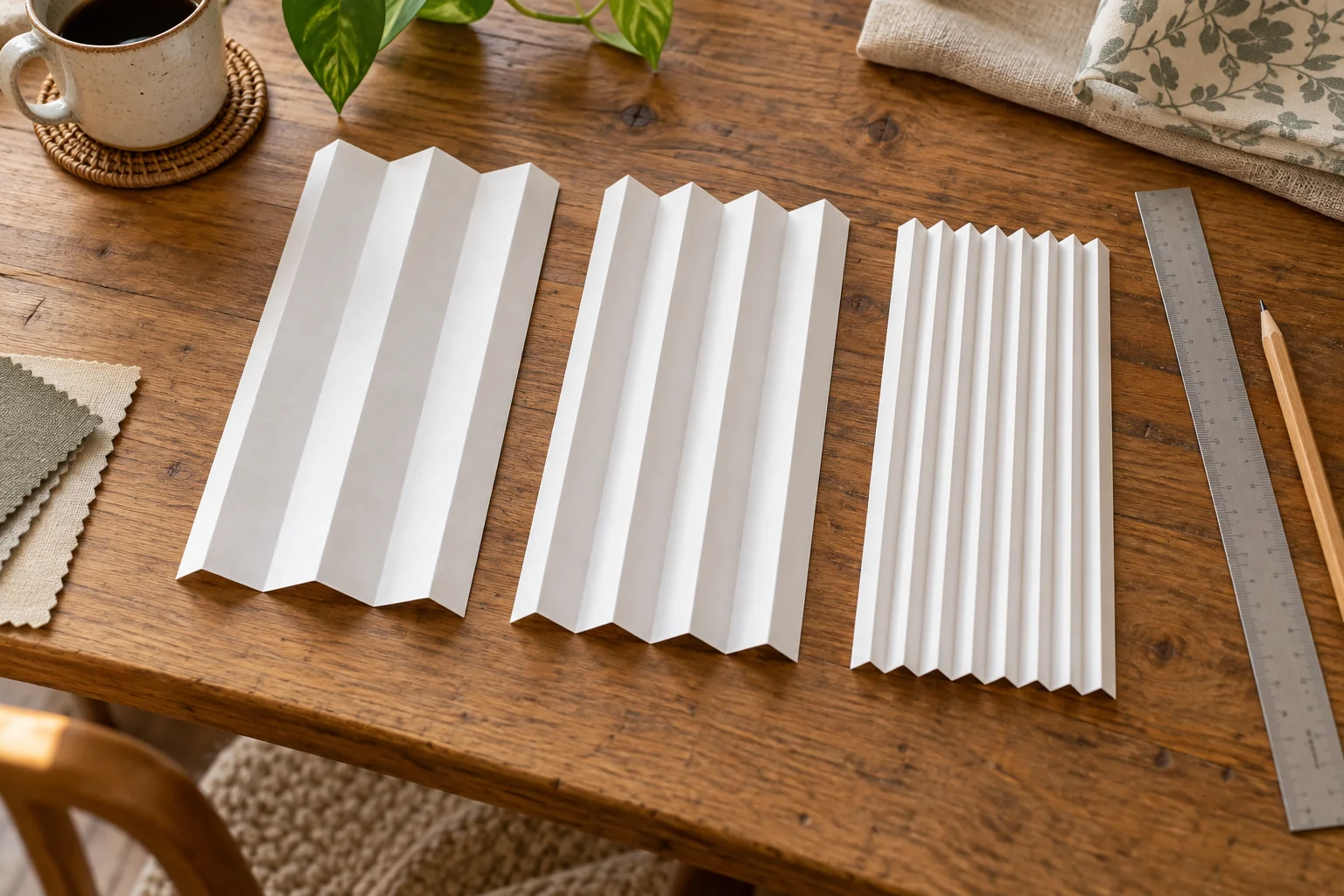
Draw a horizontal 20-centimeter line on a sheet of card. This will be the covered width of every model. Cut three strips of the same paper, all with the same height, at lengths of 30, 40 and 50 centimeters. Their flat-width-to-covered-width ratios are 1.5, 2 and 2.5.
Gather each strip into repeated loose folds until its ends align with the 20-centimeter line. Secure it to a separate card so the samples can stand side by side. Do not force one sample into sharp miniature pleats and leave another in soft waves: different folding methods would introduce another variable.
Label each card with its flat length, covered width and ratio. Add a clear note that the folds are a visual exercise, not a sewing pattern. A real heading may impose fixed pleats or carrier spacing that this free-folded paper cannot reproduce.
Original comparison worksheet
| Sample | Flat paper | Covered span | Ratio | Observation to record |
|---|---|---|---|---|
| A | 30 cm | 20 cm | 1.5 | How broad are the visible flat faces? |
| B | 40 cm | 20 cm | 2 | Does the fold rhythm suit the imagined window? |
| C | 50 cm | 20 cm | 2.5 | Does the extra folding compete with a pattern? |
Photograph all three from the same distance and under the same light. Place a plain rectangle behind them to represent the window. If you want to explore a two-panel arrangement, divide every sample into equal halves rather than comparing one panel in one model with two in another.
Translate the choice into an ordering question
Suppose an illustrative rod span is 180 centimeters and you prefer the middle model. Multiplying 180 by 2 gives 360 centimeters of flat material before any supplier-specific treatment of returns, overlaps or finishing. Two 145-centimeter panels total 290 centimeters, a ratio of about 1.61 over that span. Four total 580 centimeters, about 3.22.
This arithmetic reveals a purchasing decision rather than selecting the correct product automatically. A ready-made pair might not match your preferred model exactly. You could compare another panel width, accept a different effect or ask about a custom option. Do not conclude that excess panels can simply be cut down without considering headings, hems and pattern placement.
For a custom order, send the desired covered width and the supplier’s requested measurements. Explain the visual preference using the mockup photograph. Let the workroom specify the fabric quantity needed for its construction instead of presenting your paper length as a cutting instruction.
Test pattern separately from volume
Draw a few broad vertical marks on a second set of strips. Gathering them makes it easier to see how folds can hide parts of a motif. This is a composition exercise: it will not show an actual fabric repeat unless that repeat has been scaled accurately and positioned as the maker intends.
After choosing a preferred rhythm, request a real fabric sample and view it at the window. Note the lining and heading under consideration. A thin paper strip and a lined velvet panel can have the same nominal ratio while looking and behaving very differently.
Keep the limits beside the result
The model does not establish blackout, privacy, acoustic performance or mounting capacity. It also cannot reliably calculate stackback, because paper thickness and stiffness differ from the finished curtain. Obtain actual hardware and panel guidance before deciding how far the pole should extend beyond the glass.
Keep one photograph, the worksheet and the supplier’s width definition together. The useful outcome is a precise conversation: “I prefer this amount of folding over this covered span.” That is a stronger starting point than ordering extra fabric because an unqualified rule says every window needs the same multiplier.