Key takeaways
- Compare dehumidifier tanks, gravity hoses, and condensate pumps for small rooms, including practical spill, electrical, and dorm-policy checks.
The safest dehumidifier drainage option for most small bedrooms and dorm rooms is the built-in tank, provided it has reliable full-tank shutoff and can be carried without spilling. A gravity hose can work only when there is a permitted drain continuously below the outlet and the hose can be secured without crossing a walkway. Built-in or external pumps can lift condensate, but they add failure points, maintenance, noise, and policy questions. Never drain into an open bucket or route a hose where a leak could reach people, electronics, or building materials.
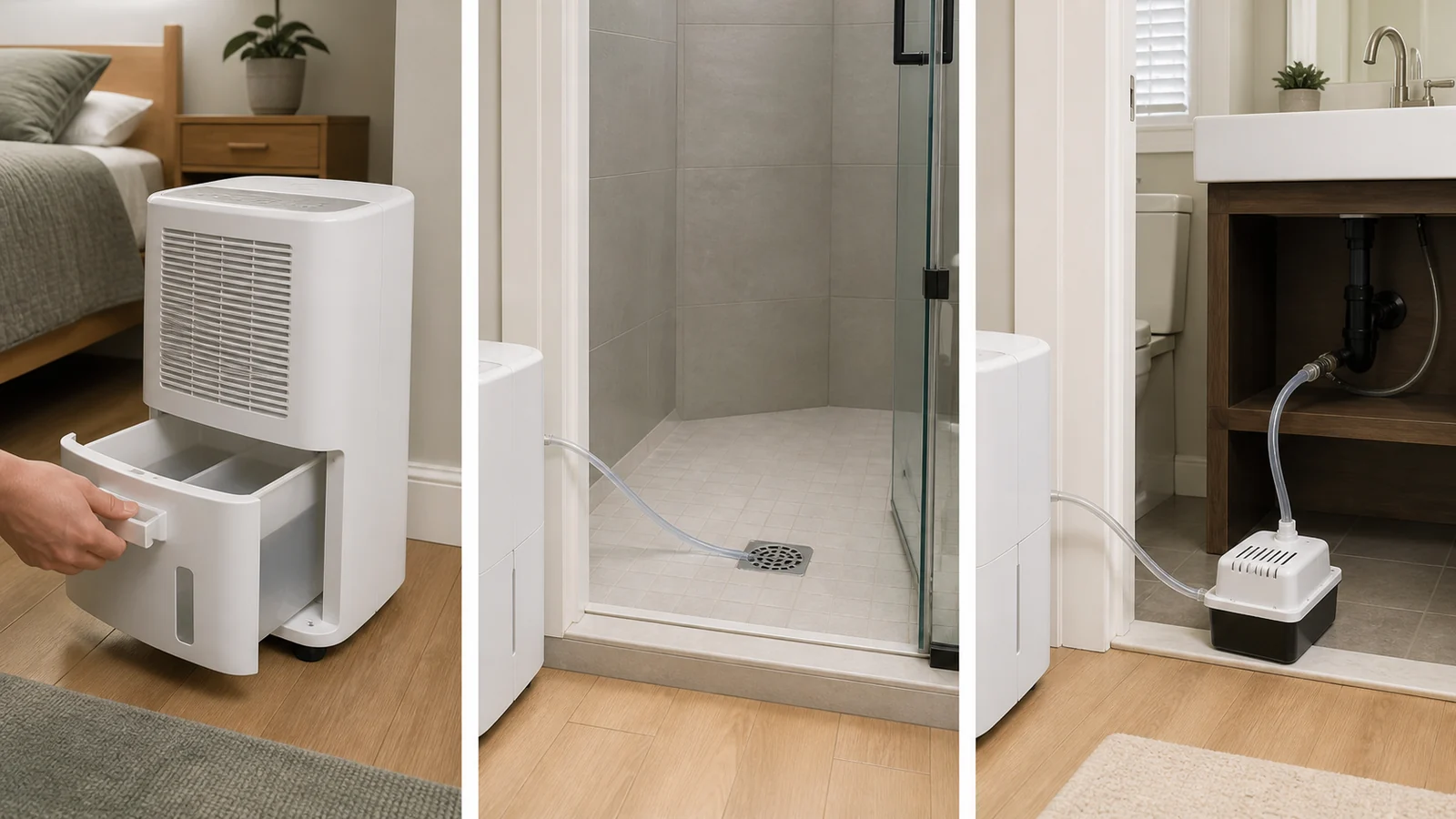
Editorial illustration; consult the exact appliance manual and housing policy before installation.
Our top picks


As an Amazon Associate we earn from qualifying purchases at no extra cost to you.
Why drainage deserves its own decision
Dehumidifiers turn airborne moisture into liquid water. Even a suitable machine becomes inconvenient or hazardous if the resident cannot empty it safely. Small rooms contain narrow paths, rugs, power strips, electronics, and furniture, leaving little margin for a loose hose or heavy container.
Drainage also affects whether the appliance can operate unattended. Automatic shutoff limits overflow risk from a tank, while continuous systems depend on every connection and downstream drain remaining functional. A “continuous drain” label does not guarantee that a particular room has a safe destination.
Before choosing a method, read the manufacturer’s manual and the residence or lease rules. Do not modify plumbing, drill walls or furniture, run a hose into a corridor, or use an unapproved sink connection.
Option 1: the removable tank
Most portable dehumidifiers include a collection bucket. Water accumulates until a float or sensor stops operation. This is the simplest option because it needs no hose, drain, or pump.
Look for:
- automatic shutoff when the tank is full or incorrectly seated;
- a visible level indicator;
- a secure handle and stable shape;
- a splash-resistant pour path;
- easy access without moving the whole appliance;
- a tank size that the user can carry comfortably.
Do not assume that a larger tank is always better. It reduces emptying frequency but becomes heavier and harder to maneuver. In a dorm, the route to the sink may pass desks, cables, or a roommate’s belongings. A modest tank emptied routinely can be safer.
Test the shutoff only as the manual permits. Never wedge the float, hold down a switch, or continue operation with a missing tank. If water appears outside the bucket, unplug from a dry safe location and inspect only user-serviceable parts.
Safe tank handling
Check the tank daily during the first week to learn the actual collection rate. Turn the unit off before removal if the manual instructs it. Carry the container with both hands and keep it level. Use an approved sink or drain and avoid pouring over food-preparation areas.
Condensate is not drinking water. It can contain dust, microorganisms, metals, or residues from internal surfaces. Do not use it for beverages, cooking, pets, humidifiers, or personal care. Plant use is also not automatically safe; follow authoritative local guidance rather than assuming collected water is clean.
Rinse and clean the tank at the interval and with the method specified by the manufacturer. Never mix cleaning chemicals. Reinstall it completely dry where required and confirm that it seats correctly.
Option 2: gravity hose drainage
Some units include a threaded or push-fit outlet that bypasses the tank. Gravity drainage works only when the entire path flows continuously downward from the appliance to an approved drain. Water will not reliably travel uphill, and a shallow sag can trap water and stop flow.
A sound gravity setup needs:
- the correct hose diameter and connector from the manual;
- a tight, supported connection;
- a continuous downward slope;
- no kinks, compression, or loops;
- a drain that cannot back up;
- a hose end secured so it cannot jump out;
- a route protected from feet, chairs, doors, and cleaning equipment.
Many small bedrooms fail one or more of these requirements. A bathroom sink may be higher than the dehumidifier outlet. A hose across the floor is a trip and leak hazard. A shower may be needed by multiple residents and cannot safely hold a permanent loose hose.
Do not drain into a bucket and call it continuous drainage. The machine may keep producing water after the bucket fills, causing an overflow without the tank’s internal shutoff.
Condensate hose details that matter
Use only material and length permitted by the manual. An excessively long or soft hose can kink. The connection should remain visible for inspection rather than hidden behind furniture. Protect it from heat and sharp edges.
Some drain outlets rely on a cap, gasket, or adapter. Store removed pieces so the tank mode can be restored correctly. If a connection seeps, stop the appliance and correct it according to the manual; do not improvise with glue or permanent sealant that could damage the unit.
The destination must accept the flow without creating a sanitation issue or violating plumbing rules. Never insert a hose so deeply into a drain that dirty water can siphon backward. Follow any air-gap or backflow instructions provided by the manufacturer and local authority.
Option 3: a built-in condensate pump
Some dehumidifiers include a pump that can lift water to a higher drain. This can solve an elevation problem, but it adds a reservoir, sensor, tubing, and electrical mechanism. Published lift height and hose limits must come from the exact manual, not a generic product category.
Verify whether the pump stops the dehumidifier when it faults or whether water can back up elsewhere. Learn how the unit signals a blocked hose or full internal reservoir. Keep the discharge tube secured and within the rated vertical and horizontal limits.
A pump may produce intermittent sound that is noticeable at night. It also requires cleaning. Biofilm, dust, mineral deposits, or a pinched tube can reduce reliability. Pump drainage is therefore not “set and forget.”
In a residence hall, written permission is especially important. A hose rising to a sink or bathroom creates routing challenges and may interfere with shared facilities.
Option 4: an external condensate pump
An external pump receives water from a gravity outlet and then pushes it to a higher destination. These systems are common in some mechanical applications, but they may be excessive for a small occupied room. They add another power cord, reservoir, float switch, hose connection, and potential spill location.
The dehumidifier and pump must be compatible, and the pump should have an appropriate safety or overflow strategy. If the pump fails while the dehumidifier continues draining, water can escape. Do not assume that two separate products communicate unless the documentation explicitly describes it.
External pumps also need a stable, accessible location and routine service. They should not sit where bedding, bags, or a chair can disturb them. Because small bedrooms rarely have a protected mechanical area, a removable tank is often more appropriate.
Compare the four options
Tank: fewest components and usually easiest to approve; requires regular carrying and cleaning.
Gravity hose: no pump power and potentially continuous; requires a lower approved drain and a protected downward route.
Built-in pump: can lift water and reduce manual emptying; adds sound, service, and fault-management questions.
External pump: flexible for special installations; adds the most connections, equipment, electrical load, and spill points.
Choose based on the room’s physical path and policy, not convenience claims. The more continuous the drainage system, the more important it is to inspect connections and understand failure behavior.
Dorm and rental restrictions
Residence policies may allow a dehumidifier but prohibit hoses. Continuous drainage can cross common paths, occupy a shared fixture, penetrate screens, or move water somewhere the building did not approve. Ask specifically; general appliance approval may not include plumbing connections.
Do not discharge through a window, into a planter, onto a roof, or into a floor penetration. Do not tape a hose permanently to university fixtures. Never defeat a door closure or fire barrier to reach another room.
Renters outside campus should also obtain permission before modifying fixtures or routing a permanent drain. Building codes and lease terms vary. The appliance manual cannot grant permission to alter the property.
Placement and electrical protection
Set the dehumidifier on a hard, level surface with every intake and exhaust clearance required by the manual. A tilt can interfere with tank sensors or drainage. Do not place the unit on a desk above electronics merely to gain gravity head.
Keep hoses and water away from receptacles, power strips, and cords. Plug into the appropriate wall outlet as directed; do not use an extension cord to reach a pump or appliance. If water reaches electrical equipment, avoid contact and follow emergency procedures from a dry location.
Check the exact model in the CPSC recall database. Dehumidifiers have been recalled for overheating and fire hazards. Recognized certification, undamaged wiring, and current recall status are baseline checks, not optional extras.
How capacity affects drainage frequency
A room with a larger moisture load can fill the same tank faster, but rated daily extraction is measured under specified conditions. Actual collection varies with temperature, RH, fan setting, and compressor cycling. Do not calculate an exact emptying schedule from the advertised pint rating.
Instead, observe the first several days. If the tank fills at inconvenient times, consider whether moisture sources can be reduced before changing drainage. Our guide to reducing dorm humidity addresses showers, wet textiles, windows, and ventilation.
If a correctly placed unit runs constantly or produces far more water than expected, check for leaks or HVAC problems. A continuous hose should not make an abnormal moisture source easier to ignore.
Choose the appliance before the drain accessory
Drainage cannot rescue a poorly selected dehumidifier. Confirm that the machine is permitted, operates at the room’s temperature, has appropriate capacity, and fits with safe clearances. The dorm dehumidifier guide covers those gates, while the small-room technology comparison separates extraction capability from tank convenience.
Then read the manual for the exact drainage modes. Retail listings sometimes use “continuous drain capable” without supplying the necessary hose or explaining required elevation. Verify included parts and dimensions from manufacturer documentation.
A pre-installation checklist
Before using any drain method, answer these questions:
- Is the dehumidifier and drainage method allowed in writing?
- Is the water destination approved and available at all operating times?
- Can the route avoid every walkway, doorway, cord, and electrical device?
- Does gravity slope downward continuously, or is a rated pump required?
- What happens when the tank is full, hose blocks, pump fails, or drain backs up?
- Can every connection be inspected without moving heavy furniture?
- Who will clean the tank, hose, or pump and how often?
- Is there a plan for weekends and holidays?
If any answer is uncertain, use the tank under supervision or pause until housing and the manufacturer clarify it.
Monitor after setup
Inspect the appliance, tank, outlet, and full hose path after the first operating hour and daily at first. Look for seepage, kinks, vibration, discoloration, or a loose discharge end. Confirm that RH improves without forcing the room excessively dry.
Never leave a new continuous system unattended immediately after installation. Campus policy may prohibit unattended operation entirely. Before a long absence, shut down and store the unit as its manual directs rather than assuming the drain will remain reliable.
For most small occupied rooms, simple tank drainage wins because its failure is easier to observe and its shutoff is contained within the appliance. Continuous drainage should be chosen only when the room provides a genuinely safe, approved route—not merely because the product includes a hose port.
Sources
- ENERGY STAR: Dehumidifiers
- U.S. EPA: A Brief Guide to Mold, Moisture and Your Home
- U.S. Department of Energy: Consumer dehumidifiers
- U.S. Consumer Product Safety Commission: Recalls