Key takeaways
- Plan an open shelf around daily access, then add decorative groups using a removal-path worksheet and an illustrative household example.
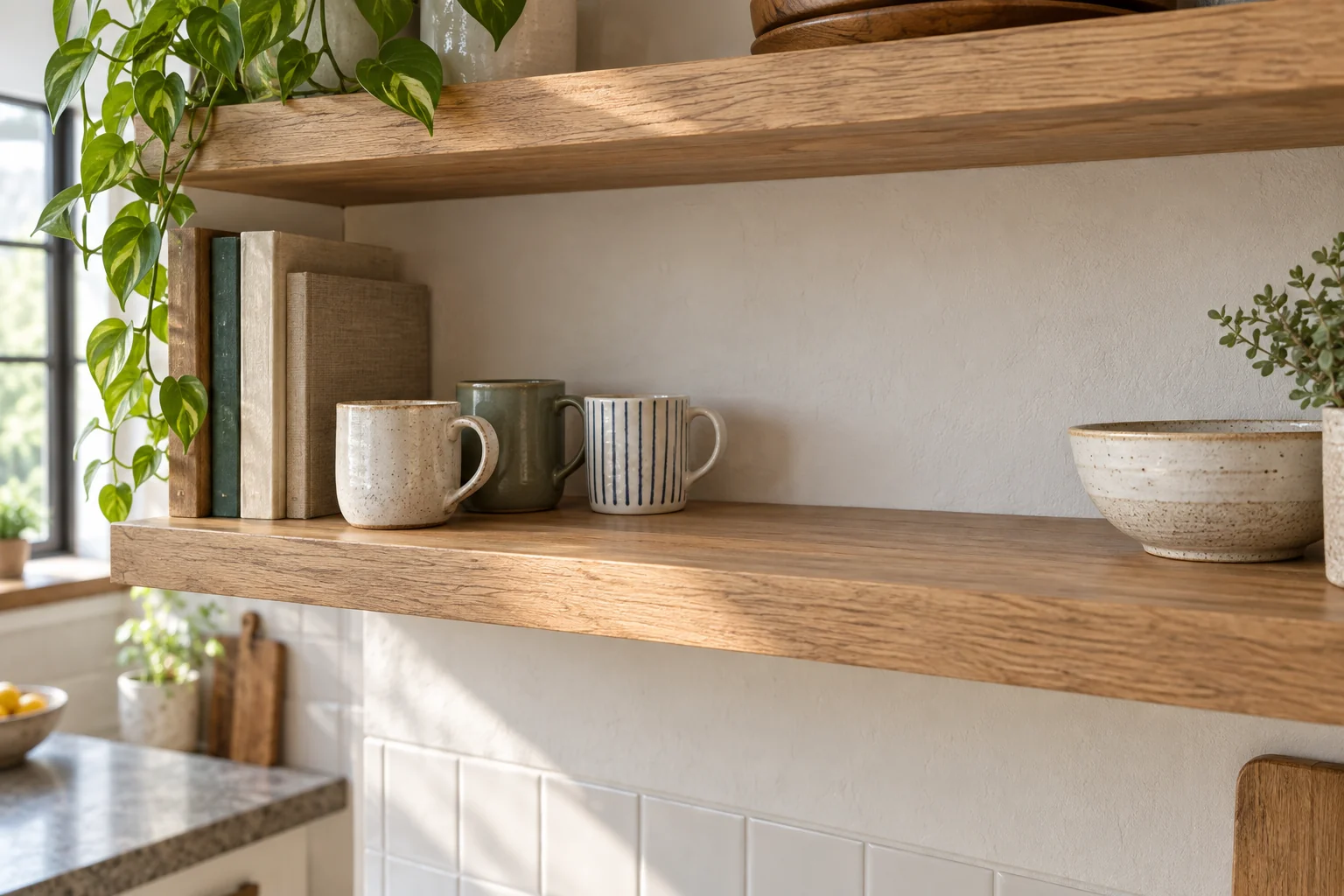
An open shelf works when the objects you use can come out without dismantling the display. Begin with your everyday items, give each an accessible position, then use the remaining space for decoration. There is no required percentage of books, ornaments or empty space: the useful test is whether the arrangement still works on an ordinary morning.
This guide creates an access-first shelf plan. It does not establish a shelf’s weight capacity or replace its assembly instructions. Check the actual unit, shelf supports and anchoring requirements before arranging anything. A decorative arrangement cannot make unsuitable furniture stable.
Start with one ordinary day’s worth of objects
Empty one shelf rather than the entire room. Put its contents on a clear surface and divide them into daily use, occasional use and display only. Be specific: the mug used each morning belongs in the first group; a souvenir mug that stays untouched belongs in the last. Appearance does not determine the category.
For each daily item, write the action it supports: take a cup, return a notebook, reach a charging cable or lift out a recipe book. Include the return movement. An arrangement can look accessible when empty but become awkward when someone must put an object back with one hand.
IKEA describes open shelf units as a way to keep everyday items at hand, while also emphasizing stability and anchoring. Its shelf-unit guidance is a useful reminder to treat display and furniture security as separate decisions. Use the instructions and limits for your own unit, not a photograph of a similar shelf.
Draw access lanes before decorative groups
Make a simple front-view sketch. Mark fixed dividers, shelf heights and items that cannot move. Then draw a small rectangle for each everyday object and a path showing how it leaves the shelf. A bowl may need upward hand space; a book needs room to tilt and slide; a tray needs a clear route straight forward.
These paths are practical observations, not standardized clearances. Try the movement with the actual object and an empty shelf first. If the object catches a frame above it or brushes another object, change the arrangement. Do not rely on being able to turn an item sideways every time it is used.
Keep frequently used objects within a comfortable reach for the people using them. Avoid placing something useful high up merely to complete a visual pattern. If children use the shelf, include their ordinary reach and the unit’s safety instructions in the plan; decorative balance is not a reason to encourage climbing.
Use a shelf-access worksheet
| Object | Frequency | Removal movement | What must stay clear? | Proposed home |
|---|---|---|---|---|
| Morning mug | Daily | Grasp handle and lift | Space around handle and above rim | Front of a suitable shelf |
| Recipe notebook | Several times weekly | Slide forward | Its full forward path | Beside books, without an ornament in front |
| Decorative bowl | Display | Lift for cleaning | A deliberate cleaning route | Remaining area after daily objects |
| Your object | Record actual use | Try its normal movement | Note any collision | Choose after the trial |
Photograph the empty shelf and the proposed arrangement. The photograph makes it easier to notice overlapping silhouettes, but the removal trial remains the deciding check. A picture cannot show whether your hand fits behind a handle.
Add visual structure without adding obstacles
Choose one element already present to repeat: a wood tone, a ceramic color or the outline of your book spines. Repetition lets practical objects contribute to the display. It can also reduce the temptation to buy unrelated ornaments solely to fill gaps.
Place a display-only object behind a daily item only if it does not block removal, hide a necessary label or create an unstable stack. Better still, put the display group beside the access lane. Leave a visible patch of shelf between groups when that makes their purposes easier to read.
Do not stack a daily-use item beneath a permanent display. A handsome bowl on top of the household notebook turns every note into a rearranging task. Similarly, avoid storing small loose pieces in an opaque decorative box unless the box has a clear purpose and everyone using it knows what belongs inside.
Worked example: a shelf that serves breakfast and paperwork
In this illustrative household, a shelf holds four daily mugs, two notebooks, three rarely opened books and two ornaments. Initially the ornaments stand in front of the notebooks, and the mugs sit behind the books. The arrangement looks full but requires moving several objects before breakfast.
The revised sketch groups mugs at the front of one accessible section, places notebooks upright with unobstructed forward paths, and moves the occasional books beside them. One ornament remains in a separate display area; the second moves elsewhere. No claim is made about how much weight this shelf can support: that check comes from its own instructions.
The household tries taking and returning each daily object. One mug handle still catches its neighbor, so the mugs are rearranged rather than squeezed into a symmetrical row. The useful outcome is fewer objects moved during each task, not a prescribed styling ratio.
Review after real use
Leave the arrangement through several normal routines. Note objects repeatedly left on the counter, items returned to the wrong place and decorations moved aside. Those are clues that the plan needs adjustment. Check the shelf again after adding a large object or changing who uses it.
Keep the final worksheet with a quick photograph. When clutter returns, restore the access lanes first and decide what still deserves display space. An open shelf is successful when its useful contents remain easy to find, lift and return.