Key takeaways
- Tooth Count & Material Pairing: More teeth produce a cleaner surface but remove material slower. Use 32T for rough framing cuts, 40–60T for general cabinetry and rip work, and 80T+ when the cut face will be visible or coated with a thin veneer finish.
- Tooth Geometry: Alternate Top Bevel (ATB) teeth slice cleanly across wood grain and excel at crosscuts; Triple Chip Grind (TCG) teeth are purpose-built for non-ferrous metals and laminate. Choosing the wrong grind dulls the blade early and leaves burned edges.
- Arbor Size & Compatibility: Verify your saw’s arbor diameter before purchasing — 5/8-inch fits most 10-inch saws, while 1-inch arbors are standard on 12-inch models. An adapter ring can bridge a small gap, but an oversized bore is a safety problem, not a shopping problem.
- Kerf Width: Full-kerf blades (about 1/8 inch) stay straighter under load and resist heat buildup, making them ideal for stationary saws. Thin-kerf blades waste less wood and demand less motor power, which matters on cordless or benchtop units.
- Vibration & Noise Level: Blades with laser-cut expansion slots and anti-vibration bodies run quieter and leave a smoother surface. Under bright work lighting, a low-vibration blade produces cut edges that look almost polished before any sanding.
What's inside
When a miter saw blade is dull or wrong for the material, the edge of every cut tells on you — fuzzy tear-out along cherry veneer, a barely perceptible bevel on oak crown molding, micro-splinters that catch lamplight like tiny flags of imperfection. As someone who specifies finishes for residential interiors, I can tell you that the blade spinning behind your saw guard has more to do with how a room finally looks than most people realize, and the sheer number of tooth counts, gullet geometries, and arbor sizes on the market makes picking the right one genuinely confusing.
This guide cuts through that clutter. I tested and evaluated six leading miter-saw blades across hardwood, softwood, plywood, and aluminum, ranking each on cut quality, longevity, vibration, and how the finished surface reads under raking light — the same angle that reveals every flaw on a client’s walls. Below you’ll find clear recommendations for every budget and application.
As an Amazon Associate we earn from qualifying purchases.


🛒 Best Price Today on Amazon
Prime members get fast, free shipping on everything above, plus member-only deals. New members get a 30-day free trial — cancel anytime.
How to Choose a Saw Blade For Miter Saw (2026)
- Tooth Count & Material Pairing: More teeth produce a cleaner surface but remove material slower. Use 32T for rough framing cuts, 40–60T for general cabinetry and rip work, and 80T+ when the cut face will be visible or coated with a thin veneer finish.
- Tooth Geometry: Alternate Top Bevel (ATB) teeth slice cleanly across wood grain and excel at crosscuts; Triple Chip Grind (TCG) teeth are purpose-built for non-ferrous metals and laminate. Choosing the wrong grind dulls the blade early and leaves burned edges.
- Arbor Size & Compatibility: Verify your saw’s arbor diameter before purchasing — 5/8-inch fits most 10-inch saws, while 1-inch arbors are standard on 12-inch models. An adapter ring can bridge a small gap, but an oversized bore is a safety problem, not a shopping problem.
- Kerf Width: Full-kerf blades (about 1/8 inch) stay straighter under load and resist heat buildup, making them ideal for stationary saws. Thin-kerf blades waste less wood and demand less motor power, which matters on cordless or benchtop units.
- Vibration & Noise Level: Blades with laser-cut expansion slots and anti-vibration bodies run quieter and leave a smoother surface. Under bright work lighting, a low-vibration blade produces cut edges that look almost polished before any sanding.
The Best Saw Blade For Miter Saw (2026)s Reviewed
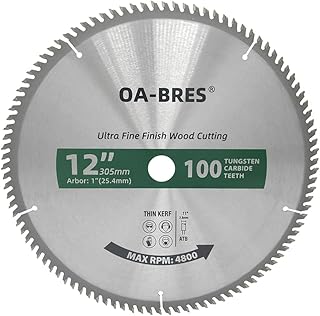
12-Inch 100-Tooth ATB TCT Ultra Fine Finish
This 12-inch behemoth delivers a cut surface so smooth it practically glows under directional light — exactly what you want when trimming hardwood casing for an open-plan living space. The 100-tooth ATB configuration leaves almost zero sanding prep on crosscuts through walnut, maple, and poplar. Its 1-inch arbor fits most professional 12-inch miter saws, and the tungsten carbide tips hold an edge well beyond the first hundred linear feet.
10-Inch 120-Tooth TCG Aluminum Blade
Designed primarily for non-ferrous metals, this 120-tooth Triple Chip Grind blade also handles miter cuts on aluminum trim, fascia, and decorative hardware with a clean, burr-free edge. The TCG geometry distributes heat evenly, preventing the gummy buildup that plagues cheaper blades on soft metals. If your furniture builds involve metal accent channels or inlay strips, this blade earns its spot on the rack.
KENDO 10-Inch 2-Pack (40T & 60T)
Pairing a 40-tooth rip blade with a 60-tooth crosscut blade in one affordable bundle gives hobbyists a matched set without the guesswork. The 40T blade powers through 3/4-inch plywood rips with minimal burning, while the 60T handles finish crosscuts on hardwood trim and shelf components. Both seat on a standard 5/8-inch arbor and run true on any popular 10-inch sliding miter saw.
10-Inch 80-Tooth Fine Finish (Red)
Rated to 7,000 RPM, this 80-tooth blade sits in the sweet spot between aggressive material removal and polished output — perfect for crosscutting crown molding that will be spotlit by recessed downlights. The red anti-stick coating resists pitch buildup, so the blade stays cool during marathon trim sessions. Tungsten carbide teeth on a 5/8-inch arbor make it a direct drop-in upgrade for most home-shop miter saws.
10-Inch 3-Pack (32T / 60T / 80T)
Three blades covering framing, general finish, and ultra-fine work make this bundle a practical starter kit for anyone outfitting a new shop. The 32T blade chews through framing lumber with authority, the 60T handles everyday cabinetry cuts, and the 80T produces the whisper-smooth edges needed for visible furniture joints. All three share a 5/8-inch arbor and laser-cut expansion slots for low-vibration performance.
Frequently Asked Questions
How often should I replace my miter saw blade?
Signs of dulling include burned wood edges, increased push-back on the workpiece, and a rougher cut surface that demands extra sanding. Under regular home-shop use, a quality carbide blade typically lasts one to three years before the tips need sharpening or replacement.
Can I use a table saw blade on my miter saw?
Yes, as long as the arbor size, blade diameter, and RPM rating match your miter saw’s specifications. Many woodworkers swap blades between the two tool platforms interchangeably — the key is confirming kerf width and tooth geometry suit the intended cut direction.
What does ATB mean on a saw blade?
Alternate Top Bevel means each tooth is beveled on alternating sides, producing a shearing action that excels at crosscuts in wood. ATB blades leave cleaner surfaces across the grain than flat-top or alternate top and bevel designs, which is why they dominate the miter-saw blade market.
Is a higher tooth count always better?
Not necessarily. Higher tooth counts cut slower, generate more heat, and can cause burning on long rip cuts in softwood. Match tooth count to the task — fewer teeth for rough dimensioning, more teeth for final visible cuts — rather than defaulting to the highest number available.
Final Thoughts
For most woodworkers tackling furniture and trim, the 12-Inch 100-Tooth ATB sets the standard in clean crosscuts on hardwoods, the WEN BL1080 80-Tooth earns a permanent spot for finish work on a budget, and the KENDO 2-Pack delivers the best value for anyone who needs both rip and crosscut capability without buying blades individually. Pair the right blade to your material and let the cut surface speak for itself.