Most chandelier disappointments happen before the box is opened. A fixture gets chosen from a single glamour shot, arrives, goes up, and then the room reads wrong: the piece floats too high to feel intentional, or the glare hits eye level at the dining table, or the finish that looked warm brass online turns yellow-green under the home’s existing bulbs. The fixture isn’t the problem. The relationship between its scale, its light output, and the room’s other light sources is.
This guide approaches chandeliers the way a lighting designer would specify them: as the anchor layer in a room, not the only layer. Below you’ll find six fixtures that cover the range most homes actually need, from a three-tier crystal statement for a stairwell to a compact five-bulb piece for a kitchen island, plus the sizing and dimming logic that determines whether any of them will look right once installed.
Our top picks


 Black Chandelier
- Black Farmhouse Chandelier: Embracing a rustic and industrial…
- No Assembly & Easy Installation: The lamp arm…
- Bulb Requirement: This candle chandelier features 6 E12…
As an Amazon Associate we earn from qualifying purchases at no extra cost to you.
🛒 Best Price Today on Amazon
Prime members get fast, free shipping on everything above, plus member-only deals. New members get a 30-day free trial — cancel anytime.
How to Choose a/an Chandelier (2026)
- Diameter before style: Add your room’s length and width in feet, and use that number in inches as your target diameter. A 14×16 room lands near 30 inches. Over a dining table, ignore the room and size to the table instead: aim for roughly half to two-thirds the table’s width.
- Hanging height with intent: Leave 30 to 36 inches between tabletop and the fixture’s lowest point. In open rooms, keep at least seven feet of clear headroom. For stairwells and double-height foyers, hang so the fixture reads well from both floors, and confirm the included downrods or chain actually reach that far before ordering.
- Beam behavior, not just brightness: Crystal fixtures scatter and refract light, throwing sparkle onto ceilings and walls. Glass shades and shaded arms direct it downward with softer edges. Exposed bulbs give you shape and glow but little usable task light, so pair them with recessed cans or sconces.
- Bulb temperature discipline: Pick one Kelvin value for the whole room and hold to it. Warm 2700K for dining and bedrooms, 3000K for entryways and kitchens. Multi-bulb chandeliers punish inconsistency, and mismatched bulbs are visible from across a room.
- Dimming and rated load: A 12-to-31-light fixture is unusable at full output most evenings. Confirm the fixture is dimmable, verify your dimmer is LED-compatible, and check the maximum wattage per socket. Also weigh the fixture against your junction box rating; anything heavy needs a brace or a fan-rated box.
The Best Chandelier (2026)s Reviewed
Gold Crystal 12-Light Empire Chandelier, 22″
The empire silhouette does something a linear fixture cannot: it draws the eye upward and gives a foyer or dining room a defined vertical center. At 22 inches, this is the right pick for rooms in the 10×12 range where a 30-inch fixture would crowd the space, and the adjustable height makes it workable under both eight- and ten-foot ceilings.
37″ Extra Large 14-Light Gold Chandelier
Tiered smoke glass on brass is a quieter kind of drama. The tinted globes cut glare that clear glass would let through, and the diffused amber tone flatters wood tables and warm plaster walls. Reserve this one for genuinely large rooms; at 37 inches it needs breathing room on all sides to read as designed rather than as oversized.
31-Light Chrome Three-Tier Empire Crystal Chandelier, 32″
This is a stairwell and double-height foyer fixture, full stop. The chrome finish keeps the refraction cool and crisp rather than golden, and the three-tier build gives the piece presence from two floors at once. Plan for a braced box and put it on a dimmer, because 31 sockets at full output is more light than any entry needs.
Antique Gold 12-Light Three-Tier Raindrop Chandelier, 31″
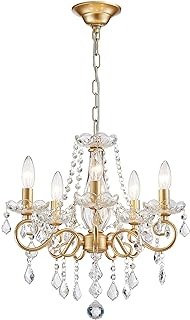
The raindrop crystal reads more contemporary than a traditional cut-crystal basket, and the antique gold finish sits comfortably alongside both warm woods and matte black hardware. It’s the most versatile large-format crystal option here for a dining room that isn’t committed to a single period.
Black 6-Light Farmhouse Chandelier
A matte black frame with exposed bulbs works as a graphic element, holding its shape against light walls without adding visual weight. No-assembly-required shipping is a real advantage on a fixture you may be installing solo, and six bulbs on a dimmer covers a standard dining room comfortably.
Frequently Asked Questions
How high should a chandelier hang over a dining table?
Thirty to 36 inches from tabletop to the fixture’s lowest point. Go lower if the table is narrow or the room has low ceilings, higher only if the fixture is small enough that raising it won’t make it disappear.
Do I need an electrician?
For a straightforward swap on an existing box at a reachable height, many people handle it themselves with the power off at the breaker. Bring in an electrician for high ceilings, stairwell installations, heavy fixtures needing a brace, or any box you’re not certain is rated for the weight.
Is crystal too formal for a modern home?
Not anymore. Raindrop and cascade crystal in gold or chrome reads contemporary, especially with clean furniture and minimal molding. Formality comes from the frame shape and the surrounding trim more than from the crystal itself.
Can a chandelier work in a bedroom or over a kitchen island?
Yes, with restraint on scale. A 16-to-17-inch mini crystal fixture suits an island or a bedroom without dominating, and it should be dimmable so the room can drop to a low glow in the evening.
Final Thoughts
For most dining rooms, the antique gold 12-light raindrop at 31 inches offers the best balance of scale, sparkle, and style flexibility. If you’re filling a double-height foyer or stairwell, the 31-light chrome three-tier is the only fixture here with enough vertical presence to hold that volume. And for kitchen islands, small bedrooms, or a modest entry, the ANJIADENGSHI mini crystal chandelier delivers the same refracted glow at a scale those spaces can actually carry.