Key takeaways
- Airflow vs. Room Size: A compact powder room can get away with 50–80 CFM, but a full bath with a shower demands 110 CFM or higher to clear steam before it colonizes your grout lines and ceiling paint.
- Noise Floor: Anything under 1.0 sones is genuinely imperceptible during a hot shower. Models at 1.5 sones produce a soft hum that most people won’t notice, but if silence is non-negotiable, chase the lowest number on the spec sheet.
- Color Temperature Flexibility: Tunable CCT — especially 3CCT or 5CCT options — lets you match the light to your tile palette and vanity lighting. A 5000K daylight tone reads clinical; 3000K warmth flatters skin tones and softens hard surfaces.
- Installation Constraints: Not every bathroom has accessible attic space above the ceiling. Units designed for no-attic or rear-access installation save you from tearing into drywall or hiring a contractor for what should be a weekend project.
- Smart Sensors and Certifications: Built-in humidity sensors automate ventilation and prevent mold creep, while ETL, FCC, HVI, and Energy Star certifications confirm the unit meets baseline safety and efficiency standards — don’t skip these checks.
What's inside
Shopping for a bathroom ceiling fan with light can feel like navigating a maze of conflicting specs and vague marketing claims. Between airflow ratings, sone levels, color temperature options, and smart humidity sensors, it’s easy to end up with a unit that either howls like a wind tunnel or casts a sickly yellow glow over your morning routine. The wrong choice doesn’t just underperform — it actively undermines the comfort and design of the room.
As someone who thinks about light quality for a living, I approach bathroom ventilation fans differently than most buyers. Beyond cubic feet per minute and noise thresholds, I look at how a fan-light combo shapes the way a bathroom actually feels at 6 a.m. and 11 p.m. This guide distills six standout models through both a performance and ambience lens, helping you find a unit that ventilates efficiently while making your space look and feel right.
As an Amazon Associate we earn from qualifying purchases at no extra cost to you. Product prices and availability are accurate as of the date shown and are subject to change.


🛒 Best Price Today on Amazon
Prime members get fast, free shipping on everything above, plus member-only deals. New members get a 30-day free trial — cancel anytime.
How to Choose a Bathroom Ceiling Fan With Light (2026)
- Airflow vs. Room Size: A compact powder room can get away with 50–80 CFM, but a full bath with a shower demands 110 CFM or higher to clear steam before it colonizes your grout lines and ceiling paint.
- Noise Floor: Anything under 1.0 sones is genuinely imperceptible during a hot shower. Models at 1.5 sones produce a soft hum that most people won’t notice, but if silence is non-negotiable, chase the lowest number on the spec sheet.
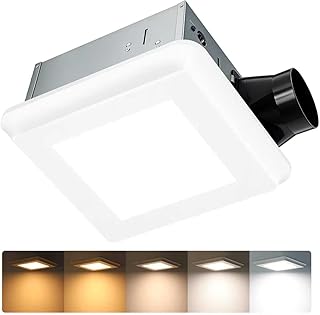
- Color Temperature Flexibility: Tunable CCT — especially 3CCT or 5CCT options — lets you match the light to your tile palette and vanity lighting. A 5000K daylight tone reads clinical; 3000K warmth flatters skin tones and softens hard surfaces.
- Installation Constraints: Not every bathroom has accessible attic space above the ceiling. Units designed for no-attic or rear-access installation save you from tearing into drywall or hiring a contractor for what should be a weekend project.
- Smart Sensors and Certifications: Built-in humidity sensors automate ventilation and prevent mold creep, while ETL, FCC, HVI, and Energy Star certifications confirm the unit meets baseline safety and efficiency standards — don’t skip these checks.
The Best Bathroom Ceiling Fans With Light (2026) Reviewed
Panasonic WhisperFit FV-0511VFL1
Panasonic has earned a near-legendary reputation among contractors for a reason. The WhisperFit delivers selectable 50/80/110 CFM airflow with a dimmable LED module in a low-profile housing that tucks neatly into standard ceiling cavities. If you want a proven, whisper-quiet workhorse that designers consistently specify for residential projects, this is the benchmark.
Fitop 130 CFM Exhaust Fan with Light
Pushing 130 CFM at just 1.5 sones while consuming only 47 watts, this Fitop model punches well above its weight class. The 1100-lumen output fills a full-size bathroom without that washed-out fluorescent feel, and the no-attic installation design is a genuine time-saver for renovations where ceiling access is limited.
AUPU Bathroom Exhaust Fan with 3CCT LED & Humidity Sensor
The AUPU stands out for combining three-color tunable LED lighting with a responsive humidity sensor at a notably quiet 0.8 sones. The retractactable bracket system simplifies mounting, and Energy Star certification confirms it sips power responsibly. For buyers who want the sensor-driven “set it and forget it” experience, this is a strong contender.
Bathroom Exhaust Fan with Humidity Sensor (130 CFM, 5CCT)
This unit’s five-position CCT switch is a lighting designer’s dream — you can dial in everything from warm 2700K relaxation tones to crisp 6500K task lighting from a single fixture. Paired with 130 CFM, a 1.0-sone noise floor, and integrated humidity sensing, it’s a feature-rich package that covers virtually every bathroom scenario.
Fitop 110 CFM Exhaust Fan with Light
Slightly more modest than its 130 CFM sibling, this Fitop model still delivers 1200 lumens at a razor-thin 1.0 sones and just 43 watts. It’s the ideal pick for standard-sized bathrooms where you want strong light output and barely-there noise without overspending on capacity you don’t actually need.
Frequently Asked Questions
What CFM rating do I actually need for my bathroom?
Match the CFM to your bathroom’s square footage as a baseline — roughly 1 CFM per square foot. A 50-square-foot half bath needs about 50 CFM; a 100-square-foot master bath with a shower should target 110 CFM or higher to handle the moisture load effectively.
How quiet should a bathroom fan be?
At under 1.0 sone, you’ll barely notice the fan is running, even in a quiet house at night. Anything between 1.0 and 1.5 sones produces a gentle background hum that won’t compete with conversation or music, but 0.8-sone models like the AUPU are remarkably close to silent.
Do I need a humidity sensor, or is a manual switch enough?
A manual switch works fine if you’re disciplined about leaving the fan running 20–30 minutes after a shower. A humidity sensor automates this process, powering the fan on when moisture rises and off when conditions normalize — genuinely valuable if anyone in your household routinely forgets.
Can I install these fans without attic access?
Several models — including both Fitop units — are specifically engineered for no-attic installation using a rear-access or telescoping bracket. If your bathroom ceiling has no crawlspace above it, prioritize these designs to avoid expensive structural work.
Final Thoughts
For most buyers, the Panasonic WhisperFit remains the gold standard of reliability and whisper-quiet operation. If cutting-edge lighting flexibility matters most, the Bathroom Exhaust Fan with Humidity Sensor’s 5CCT system offers unmatched ambience control. And for the best overall balance of silence, smart sensing, and efficiency, the AUPU with its 0.8-sone rating deserves a hard look. Any of these three will elevate your bathroom from purely functional to genuinely comfortable.