Key takeaways
- Color Temperature (Kelvin): Stick to 2700K for living and dining spaces — it reproduces the amber warmth of vintage incandescent light that makes skin tones and wood grain look natural. Pushing above 3000K in a chandelier context reads cold and institutional.
- Color Rendering Index (CRI): A CRI above 90 reveals true fabric colors and paint shades under the fixture. Below 80, everything shifts slightly grey-green, which is especially noticeable on dinner tables and artwork nearby.
- Dimming Compatibility: Not all LED candelabra bulbs play nicely with every dimmer switch. Prioritize bulbs specifically labeled dimmable and, if possible, tested with leading-edge (trailing-edge) dimmers for the smoothest low-end fade without flicker.
- Bulb Shape and Glass Clarity: B10 and B11 candle shapes suit traditional crystal chandeliers, while CA10 flame-tip designs add a decorative pointed silhouette in transitional fixtures. Clear glass showcases LED filaments; frosted glass diffuses more evenly but hides the vintage filament look.
- Lumen Output vs. Wattage: A 4-watt LED delivering 450–460 lumens is plenty for ambient chandelier lighting; step up to 600 lumens only when the fixture is the primary light source in a large room rather than accent or mood lighting.
What's inside
Choosing the right chandelier bulb is one of those deceptively simple decisions that either elevates a room or quietly undermines it. The wrong color temperature turns a dining nook clinical; the wrong dimming curve kills the mood the moment you reach for the switch. Most shoppers grab the cheapest pack and hope for the best — and then wonder why their brand-new chandelier looks like a hospital corridor.
This guide distills what a lighting designer actually considers when selecting candelabra bulbs: color rendering, dimming behavior, filament aesthetics, and whether the glass shape complements or clashes with the fixture. Below you’ll find the strongest E12 chandelier bulbs available in 2026, broken down so you can match the right bulb to the right room without second-guessing.
As an Amazon Associate we earn from qualifying purchases at no extra cost to you. Product prices and availability are accurate as of the date shown and are subject to change.



🛒 Best Price Today on Amazon
Prime members get fast, free shipping on everything above, plus member-only deals. New members get a 30-day free trial — cancel anytime.
How to Choose a Light Bulb For Chandelier (2026)
- Color Temperature (Kelvin): Stick to 2700K for living and dining spaces — it reproduces the amber warmth of vintage incandescent light that makes skin tones and wood grain look natural. Pushing above 3000K in a chandelier context reads cold and institutional.
- Color Rendering Index (CRI): A CRI above 90 reveals true fabric colors and paint shades under the fixture. Below 80, everything shifts slightly grey-green, which is especially noticeable on dinner tables and artwork nearby.
- Dimming Compatibility: Not all LED candelabra bulbs play nicely with every dimmer switch. Prioritize bulbs specifically labeled dimmable and, if possible, tested with leading-edge (trailing-edge) dimmers for the smoothest low-end fade without flicker.
- Bulb Shape and Glass Clarity: B10 and B11 candle shapes suit traditional crystal chandeliers, while CA10 flame-tip designs add a decorative pointed silhouette in transitional fixtures. Clear glass showcases LED filaments; frosted glass diffuses more evenly but hides the vintage filament look.
- Lumen Output vs. Wattage: A 4-watt LED delivering 450–460 lumens is plenty for ambient chandelier lighting; step up to 600 lumens only when the fixture is the primary light source in a large room rather than accent or mood lighting.
The Best Light Bulbs For Chandelier (2026) Reviewed
60W Candelabra Incandescent B10 Clear (12-Pack)
This traditional 60W incandescent remains the gold standard for dimming smoothness — no staircase effect, no hum, just a seamless slide from full brightness down to a faint amber glow. The clear B10 glass is perfectly proportioned for classic crystal chandeliers, and at 600 lumens per bulb it doubles as genuine task lighting when the fixture sits over a dining table. The trade-off, predictably, is energy consumption and heat.
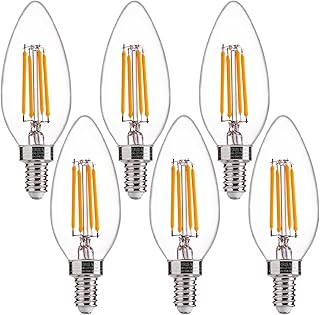
60W Equivalent LED Chandelier B11 Filament (6-Pack)
These LED filament B11s replicate the visual appeal of vintage carbon-filament bulbs while sipping a fraction of the electricity. The visible filament strands emit a soft 2700K glow that photographs beautifully and looks intentional in open-cage or exposed-fixture designs. They’re a strong pick when aesthetic presence matters as much as performance — just note the six-pack may require multiple purchases for larger chandeliers.
E12 Candelabra LED Flame Tip 4W (12-Pack)
At 460 lumens from just 4 watts, these flame-tip candles balance efficiency with genuine warmth. The tapered glass tip extends the visual line of a chandelier arm upward, which subtly makes a fixture appear taller and more elegant. They’re a reliable mid-range choice for rooms where the chandelier is decorative rather than the primary light source.
Hizashi 90+ CRI LED CA10 Flame Tip (12-Pack)
This is the designer’s pick for rooms where color fidelity matters — a dining room with a linen tablecloth, a powder room with carefully chosen paint. The 90+ CRI rating means fabrics, food, and faces look richly accurate under this light rather than subtly washed out. UL listed for peace of mind, and the flame-tip CA10 silhouette feels refined without being fussy.
MEQIQTEK 60W Incandescent B10 Clear (12-Pack)
Slightly warmer than most competitors at 2500K, these incandescents cast a deeper amber tone that flatters rooms with warm-toned furnishings — think terracotta, walnut, or brass-heavy fixtures. The 600-lumen output is generous, and like all true incandescents, they dim down to practically nothing without stepping or flickering. An excellent choice when you want the chandelier to feel like candlelight.
Frequently Asked Questions
How many lumens do I need per chandelier bulb?
For ambient mood lighting in a dining or living room, 400–500 lumens per bulb is the sweet spot — enough to feel inviting without overpowering the room. If the chandelier is the only overhead light in a large space, aim for 600 lumens or pair it with supplementary lamps.
Are LED chandelier bulbs dimmable like incandescent?
Quality LED candelabra bulbs now dim very smoothly, but they require a compatible LED-rated dimmer switch. Older TRIAC dimmers designed purely for incandescent loads can cause LED flicker or a limited dimming range. Replacing the dimmer with a modern LED-compatible model solves most issues.
Does bulb color temperature really matter that much?
Absolutely — it’s the single biggest factor in how a room feels. At 2700K, a space reads warm and intimate; jump to 3000K and the same room feels noticeably cooler and more alert. For chandeliers specifically, 2700K almost always produces the most flattering environment.
What does CRI mean, and should I care?
CRI measures how accurately a light source renders colors compared to natural daylight. A CRI above 90 makes reds richer, whites truer, and skin tones healthier. In a chandelier context, higher CRI is most visible in dining rooms and foyers where you want surfaces and people to look their best.
Final Thoughts
For the best all-around balance of warmth, dimming performance, and visual appeal, the Hizashi 90+ CRI LED stands out as the top recommendation — its color rendering genuinely makes a difference in rooms where atmosphere counts. If you prioritize buttery-smooth dimming and don’t mind the energy trade-off, the MEQIQTEK 60W incandescent delivers unmatched warmth at 2500K. And for a straightforward, efficient workhorse that suits most chandeliers without fuss, the E12 Flame Tip 4W 12-pack covers the most ground for the least money.