Key takeaways
- Color temperature range: Look for 3CCT switching (roughly 3000K / 4000K / 5000K) so one fixture can run warm for evenings and neutral for daytime tasks. If the fan is fixed at a single temperature, make sure that temperature suits the room’s primary use — 3000K or lower for bedrooms and lounges, cooler only for kitchens and workspaces.
- Dimming behavior: A light that stops at 20% is not a dimmer. Check that the fixture dims deeply and smoothly, and confirm whether dimming happens via remote, app, or a wall dimmer, since most integrated LED fan lights will not work on a standard triac dimmer.
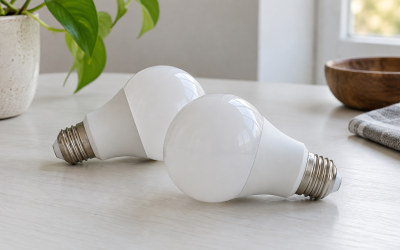
- Diffusion and glare: Frosted or opal glass spreads light across the ceiling plane and hides the LED array. Bare acrylic panels and exposed diodes create hot spots you will notice every time you lie down and look up.
- Span and mounting: Match blade diameter to the room — 42 inches for bedrooms and nooks under about 150 sq ft, 52 inches for living and dining spaces. On ceilings at or below 8 feet, a low-profile flush mount keeps both blades and light out of sightlines.
- Motor and noise: DC motors run quieter, draw less power, and usually offer six speeds plus reverse for winter air mixing. Silence matters more than you think in a bedroom, where the fixture is running while you sleep.
What's inside
A ceiling fan with a light asks one fixture to do two unrelated jobs: move air and set the mood of the room. Most shoppers size the blades correctly, then discover they have installed a small floodlight in the middle of the ceiling — one flat, bluish wash that flattens texture, throws hard shadows across the bed, and refuses to soften after dark. The airflow is fine. The room, at 9pm, feels like a waiting area.
This guide looks at the current crop of indoor fan-light combos the way a lighting designer would: what color temperatures are available, how gracefully the dimming curve drops toward the low end, whether the diffuser actually diffuses, and how the fixture behaves as part of a layered scheme rather than the only source in the room. Airflow, motor noise, and mounting height are covered too, because a beautiful glow is worthless if the thing hums.
As an Amazon Associate we earn from qualifying purchases at no extra cost to you. Product prices and availability are accurate as of the date shown and are subject to change.


🛒 Best Price Today on Amazon
Prime members get fast, free shipping on everything above, plus member-only deals. New members get a 30-day free trial — cancel anytime.
How to Choose an Indoor Ceiling Fan With Light (2026)
- Color temperature range: Look for 3CCT switching (roughly 3000K / 4000K / 5000K) so one fixture can run warm for evenings and neutral for daytime tasks. If the fan is fixed at a single temperature, make sure that temperature suits the room’s primary use — 3000K or lower for bedrooms and lounges, cooler only for kitchens and workspaces.
- Dimming behavior: A light that stops at 20% is not a dimmer. Check that the fixture dims deeply and smoothly, and confirm whether dimming happens via remote, app, or a wall dimmer, since most integrated LED fan lights will not work on a standard triac dimmer.
- Diffusion and glare: Frosted or opal glass spreads light across the ceiling plane and hides the LED array. Bare acrylic panels and exposed diodes create hot spots you will notice every time you lie down and look up.
- Span and mounting: Match blade diameter to the room — 42 inches for bedrooms and nooks under about 150 sq ft, 52 inches for living and dining spaces. On ceilings at or below 8 feet, a low-profile flush mount keeps both blades and light out of sightlines.
- Motor and noise: DC motors run quieter, draw less power, and usually offer six speeds plus reverse for winter air mixing. Silence matters more than you think in a bedroom, where the fixture is running while you sleep.
The Best Indoor Ceiling Fans With Light (2026) Reviewed
52″ Modern DC Ceiling Fan with 3CCT and Remote
This is the most complete lighting package here: three selectable color temperatures, real dimming range, and a noiseless DC motor with reversible operation. In a living room it can sit at a warm low glow for evenings and step up to neutral white when you need the space to work.
Westinghouse Comet, Matte Black
The frosted glass bowl is the reason to buy this one — it renders a soft, even ambient wash with almost no visible glare, and the LED is dimmable for evening levels. Matte black with reversible blades keeps the styling quiet enough to disappear into a contemporary ceiling.
Hunter Builder 42″ Low Profile, New Bronze
A dependable flush-mount five-blade fan for 8-foot ceilings and smaller rooms, with pull-chain control and no remote to lose. Choose it when you want warm, unfussy general light in a bedroom or kitchen; the 52-inch Hunter Swanson in fresh white is the same philosophy scaled up for a larger living room.
Depuley 42″ Modern Flush Mount, Black
A genuinely small-room solution: low profile, dimmable, six speeds, a timer, and reversible black blades that read as graphic rather than heavy. The remote dimming is the differentiator at this size, letting a compact bedroom drop to a soft night level instead of full output or nothing.
OJX 52″ Fan with App and Remote Control
App control plus 3CCT and dimming turns this into a schedulable light source — warm and low in the morning, neutral through the afternoon, without touching a switch. The quiet DC motor and reversible blades make it a sensible year-round fixture for open-plan spaces.
Frequently Asked Questions
What color temperature should I choose for a bedroom?
3000K or warmer. Cooler light suppresses the wind-down cues you want in the hour before sleep, so if your fan offers 3CCT, leave it on the warmest setting and reserve 4000K for cleaning or task moments.
Can I dim an integrated LED fan light with my wall switch?
Usually not. Most integrated fan LEDs dim only through their own remote or app, and wiring them to a standard dimmer can cause flicker or buzzing. Check the manual before assuming wall control.
Is a remote worth it over a pull chain?
If you want dimming or scheduled changes, yes — pull chains generally offer on/off only. For a hallway, kitchen, or guest room where the light runs at full output anyway, a pull chain is one less thing to replace.
Will the blades cause the light to flicker?
Not with a downward-facing diffused fixture, since the light sits below the blade plane. Flicker complaints almost always trace back to the LED driver or an incompatible dimmer, not the fan itself.
Final Thoughts
For a main living space where the fan doubles as the room’s ambient layer, the 52-inch Modern DC fan with 3CCT gives you the widest tonal range for the money, and the OJX 52-inch adds scheduling if you like automation. If glare is your priority, the Westinghouse Comet’s frosted glass produces the softest, most forgiving light of the group — and the Hunter Builder 42-inch remains the safe, quiet choice for a low bedroom ceiling.