Key takeaways
- Color temperature: Aim for adjustable 3000K–5000K. Warm-only light hides blue and purple undertones in concealer; cool-only light exaggerates redness and makes you overcorrect. The ability to preview your face in both warm restaurant light and cool daylight before you leave the house is the single most useful feature on this list.
- Placement geometry: Light should arrive from the sides of your face at roughly eye height, or wrap the mirror perimeter. Anything mounted only along the top edge will reproduce the overhead shadow problem you are trying to escape.
- Diffusion and glare: Bare high-output LEDs create hot spots and squinting. Look for frosted diffusers, matte bulb finishes, or strips with a milky channel. Your pupils should stay relaxed — constricted pupils change how you perceive contrast.
- Dimming range: Full brightness is for detail work like liner and lash placement. A low setting matters for checking overall balance and for evening use. Verify the dimmer reaches genuinely low output, not just 60 percent.
- Mounting and power: Adhesive strips need a clean, non-textured surface and a plan for cable routing to a USB port or outlet. Freestanding lit mirrors skip installation entirely, which is the right call for renters and anyone who rearranges furniture.
What's inside
Most vanity setups fail for the same reason: the light lives above the mirror instead of beside it. Overhead ceiling fixtures rake down across the brow ridge and nose, carving shadows into the exact places where foundation blending matters most. The result is makeup that reads flawless at the mirror and patchy the moment you step into daylight, because you were never actually seeing your face — you were seeing a topography map of it.
Good vanity lighting is a front-and-side proposition with a neutral color temperature and enough diffusion to soften edges without flattening dimension. This guide breaks down the two workable approaches — bulb-style Hollywood strips that frame a mirror you already own, and all-in-one lit mirrors that solve placement for you — plus what color temperature range, brightness, and mounting method actually deliver in a real bedroom or bathroom.
As an Amazon Associate we earn from qualifying purchases at no extra cost to you. Product prices and availability are accurate as of the date shown and are subject to change.


🛒 Best Price Today on Amazon
Prime members get fast, free shipping on everything above, plus member-only deals. New members get a 30-day free trial — cancel anytime.
How to Choose a Light For Makeup Vanity (2026)
- Color temperature: Aim for adjustable 3000K–5000K. Warm-only light hides blue and purple undertones in concealer; cool-only light exaggerates redness and makes you overcorrect. The ability to preview your face in both warm restaurant light and cool daylight before you leave the house is the single most useful feature on this list.
- Placement geometry: Light should arrive from the sides of your face at roughly eye height, or wrap the mirror perimeter. Anything mounted only along the top edge will reproduce the overhead shadow problem you are trying to escape.
- Diffusion and glare: Bare high-output LEDs create hot spots and squinting. Look for frosted diffusers, matte bulb finishes, or strips with a milky channel. Your pupils should stay relaxed — constricted pupils change how you perceive contrast.
- Dimming range: Full brightness is for detail work like liner and lash placement. A low setting matters for checking overall balance and for evening use. Verify the dimmer reaches genuinely low output, not just 60 percent.
- Mounting and power: Adhesive strips need a clean, non-textured surface and a plan for cable routing to a USB port or outlet. Freestanding lit mirrors skip installation entirely, which is the right call for renters and anyone who rearranges furniture.
The Best Light For Makeup Vanity (2026)s Reviewed
Hollywood Style 10ft Ultra Bright White LED Strip
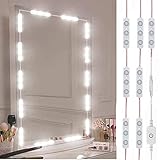
Ten feet of continuous ultra-bright white output gives you enough length to run both vertical sides and the top of a standard vanity mirror, which is exactly the wrap you want. The touch dimmer is responsive and the fixed white tone is clean and neutral — a straightforward pick if you prefer one reliable color over toggling modes.
Consciot LED Vanity Lights, 10 Dimmable Bulbs
This is the closest thing to a true theatrical dressing-room bar at a fraction of the cost, and the individual bulbs produce the soft, overlapping pools of light that make blending genuinely easy to judge. Adjustable color and brightness plus simple USB power make it the most versatile choice here for anyone who does detailed work.
3-Mode Ultra Bright Vanity Light Strip
Three color temperature modes with independent dimming let you preview your face under warm, neutral, and daylight conditions in seconds — the workflow that prevents foundation mismatches. The low-profile strip disappears against a mirror frame, making it a good fit for setups where you want the light without the visible hardware.
ViLSOM 13ft Vanity Mirror Lights Kit
At 13 feet and 240 LEDs, this kit has the headroom to handle oversized or trifold mirrors that shorter strips leave dark at the corners. The included power supply and inline dimmer feel more substantial than typical USB-only setups, which matters if the strip is running a long circuit.
Vanity Mirror with 10X Magnification
The detachable 10X magnifier is the standout feature, handling brow shaping and lash work that a standard mirror simply cannot support. Three lighting modes, touch control, and 360-degree rotation let you angle the light source rather than repositioning your whole head.
Frequently Asked Questions
What color temperature is best for applying makeup?
Neutral white around 4000K is the most reliable single setting, closely matching indoor daylight. If your fixture offers modes, apply under neutral and then check the result under both warm and cool to confirm your look holds across environments.
Will LED strips damage my mirror or wall paint?
Adhesive strips generally release cleanly from glass. Painted drywall is riskier — warm the adhesive with a hair dryer and peel slowly at a shallow angle. On delicate or freshly painted surfaces, mount to the mirror frame instead.
How bright does vanity lighting need to be?
Enough to see clearly without squinting, which for most vanities means a fixture that can push bright but usually sits at 50 to 70 percent. Brightness beyond that point stops helping and starts causing you to overapply product in response to washed-out contrast.
Should I choose a lit mirror or a light strip?
Choose a lit mirror if you rent, travel, or want zero installation. Choose a strip if you already have a mirror you like and want a larger illuminated area with better side coverage.
Final Thoughts
For most people, the Consciot Hollywood-style bulb bar delivers the best combination of flattering diffusion, adjustable color, and easy USB setup. If you have a large or trifold mirror, the ViLSOM 13ft kit has the length and power supply to light it properly, while the FENNIO 17”x13” lit mirror is the cleanest no-installation option for renters and smaller spaces.