Key takeaways
- Reserve room for drinks, remotes and reading before arranging coffee table decor, using a task map and a worked tray-size example.
What's inside
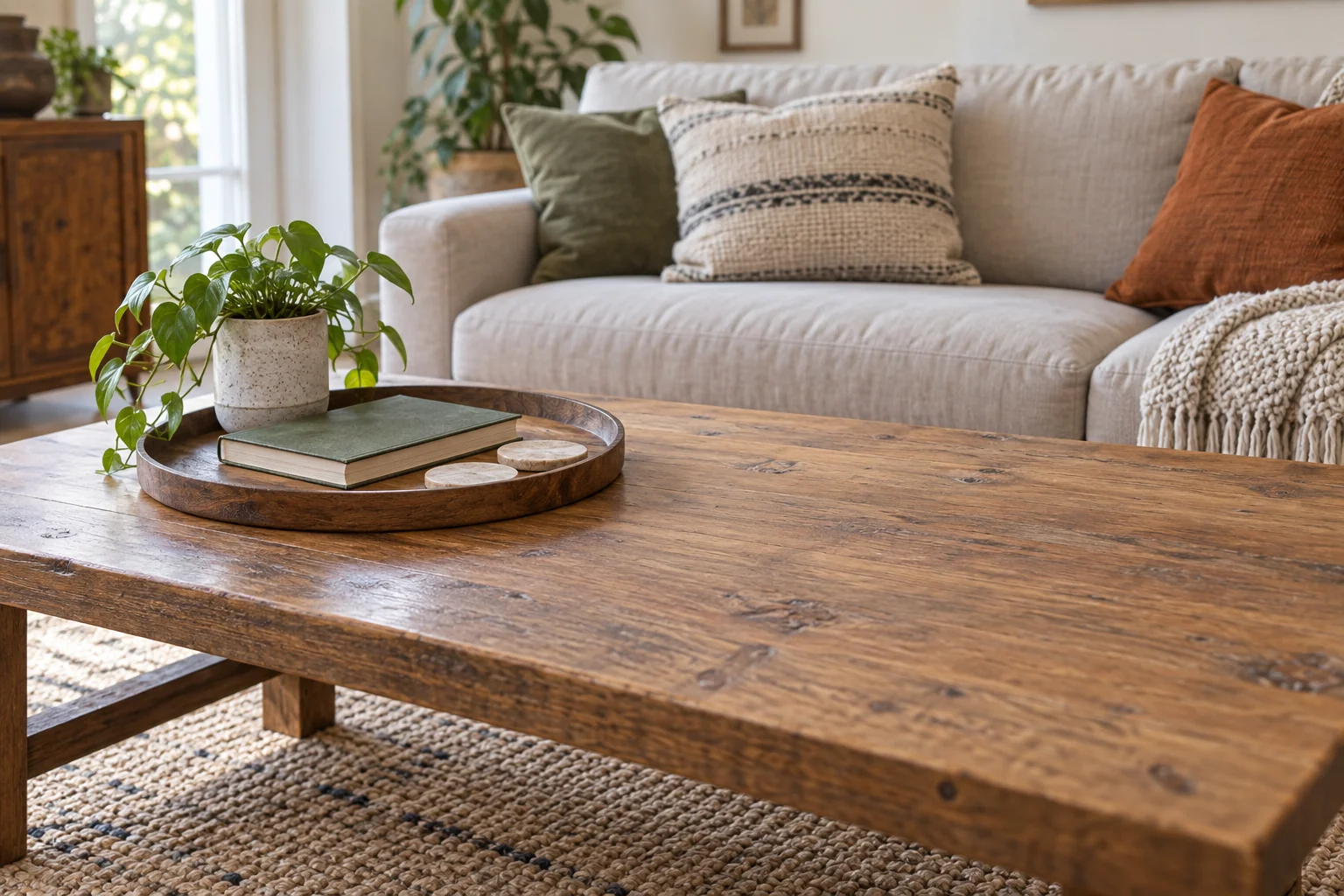
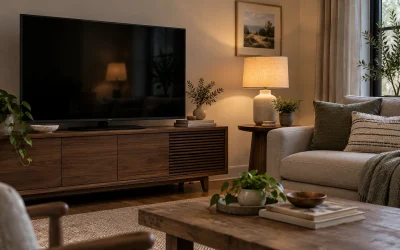
Edit a coffee table display by reserving space for what people actually put down, then placing decoration in the remaining area. Test the arrangement from every regular seat. A tabletop can look spacious from above while a vase or tray blocks the only convenient place to set a cup.
Begin with your existing table and objects. The goal is a display that survives an ordinary evening without a pile of displaced decorations on the sofa. You do not need a fixed number of books, a prescribed tray shape or a new collection of accessories.
Record the table’s daily jobs
Clear the surface temporarily and list its normal uses: two drinks, remote controls, an open book, a snack plate or an occasional board game. Ask the other people who use the room. Include where they sit and which hand they naturally use to reach the table.
Separate frequent uses from occasional ones. A game played once a month can justify a removable display; a cup used every evening deserves a permanent place. If the table has a lifting top, drawer or removable lid, include the movement needed to open it. Decorations that fit only while everything remains closed are not yet a working arrangement.
Check the table’s care instructions before adding trays, pads or plants. A tray does not automatically protect the finish from moisture or scratches. Use surface protection compatible with the table, and do not attach layout tape to a delicate finish just to mark a planning grid.
Build a task-first surface map
Place your actual coasters, a closed remote and an empty snack plate in the positions you want to use. Sit down and reach for them without leaning around a tall object. For an occasional reading area, open the actual book rather than estimating from its closed dimensions.
Sketch these positions on paper. Treat them as working spaces, not gaps that should eventually be filled. Note which area can move easily for a visitor and which is needed every evening. The remaining patch is the starting point for decoration.
| Table job | Position to reserve | What may obstruct it | Adjustment |
|---|---|---|---|
| Drink from left seat | Reachable coaster position | Tray handle or leaning stems | Move or reduce display |
| Drink from right seat | Separate coaster position | Book stack at the edge | Reduce the stack footprint |
| Remote controls | Visible retrieval spot | Deep decorative bowl | Use a shallow accessible location |
| Reading or game | Open working area | Several loose ornaments | Make one removable group |
| Drawer or lifting top | Full opening movement | Overhanging accessories | Keep the movement area clear |
Choose one display anchor
Crate & Barrel’s coffee-table styling guide includes a single displayed book as a restrained option and describes storage beneath the surface for everyday items. Use these as possibilities, then adapt them to your surface map. The examples do not establish a mandatory number of decorative pieces.
Try one low tray, one book or one small object as the anchor. Add a second piece only if it has a clear place and does not consume a reserved task area. Inspect the arrangement from the doorway and the seats; a display that looks balanced from one direction can hide the remote from another.
If you use a tray, distinguish a decorative tray from one intended to carry loaded items. Check its handling instructions and condition. When clearing the table, remove fragile objects separately unless the tray is suitable for carrying them. An attractive handle is not evidence of a particular load capacity.
Worked example: the area that looks free is not always usable
Consider an illustrative rectangular table measuring 100 by 60 centimeters. A 40 by 30 centimeter tray occupies 1,200 square centimeters of the 6,000 square centimeter surface: 20 percent. That figure alone cannot tell you whether the arrangement works.
Placed centrally, the tray leaves 15 centimeters in front and behind it. A reader’s book opens to a 42 by 28 centimeter footprint, so the shallow front strip cannot hold it. Moving the tray to one side may create a continuous reading patch, while removing the tray entirely may be better when two people want snacks.
Try both arrangements with the real objects. Leave drinks empty during the layout check. The calculation helps identify a constraint; it does not prove that a certain occupied percentage is ideal for all tables. Curved tables and overhanging tray handles need their own physical check.
Give displaced items a destination
A removable display needs somewhere to go. Choose a nearby shelf or cabinet surface before declaring the table ready for games. That destination must fit the items without blocking another household task. Moving clutter from the table onto a dining chair simply postpones the problem.
Use the arrangement through a normal evening and note what gets moved. If the same ornament is repeatedly relocated, remove it from the daily display. If papers continually land beside the tray, decide whether they need a separate inbox rather than a larger tray.
Finish with a short reset list: return remotes, remove used dishes, wipe according to the table’s care directions and restore only the objects you chose to keep. Seasonal changes can then replace one accent without rebuilding the whole arrangement or sacrificing the useful spaces.