Most rooms fail on lighting long before they fail on furniture. A single ceiling fixture pushes light straight down into the middle of the floor, leaving counters in shadow, artwork flat, and corners reading as dead space. Buyers notice something is off, buy another floor lamp, and end up with more clutter and the same washed-out ceiling glow. Track lighting solves the actual problem: it lets you aim light where the room needs it, then re-aim it when the room changes.
This guide looks at six track kits worth installing in 2026, judged the way a lighting designer judges them — beam control, color quality, head movement, and how the hardware reads when the lights are off. You will find picks for galley kitchens, gallery walls, studio workspaces, and open-plan rooms where one run of track has to do three jobs at once.
Our top picks

 LED 4 Light Track Lighting Kit
- Concise Design: The Unicozin led track lights has…
- Flexible Adjustable Heads: You can adjust the light…
- Energy Saving: Includes 4 x 4 W GU10…


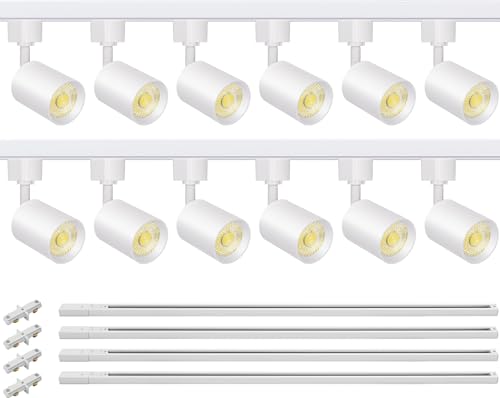 VANoopee 12-Light LED Track Lighting Kit with
12 track heads cover a long 13-foot run in one kit
CRI of 90+ renders colors accurately for display lighting
Backed by a 3-year warranty and 40,000-hour rated lifespan
Installation requires hardwiring rather than a simple plug-in
Full 12-head kit is heavier and bulkier than single fixtures

As an Amazon Associate we earn from qualifying purchases at no extra cost to you.
🛒 Best Price Today on Amazon
Prime members get fast, free shipping on everything above, plus member-only deals. New members get a 30-day free trial — cancel anytime.
How to Choose Track Lighting (2026)
- Count your targets, not your square footage: Decide how many surfaces need a beam — sink, island, cooktop, art wall — and buy one head per target plus one spare. Four heads suit a compact kitchen; eight to twelve suit a long room or a studio.
- Color temperature sets the mood: 2700K–3000K keeps living rooms and bedrooms warm and skin-flattering. 4000K–5000K reads crisp and clinical, which works for prep counters, garages, and craft tables but rarely for lounging.
- Chase CRI, not just lumens: CRI 90+ makes wood grain, paint, and food look like themselves. A bright fixture with poor color rendering will make a beautifully finished room look cheap.
- Check the head’s range of motion: Look for heads that swivel a full circle and tilt steeply. Narrow tilt means you can light the floor or the wall, but not the picture frame between them.
- Decide on bulbs and dimming up front: GU10 sockets let you swap beam angles and warmth later; integrated LEDs are tidier but fixed. If you want evening ambience, confirm the kit is dimmable and matched to your dimmer.
The Best Track Lighting of 2026, Reviewed
VANoopee 12-Light Track Kit with 13FT H Track
Thirteen feet of rail and twelve dimmable 10W heads at 3000K with CRI 90+ is the closest thing here to a proper designed lighting layer. The 24° beam is tight enough to make surfaces glow rather than flood, which is exactly what you want over a long island or a hallway of framed prints.
AUQUEE 8-Light Matte Black Track Fixture
Eight rotatable heads on one matte black bar gives you real zoning ability in a kitchen or hallway without running a second circuit. The finish disappears against dark ceilings and reads intentional against white ones, and leaving the GU10 choice open means you set the warmth yourself.
Bojim 6-Light Gold Track Kit
The acrylic ring on each head softens the edge of the beam, so the fixture avoids the harsh pinpoint look that spoils most spotlight bars. Warm gold hardware belongs in a room where the lighting is part of the decor — a studio, art room, or galley kitchen with brass fittings already in play.
4-Light Dual-Lighting Black Spotlight Kit
Two output modes — 50W plus a 20W setting — let one fixture handle task brightness and evening ambience without a dimmer switch. Bulbs are included and it mounts on wall or ceiling, making it the practical choice for renters and quick refreshes.
LED 4-Light Kit, 24.8″ Black with Bulbs
A tidy 24.8-inch run with four 5000K daylight bulbs already in the box, ready to go the afternoon it arrives. The cool tone is best over work surfaces; if it lands in a living room, swap the GU10s for something around 2700K.
Frequently Asked Questions
Can I install track lighting myself?
If you are replacing an existing ceiling fixture on the same junction box, most homeowners can manage it with the breaker off. New runs, added circuits, or anything involving unfamiliar wiring should go to a licensed electrician.
How far apart should the heads sit?
Roughly two to three feet apart for general coverage, tighter when you are highlighting specific objects. Keep the track about two feet out from the wall when lighting art so beams strike at a flattering angle instead of grazing straight down.
Is track lighting dated?
The 1990s white plastic canister look is dated. Slim matte black and brushed gold bars with small directional heads read as current, and the underlying idea — aimable light — never went out of fashion.
Do I need dimmable heads?
In kitchens and living rooms, yes. Dimming is what turns a task fixture into an ambience fixture after dark. Confirm both the LED and the wall dimmer are rated to work together, or you will get flicker and buzz.
Final Thoughts
For a full lighting plan across a long or open room, the VANoopee 12-Light kit gives you the reach, beam control, and CRI 90+ color quality that make a space look designed rather than merely lit. The AUQUEE 8-Light matte black bar is the smart middle ground for kitchens and hallways, and the Bojim 6-Light gold kit is the one to pick when the fixture itself needs to earn its place on the ceiling.