Key takeaways
- Surface finish over surface color: Matte and lightly textured laminates diffuse light and hide fingerprints. Gloss tops mirror your ceiling fixture straight into your eyeline, which is the single most common cause of “my desk feels harsh” complaints.
- Vertical clearance for a lamp: Tiered desks and monitor shelves eat the space a task lamp needs. Measure from the desktop to the underside of the shelf, and confirm at least 15 inches if you want anything other than a slim clip light.
- Edge thickness and depth: Clamp lamps typically want a lip between 0.5 and 1.5 inches thick with a few inches of clear rear space. Desks with flush back panels or immediate shelving often rule clamps out entirely.
- Tone under your actual bulbs: Oak and warm brown finishes glow under 2700K and can look muddy under 5000K. Whites stay neutral but bounce more light upward, which is either a small-room advantage or a glare source depending on your fixture.
- Placement flexibility: Folding and no-assembly designs let you test two or three orientations against your window before committing. Perpendicular to a window almost always beats facing it or backing it.
What's inside
A small desk is rarely just a furniture problem. Squeeze a work surface into a bedroom corner or a rented studio and you inherit a lighting problem too: the only outlet is behind the bed, the window throws hard glare across the screen from 3pm onward, and the overhead fixture sits directly above your head, painting your keyboard in the shadow of your own shoulders. Most compact desk buyers discover this on day two, after the desk is already assembled.
This guide looks at the best small space computer desks for 2026 through that lens. Alongside the usual concerns of footprint, stability, and storage, I’ve weighed how each surface handles reflected light, whether monitor shelves and hutches steal the room from a lamp, how much edge thickness you get for a clamp light, and how each finish behaves under warm bulbs versus cool daylight. The goal is a desk that still feels good at 9pm, not just one that fits the tape measure.
As an Amazon Associate we earn from qualifying purchases.




🛒 Best Price Today on Amazon
Prime members get fast, free shipping on everything above, plus member-only deals. New members get a 30-day free trial — cancel anytime.
How to Choose a Small Space Computer Desk (2026)
- Surface finish over surface color: Matte and lightly textured laminates diffuse light and hide fingerprints. Gloss tops mirror your ceiling fixture straight into your eyeline, which is the single most common cause of “my desk feels harsh” complaints.
- Vertical clearance for a lamp: Tiered desks and monitor shelves eat the space a task lamp needs. Measure from the desktop to the underside of the shelf, and confirm at least 15 inches if you want anything other than a slim clip light.
- Edge thickness and depth: Clamp lamps typically want a lip between 0.5 and 1.5 inches thick with a few inches of clear rear space. Desks with flush back panels or immediate shelving often rule clamps out entirely.
- Tone under your actual bulbs: Oak and warm brown finishes glow under 2700K and can look muddy under 5000K. Whites stay neutral but bounce more light upward, which is either a small-room advantage or a glare source depending on your fixture.
- Placement flexibility: Folding and no-assembly designs let you test two or three orientations against your window before committing. Perpendicular to a window almost always beats facing it or backing it.
The Best Small Space Computer Desks (2026) Reviewed
Dripex 27.5″ 3-Tier Compact Desk
The three-tier layout is genuinely efficient in a 28-inch footprint, and the black finish is forgiving of stray reflections, but the monitor shelf and lower storage leave little room for a conventional lamp base. Pair it with a slim LED bar mounted under the monitor shelf and it becomes one of the better-lit compact setups here.
GreenForest Folding Desk, No Assembly
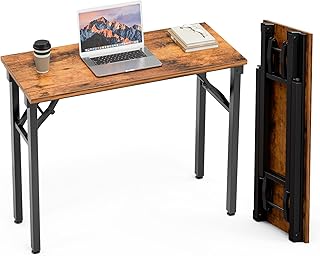
Arriving ready to use and folding flat makes this the easiest desk to reposition while you figure out where the daylight actually falls. The oak finish reads warm and soft under 2700K bulbs, though the open two-tier shelf means cables and lamp cords stay visible.
TEMI 35.8″ Folding Desk
At nearly 36 inches wide with no shelving overhead, this is the most lighting-friendly pick in the roundup: full clearance for a proper task lamp, and enough surface to keep the light source off to one side rather than behind your monitor. The brown top is matte enough to avoid hot spots.
ODK 27.5″ Desk with Storage & Monitor Stand
A tidy, well-built option where the deep brown finish absorbs glare better than most and the monitor stand raises the screen to a sensible height. Like the Dripex, plan for a clip-on or under-shelf light rather than a freestanding lamp.
Lufeiya 40″ White Desk with Drawers
The 40-inch white top is the brightest surface here, which helps in windowless corners but demands a shaded or diffused lamp to avoid bounce. Fabric drawers keep the small stuff out of sight, and the reversible version lets you orient storage away from your light source.
Frequently Asked Questions
Where should I put a small desk relative to a window?
Perpendicular, with the window to your left or right. Facing a window gives you glare behind the screen; backing it puts reflections directly on the display.
Do monitor shelves make lighting harder?
Usually, yes. They block the natural spot for a task lamp and cast a shadow across the keyboard. Under-shelf LED strips solve this cheaply and add no footprint.
Is a folding desk stable enough for daily work?
For a laptop, monitor, and lamp, the no-assembly folding designs here are fine. Avoid mounting heavy clamp arms on any folding frame.
White or wood finish for a small room?
White reflects more light and visually expands tight corners. Wood tones feel warmer at night and hide dust and cable clutter better.
Final Thoughts
If you want the most usable lit workspace, the TEMI 35.8″ folding desk gives you the width and headroom a real task lamp needs. For tight corners where vertical storage matters more, the ODK 27.5″ desk handles glare well, and the Lufeiya 40″ white desk is the pick for dim, windowless spaces that need every bit of bounced light.