Key takeaways
- Thickness matched to your build: Lighter sleepers under 150 lb rarely compress past 2–3 inches, so a thick slab just floats them. Heavier or broad-shouldered sleepers need 4–5 inches before the hip can drop enough to let the spine straighten.
- Contour without collapse: Look for foam that lets the hip and shoulder sink while still pushing back under the lumbar curve. A topper that compresses uniformly leaves the low back unsupported, which is exactly where sciatic irritation begins.
- Heat management: Nerve pain and overheating amplify each other. Gel infusion, ventilation channels, or a viscose bamboo cover all reduce the trapped-warmth effect that dense memory foam is notorious for.
- Anchoring: Deep-pocket skirts or four-way straps matter more than they sound. A topper that migrates overnight creates a ridge under your hip, and you’ll blame your back instead of the bedding.
- Certification and off-gassing: CertiPUR-US and Oeko-Tex marks indicate tested foam content. Expect a mild odor for two to three days regardless — unwrap it in a ventilated room before you build the bed.
What's inside
I spend my working life adjusting how a room feels after sunset — where the light falls, how warm it reads, how quickly a space tells a body it’s allowed to stop. Sciatica taught me the limits of that work. You can dim a bedroom beautifully and still lie awake at 2 a.m. with a hot wire running from your hip to your calf, because the surface underneath you is doing something your nerve disagrees with. A mattress that’s too firm shoves the hip upward and torques the lumbar spine. One that’s too soft lets the pelvis sag until the sciatic nerve gets pinched from a different direction. Either way, the room’s atmosphere is irrelevant; the geometry wins.
A topper is the cheapest way to change that geometry without replacing a mattress. This guide looks at six toppers through the same lens I use for lighting design — layers, transitions, and how a surface behaves at the edges rather than just at the center. Below you’ll find what actually matters for nerve pain, honest notes on where each option fits, and answers to the questions people ask me once they realize their sleep problem isn’t their lamp.
As an Amazon Associate we earn from qualifying purchases.



🛒 Best Price Today on Amazon
Prime members get fast, free shipping on everything above, plus member-only deals. New members get a 30-day free trial — cancel anytime.
How to Choose a Mattress Topper For Sciatica (2026)
- Thickness matched to your build: Lighter sleepers under 150 lb rarely compress past 2–3 inches, so a thick slab just floats them. Heavier or broad-shouldered sleepers need 4–5 inches before the hip can drop enough to let the spine straighten.
- Contour without collapse: Look for foam that lets the hip and shoulder sink while still pushing back under the lumbar curve. A topper that compresses uniformly leaves the low back unsupported, which is exactly where sciatic irritation begins.
- Heat management: Nerve pain and overheating amplify each other. Gel infusion, ventilation channels, or a viscose bamboo cover all reduce the trapped-warmth effect that dense memory foam is notorious for.
- Anchoring: Deep-pocket skirts or four-way straps matter more than they sound. A topper that migrates overnight creates a ridge under your hip, and you’ll blame your back instead of the bedding.
- Certification and off-gassing: CertiPUR-US and Oeko-Tex marks indicate tested foam content. Expect a mild odor for two to three days regardless — unwrap it in a ventilated room before you build the bed.
The Best Mattress Topper For Sciatica (2026)s Reviewed
SHOUREN 5 Inch Memory Foam Topper
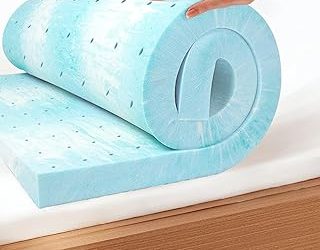
The most substantial option here, and the one I’d point toward if your mattress is genuinely too firm rather than slightly wrong. Five inches of gel memory foam gives the pelvis room to settle into neutral alignment, and the four-way straps keep that alignment from drifting by morning.
Lucid 4 Inch Memory Foam Topper
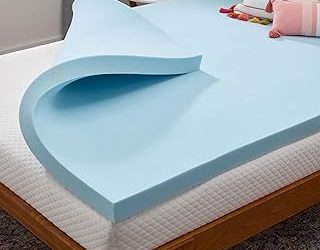
A well-judged middle ground — plush enough to relieve hip pressure, ventilated enough that side sleepers don’t wake up damp. The four-inch profile suits average-to-heavier builds who found three inches disappeared under them.
JSELF 3 Inch Gel Memory Foam Topper
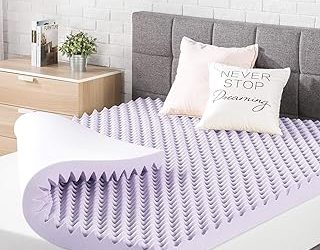
The dual-layer construction is the interesting part: a firmer base holds the lumbar region while the wave-textured top layer diffuses pressure across the glute and hip. Non-slip backing and Bekaert fabric cover make it the most thoughtfully finished three-inch option on this list.
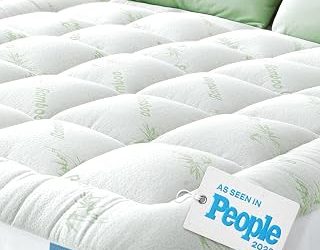
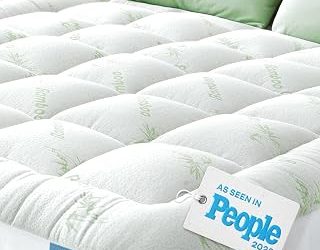
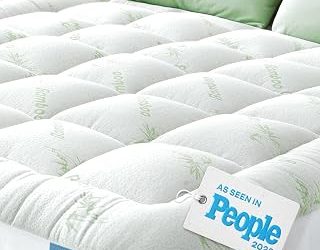
BEDLORE Viscose Bamboo Pillow Top
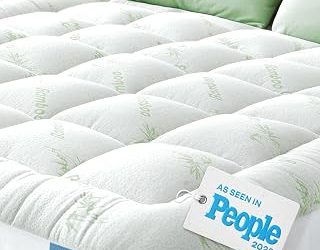
Not foam, and that’s the point. If your mattress supports you correctly but the surface itself feels punishing, this adds cushioning and a genuinely cool bamboo face without altering your spinal alignment. Stretch pockets fit 6″–18″ depths securely.
Linenspa 3 Inch Gel Memory Foam Topper
The value entry, and a sensible starting point if you’re unsure whether a topper will help at all. Gel-infused, CertiPUR certified, and plush enough to test the theory before committing to a thicker build.
Frequently Asked Questions
Is a firm or soft topper better for sciatica?
Neither extreme. You want a surface that yields at the hip and shoulder while resisting under the lower back — medium-firm response with contouring, not uniform softness.
How long before I notice a difference?
Give it two to three weeks. Foam needs a few nights to fully expand, and your body needs longer than that to unlearn a compensating sleep posture.
Will a thick topper make my sheets fit?
A four- or five-inch topper usually requires deep-pocket sheets rated to 18 inches. Measure your total stack before ordering.
Can a topper replace treatment?
No. It removes a nightly aggravator, which is meaningful, but persistent radiating leg pain warrants a clinical assessment.
Final Thoughts
If your mattress is the problem, the SHOUREN 5 Inch gives you the most room to correct alignment. For most sleepers, the JSELF 3 Inch dual-layer strikes the smartest balance between contouring and lumbar support, while the BEDLORE bamboo pillow top is the right call when you need surface comfort rather than structural change.