Key takeaways
- Ceiling clearance: Measure the distance from your floor to the lowest point of the fan. Hugger fans typically sit 8 to 10 inches from the ceiling, which is ideal for rooms with seven- to eight-foot ceilings where every inch of vertical space matters.
- Motor type: DC motors use roughly 70 percent less energy than AC motors and operate at a near-silent hum. If the fan is going into a bedroom or nursery, prioritize a reversible DC motor for year-round airflow direction control and minimal noise.
- Light output and color temperature: A fan that doubles as a light fixture should offer tunable CCT — at minimum a choice between warm white (2700K) and neutral (4000K). Dimmable LED modules let you shift from task lighting to ambient glow without swapping bulbs.
- Blade span and room size: A 52-inch fan comfortably serves rooms up to 225 square feet. For tighter spaces like hallways or kitchens, a 42- to 48-inch model moves adequate air without overwhelming the ceiling plane.
- Control options and smart features: Remote controls are standard, but app-based control lets you adjust speed and lighting schedules from your phone. Look for fans that also include wall-mount remotes if you want a backup to the handheld unit.
What's inside
Most homes with ceilings under eight feet face the same frustrating trade-off: you want airflow and ambient light, but a standard ceiling fan hangs too low and eats into headroom. A hugger ceiling fan solves that by mounting flush against the ceiling, keeping the room open while still moving air effectively. The challenge is that not every flush-mount fan performs equally — blade pitch, motor type, light output, and build quality vary wildly across models.
This guide breaks down the top hugger ceiling fans available in 2026 from a lighting and ambience standpoint: which ones produce genuinely usable illumination, which whisper-quiet DC motors won’t interfere with sleep, and which finishes complement modern interiors without looking like an afterthought. Each pick below was evaluated on light quality, airflow efficiency at low-profile height, noise, and overall design coherence.
As an Amazon Associate we earn from qualifying purchases.




🛒 Best Price Today on Amazon
Prime members get fast, free shipping on everything above, plus member-only deals. New members get a 30-day free trial — cancel anytime.
How to Choose a Hugger Ceiling Fan (2026)
- Ceiling clearance: Measure the distance from your floor to the lowest point of the fan. Hugger fans typically sit 8 to 10 inches from the ceiling, which is ideal for rooms with seven- to eight-foot ceilings where every inch of vertical space matters.
- Motor type: DC motors use roughly 70 percent less energy than AC motors and operate at a near-silent hum. If the fan is going into a bedroom or nursery, prioritize a reversible DC motor for year-round airflow direction control and minimal noise.
- Light output and color temperature: A fan that doubles as a light fixture should offer tunable CCT — at minimum a choice between warm white (2700K) and neutral (4000K). Dimmable LED modules let you shift from task lighting to ambient glow without swapping bulbs.
- Blade span and room size: A 52-inch fan comfortably serves rooms up to 225 square feet. For tighter spaces like hallways or kitchens, a 42- to 48-inch model moves adequate air without overwhelming the ceiling plane.
- Control options and smart features: Remote controls are standard, but app-based control lets you adjust speed and lighting schedules from your phone. Look for fans that also include wall-mount remotes if you want a backup to the handheld unit.
The Best Hugger Ceiling Fan (2026)s Reviewed
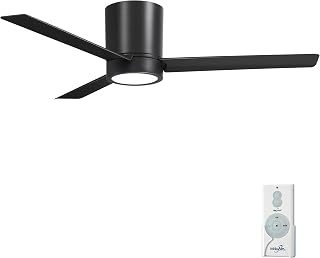
52-Inch Flush Mount DC Motor Fan
This matte-black 52-inch hugger delivers the most complete package for low-ceiling rooms. The three-color CCT dimmable LED produces smooth, flicker-free light across its full range, and the six-speed reversible DC motor runs so quietly you genuinely forget it is on. Its wide 90–264V compatibility makes it a versatile choice for older wiring or varied voltage environments.
Design House Millbridge 52-Inch
Finished in satin nickel with a traditional five-blade steel profile, the Millbridge leans into classic American design while hiding modern internals. The LED light kit casts a warm, even wash suitable for living rooms and dining areas, and its ceiling-mount silhouette keeps the overall depth under ten inches. Best for spaces where you want a fan that looks built-in rather than bolted on.
Minka-Aire Roto Flush 52-Inch
Minka-Aire’s Roto Flush in coal brings genuine architectural presence — its curved blade geometry channels air more aggressively than flat designs, producing noticeably stronger airflow at lower speed settings. The integrated LED module has a clean, diffused quality that avoids the harsh center hotspot common in flush-mount fixtures. An excellent pick when the fan needs to anchor the room’s design language rather than disappear.
52-Inch Black Flush Mount with App Control
The standout feature here is the companion app, which lets you program lighting scenes, set sleep timers, and adjust all six speeds from your phone — a real convenience in rooms without a convenient wall-switch location. The 3CCT dimmable LED covers warm to cool tones, and the low-profile blade design minimizes visual weight against the ceiling. A strong value for bedrooms where remote accessibility matters.
LEDLUX 48-Inch No-Light Flush Mount
Some rooms already have adequate ambient lighting, and the LEDLUX 48-inch is purpose-built for that scenario. Without an integrated light module, the fan sits even closer to the ceiling, preserving maximum clearance. Four reversible blades let you swap between a lighter and darker finish depending on your décor direction, and the six-speed DC motor keeps operations virtually silent. Pair it with recessed cans or pendant lights for a layered lighting design without redundancy.
Frequently Asked Questions
How close can a hugger fan sit to the ceiling?
Most hugger fans mount within 8 to 10 inches of the ceiling surface. This is significantly tighter than standard downrod models, which typically extend 12 inches or more. Always verify the manufacturer’s minimum ceiling clearance requirement before purchasing.
Are DC motors worth the price premium over AC motors?
Yes, especially in bedrooms and living areas. DC motors consume up to 70 percent less energy, run nearly silent at low speeds, and support more speed increments — usually six versus three or four with AC. The payback period on the energy savings is typically under two years.
Can I install a hugger fan on a sloped ceiling?
Most hugger fans are designed for flat ceilings only. Sloped ceilings require either a standard downrod fan or a hugger model with an included adapter kit. Installing a flush-mount fan on an angle without proper hardware risks instability and reduced airflow performance.
Do flush-mount fans push as much air as downrod models?
They move slightly less air because the reduced distance to the ceiling limits the intake space above the blades. For rooms up to 225 square feet, the difference is negligible. For larger rooms, a 52-inch hugger with a strong DC motor will still deliver comfortable circulation at medium and high speeds.
Final Thoughts
For most low-ceiling homes, the 52-Inch Flush Mount DC Motor Fan strikes the best balance of light quality, quiet operation, and price. The Minka-Aire Roto Flush is the design-forward choice when aesthetics carry equal weight. And if your room already has a dedicated lighting plan, the LEDLUX 48-Inch No-Light gives you pure airflow without visual clutter. Match the fan to your ceiling height, preferred color temperature, and how much of the room the fan should define — the right hugger fan quietly transforms a space.