Key takeaways
- Lowest seat height, not the range: Ignore the top number. You want a chair whose bottom setting lets both heels rest flat with knees at or just above hip level — for most users under 5’4″, that means a floor of 16 inches or lower.
- Seat pan depth: Aim for two to three fingers of clearance between the seat edge and the back of your knee. A pan deeper than about 18 inches will press into your calves and quietly pull you forward off the lumbar support.
- Where the lumbar curve actually sits: Support placed for an average torso lands too high on a shorter one. Look for a low-set lumbar bulge or an adjustable pad you can slide down into your natural curve.
- Surface finish and glare behavior: Glossy PU throws a visible highlight under overhead lighting and reads as a bright band in video calls; matte PU and woven mesh diffuse it. If your desk faces a window, matte wins on both comfort and appearance.
- Armrests that get out of the way: Flip-up or height-adjustable arms let you pull a lower chair fully under a standard 29-inch desk instead of parking outside it — the single biggest cause of forward reach and neck strain for shorter users.
What's inside
Most task chairs are built around a phantom occupant: roughly 5’10”, 180 pounds, arms long enough to reach a desk set at standard height. If you’re 5’3″ or under, that default costs you twice. Your feet hover, your thighs take the load the floor should be carrying, and the lumbar pad meant for a lower back lands somewhere between your shoulder blades. There’s a second cost that rarely gets mentioned: seat height decides where your face sits in the room’s light. Drop three inches below the plane a space was lit for and you move out of the soft wash from a window or pendant and into the shadow beneath it — or worse, into the reflected hot spot bouncing off your screen.
I spend my working life deciding where light lands in a room, which means I spend a lot of time thinking about where people’s eyes end up. This guide looks at ergonomic chairs sized for shorter bodies through both lenses: the mechanics of fit — seat height floor, pan depth, lumbar placement, armrest range — and the quieter question of how a chair sits in a room visually, from the sheen of PU leather under a downlight to the visual weight a compact frame carries in a small home office.
As an Amazon Associate we earn from qualifying purchases.



🛒 Best Price Today on Amazon
Prime members get fast, free shipping on everything above, plus member-only deals. New members get a 30-day free trial — cancel anytime.
How to Choose an Ergonomic Office Chair For Short Person (2026)
- Lowest seat height, not the range: Ignore the top number. You want a chair whose bottom setting lets both heels rest flat with knees at or just above hip level — for most users under 5’4″, that means a floor of 16 inches or lower.
- Seat pan depth: Aim for two to three fingers of clearance between the seat edge and the back of your knee. A pan deeper than about 18 inches will press into your calves and quietly pull you forward off the lumbar support.
- Where the lumbar curve actually sits: Support placed for an average torso lands too high on a shorter one. Look for a low-set lumbar bulge or an adjustable pad you can slide down into your natural curve.
- Surface finish and glare behavior: Glossy PU throws a visible highlight under overhead lighting and reads as a bright band in video calls; matte PU and woven mesh diffuse it. If your desk faces a window, matte wins on both comfort and appearance.
- Armrests that get out of the way: Flip-up or height-adjustable arms let you pull a lower chair fully under a standard 29-inch desk instead of parking outside it — the single biggest cause of forward reach and neck strain for shorter users.
The Best Ergonomic Office Chair For Short Person (2026)s Reviewed
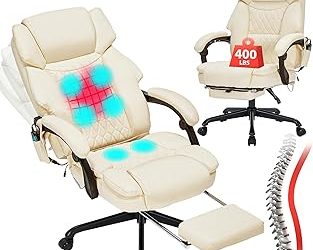
Leather Office Chair with Ergonomic Back Support
A genuinely compact PU chair with a shallow pan and a low seat floor, built for people who’ve spent years perching on the front edge of something too big. The 360° swivel and adjustable armrests are the practical wins here; the modest profile also keeps it from crowding a small room visually.
Upgraded PU Chair with Double-Layer Cushion and Neckrest, Grey
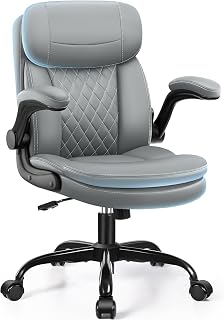
The double-layer cushion is the meaningful upgrade — it resists the flattening that turns budget foam into a hard shelf by month four. The grey finish is less reflective than black PU, which keeps it from catching a specular highlight under a ceiling fixture.
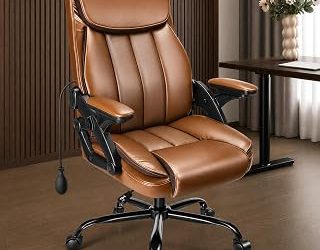
Leather Swivel Chair with Lumbar Support, Brown
A softer, more residential look with padded arms and a low-placed lumbar contour that lands correctly on a shorter torso. The warm brown tone reads well under 2700K lamps, making it a sensible pick for an office that shares space with living areas.
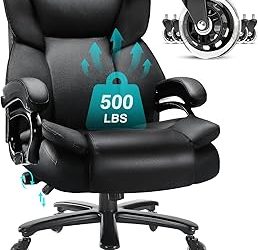
Executive Office Chair with Flip-Up Armrest, Black
The flip-up armrests are the reason to consider this one: raise them and the chair tucks completely under a standard desk, closing the reach gap that plagues shorter users. Firm lumbar support and a straightforward, unfussy silhouette.
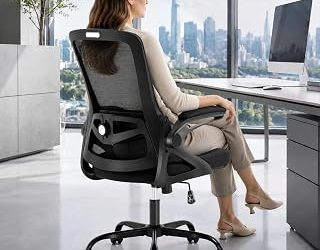
BestOffice Ergonomic Mid-Back Swivel Chair
A lean, low-cost mid-back with a breathable backrest and a genuinely low starting height, making it a strong secondary or guest desk chair. The sponge seat is firm rather than plush — good for posture, less good for eight-hour marathons.
Frequently Asked Questions
What seat height do I need at 5’0″?
Roughly 15 to 16 inches. Measure from floor to the crease behind your knee in shoes you actually wear, then confirm the chair’s minimum height matches that figure rather than its maximum.
Mesh or PU leather for a smaller frame?
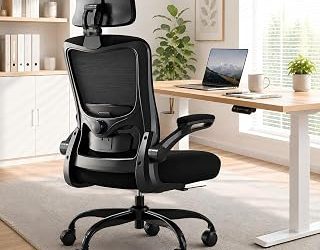
Mesh, like the high-back 330 lb-capacity mesh chair with flip-up armrests, breathes better and diffuses light rather than reflecting it. PU is easier to wipe down and looks more finished in a shared living space.
Do I still need a footrest?
Only if the chair can’t drop low enough on its own. A footrest is a fix for a mismatch — solving it at the seat height is always better, since a footrest locks you into one seated position.
Will a compact chair look undersized in my office?
Rarely. Smaller chairs cast less shadow and block less light, which tends to make a modest room feel more open, not emptier.
Final Thoughts
For most shorter users, the Upgraded PU Chair with Double-Layer Cushion is the best all-round balance of fit, cushion longevity, and low-glare finish. Choose the Executive Chair with Flip-Up Armrest if desk clearance is your main frustration, or the Brown Leather Swivel Chair when the office shares a room with the rest of your life.