Key takeaways
- Hang height and sightlines: Aim for roughly 30 to 34 inches between tabletop and the fixture’s lowest point on an eight-foot ceiling, adding about three inches per additional foot of height. The real test is whether two seated people can look at each other without the fixture in the way — check that before you tighten anything down.
- Scale against the table, not the room: Take your table’s width in inches and subtract about 12; that’s a workable diameter for a round fixture. For rectangular tables, a linear or rectangular chandelier spanning roughly half to two-thirds the table length distributes light far more evenly than a single round drum.
- Light distribution and glare control: Exposed filament bulbs read beautifully and produce hard shadows on faces. Frosted glass, downward-facing shades, or a crystal array that scatters output will soften the beam. If you go with clear glass or bare bulbs, low-wattage warm LEDs at 2700K are non-negotiable.
- Dimming as a design requirement: Full brightness is for homework and cleanup; 30 percent is for dinner. Confirm the fixture accepts dimmable bulbs and that your wall switch is a compatible LED dimmer, or you’ll get flicker and buzz that no amount of styling can fix.
- Installation reality: Check the canopy style, the total weight against your junction box rating, and whether the piece ships assembled. A 10-light crystal fixture with individual hanging strands can consume an entire afternoon; a pre-assembled cage light takes twenty minutes.
What's inside
Most dining rooms fail at the same moment: 7 p.m., when daylight has drained out of the windows and the only thing left overhead is a fixture chosen for its silhouette rather than its output. The table turns into a pool of glare with dim corners, faces flatten under a single harsh source, and the room that looked so composed in an afternoon photo stops working the instant it matters. A chandelier is not jewelry hung from a ceiling. It is the primary light source for the one room in the house where people sit still, look at each other, and stay for two hours.
This guide approaches the category the way a lighting designer would — by asking what the fixture does to the space rather than how it photographs. That means hanging height and its relationship to sightlines, how a shade or crystal array distributes light across a tabletop, the color temperature and dimming behavior that determine whether a meal feels warm or clinical, and the honest tradeoffs between open-bulb industrial pieces and layered crystal designs. Below are six fixtures worth considering in 2026, with notes on where each one genuinely earns its place.
As an Amazon Associate we earn from qualifying purchases.


🛒 Best Price Today on Amazon
Prime members get fast, free shipping on everything above, plus member-only deals. New members get a 30-day free trial — cancel anytime.
How to Choose a Dining Room Chandelier (2026)
- Hang height and sightlines: Aim for roughly 30 to 34 inches between tabletop and the fixture’s lowest point on an eight-foot ceiling, adding about three inches per additional foot of height. The real test is whether two seated people can look at each other without the fixture in the way — check that before you tighten anything down.
- Scale against the table, not the room: Take your table’s width in inches and subtract about 12; that’s a workable diameter for a round fixture. For rectangular tables, a linear or rectangular chandelier spanning roughly half to two-thirds the table length distributes light far more evenly than a single round drum.
- Light distribution and glare control: Exposed filament bulbs read beautifully and produce hard shadows on faces. Frosted glass, downward-facing shades, or a crystal array that scatters output will soften the beam. If you go with clear glass or bare bulbs, low-wattage warm LEDs at 2700K are non-negotiable.
- Dimming as a design requirement: Full brightness is for homework and cleanup; 30 percent is for dinner. Confirm the fixture accepts dimmable bulbs and that your wall switch is a compatible LED dimmer, or you’ll get flicker and buzz that no amount of styling can fix.
- Installation reality: Check the canopy style, the total weight against your junction box rating, and whether the piece ships assembled. A 10-light crystal fixture with individual hanging strands can consume an entire afternoon; a pre-assembled cage light takes twenty minutes.
The Best Dining Room Chandeliers (2026) Reviewed
Siljoy Rectangular Gold Crystal Chandelier
At 35.4 inches with two tiers of K9 raindrop crystal, this is the most convincing choice for a rectangular table — the linear footprint spreads light along the table’s length instead of concentrating it in the center. The 16 E12 sockets give you real control over intensity, and the crystal does exactly what crystal should do: breaks the point source into diffuse sparkle rather than glare.
12-Light Sputnik Chandelier, Gold and Black
The 11-to-52-inch adjustable drop makes this genuinely versatile across ceiling heights, and the mid-century radial arrangement throws light in every direction, which fills a room rather than spotlighting a table. Use warm, low-output bulbs here — twelve exposed lamps at full brightness is a lot of unshielded light at eye level.
10-Light Crystal Chandelier, Black and Gold
Five stacked tiers in a 24-inch diameter create dimensional depth that flat fixtures can’t match, and the flush-mount option makes it one of the few dramatic crystal pieces that works under a low ceiling. The black-and-gold finish keeps it from tipping into formality, so it suits a modern dining room as easily as a traditional one.
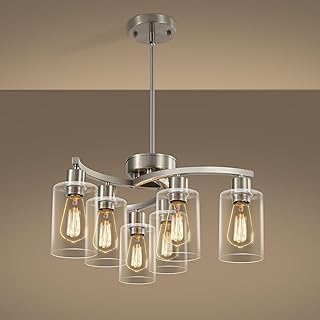
CNRATYE 6-Light Brushed Nickel Chandelier
Six clear glass shades with adjustable height make this a straightforward, well-proportioned workhorse over a standard table or kitchen island. Brushed nickel is the quiet finish choice — it recedes into a room instead of competing with it, which is precisely what you want when the table itself is the focal point.
Black Chandelier, 6-Light Farmhouse
The no-assembly-required construction is a meaningful advantage; this goes up in one session with a screwdriver and no strand-sorting. The matte black cage frame reads as architectural rather than decorative, holding its own in a foyer, hall, or dining room without demanding the whole visual budget.
Frequently Asked Questions
What color temperature should I use in a dining room?
2700K, sometimes 2200K if you want candlelit warmth. Anything at 3000K or above starts pushing the room toward task lighting, which flattens skin tones and makes food look less appetizing. Consistency matters too — mismatched bulbs in a multi-light fixture are immediately visible.
Does the chandelier need to match my other metal finishes?
No, and matching everything usually reads as flat. Two finishes in a room is a deliberate choice; three or more needs a repeating element to tie them together. A black and gold fixture, for instance, gives you a bridge to both warm and cool hardware elsewhere.
Can I install a heavy crystal chandelier myself?
Only after confirming your ceiling box is rated for the fixture’s weight — standard boxes often top out around 50 pounds, and many are not rated for fixture support at all. If the box wasn’t installed for a chandelier, have an electrician add a brace. This is not a corner worth cutting.
Is one chandelier enough light for the room?
Rarely. A chandelier sets the mood over the table but leaves perimeter walls dark, which makes the room feel smaller. Add a dimmable secondary layer — sconces, a buffet lamp, or picture lights — and the space gains depth immediately.
Final Thoughts
For rectangular tables, the Siljoy rectangular crystal chandelier remains the most technically sound choice, distributing light along the full length of the table where people actually sit. The 12-light Sputnik is the better pick if you want a fixture that lights the whole room rather than just the table, and its wide height range makes it forgiving across ceiling types. If installation simplicity ranks high, the 6-light black farmhouse chandelier delivers a confident architectural presence with none of the assembly labor — a fair trade when the goal is a room that works by 7 p.m. tonight.