Key takeaways
- Canopy density: Aim for roughly 60 to 75 percent coverage across the rafters. That range breaks up harsh midday glare while still letting shifting pools of light move across the deck, which is what makes a pergola feel alive rather than enclosed.
- Leaf translucency: Thin, papery leaves glow when backlit at golden hour and respond beautifully to uplighting from below. Thick, waxy foliage reads flat and absorbs light instead of transmitting it, so plan your fixtures accordingly.
- Structural load: Mature woody climbers like wisteria develop trunks that can twist and lift undersized lumber. Confirm your posts are set in concrete and your beams are at least 6×6 before committing to a long-lived heavyweight.
- Fixture compatibility: Twining vines wrap tightly around anything cylindrical, including low-voltage cable. Run wiring inside conduit or along the outer face of the beams, and leave a pruning gap around each fixture head.
- Climate and speed: Match hardiness zones honestly, then decide whether you want coverage this season or a permanent architectural canopy. Tender tropicals deliver fast; hardy perennials deliver for decades.
What's inside
Most pergola projects fail at the same point: the plant gets chosen from a bloom photo, and the light gets ignored. A pergola is essentially a light fixture made of shadow, and the vine you train across it becomes the diffuser. Choose a heavy, overlapping-leaf climber and you get a cool green cave that swallows every lumen by four in the afternoon. Choose something too thin and the beams still throw hard-edged stripes across the table at noon. Neither reads as inviting, and no amount of string lights fixes the underlying problem.
This guide approaches climbing vines the way a lighting designer approaches a room: as a question of density, diffusion, and how a canopy behaves when the sun drops low and the fixtures come on. Below are six proven pergola climbers, from seed packs to rooted starts, evaluated on canopy quality, leaf translucency, structural weight, and how gracefully they share space with wiring and evening light.
As an Amazon Associate we earn from qualifying purchases.




🛒 Best Price Today on Amazon
Prime members get fast, free shipping on everything above, plus member-only deals. New members get a 30-day free trial — cancel anytime.
How to Choose a Climbing Vine For Pergola (2026)
- Canopy density: Aim for roughly 60 to 75 percent coverage across the rafters. That range breaks up harsh midday glare while still letting shifting pools of light move across the deck, which is what makes a pergola feel alive rather than enclosed.
- Leaf translucency: Thin, papery leaves glow when backlit at golden hour and respond beautifully to uplighting from below. Thick, waxy foliage reads flat and absorbs light instead of transmitting it, so plan your fixtures accordingly.
- Structural load: Mature woody climbers like wisteria develop trunks that can twist and lift undersized lumber. Confirm your posts are set in concrete and your beams are at least 6×6 before committing to a long-lived heavyweight.
- Fixture compatibility: Twining vines wrap tightly around anything cylindrical, including low-voltage cable. Run wiring inside conduit or along the outer face of the beams, and leave a pruning gap around each fixture head.
- Climate and speed: Match hardiness zones honestly, then decide whether you want coverage this season or a permanent architectural canopy. Tender tropicals deliver fast; hardy perennials deliver for decades.
The Best Climbing Vine For Pergola (2026)s Reviewed
Boston Ivy Vine Seeds (50 Seeds)
Boston ivy produces the most even, roof-like diffusion of anything on this list, with overlapping palmate leaves that turn a pergola into a genuine shade structure and then flare scarlet in autumn, warming the ambient color temperature underneath. Note that it climbs by adhesive pads rather than tendrils, so it grips masonry and wood directly, which is ideal for pergolas attached to a wall and less ideal if you ever want it off again.
Thunbergia Grandiflora Blue Trumpet Vine (2-Pack)
Sky vine is my pick for anyone who wants a canopy fast without permanent structural commitment, covering substantial overhead area in a single warm season with large heart-shaped leaves. The pale blue trumpets read almost luminous in low evening light, and a single warm uplight positioned at the base makes them float against the darker foliage.
Wisteria Floribunda Live Plants (3-Pack)
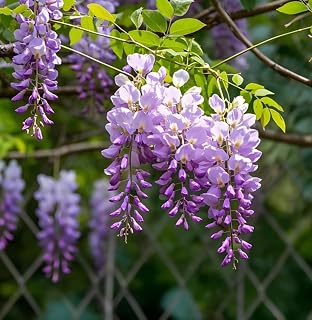
Japanese wisteria is the classic pergola canopy for good reason: the pendant flower racemes hang down through the rafters and catch late sun from behind, which is the single most striking backlighting effect available in a garden. Buy the structure first, though, because a mature specimen exerts real force and needs annual pruning to keep flowering and to stay off your light fixtures.
Mixed Mandevilla Live Plants (3-Pack)
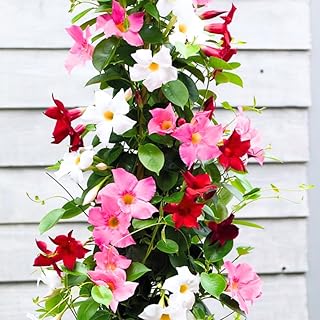
Mandevilla suits container-based pergola planting in zones 9 to 11 or seasonal display anywhere else, climbing a trellis panel to add saturated color at eye level rather than dense overhead shade. The glossy leaves reflect rather than transmit light, so treat this one as an accent lit from the front, not a diffuser.
American Purple Wisteria Live Plant
American wisteria is the better-behaved cousin, less aggressive than Asian species, quicker to bloom from a young plant, and far more manageable on a residential pergola. The lavender clusters are shorter and denser, which suits smaller structures where full-length racemes would crowd the headroom.
Frequently Asked Questions
Which vine gives the best dappled shade?
Boston ivy for consistent, even coverage, and Japanese wisteria for a looser canopy with dramatic gaps. Wisteria in particular leafs out after its bloom, so spring light reaches the space before summer shade arrives.
Can my existing pergola support wisteria?
Only if it is built for it. Look for 6×6 posts in concrete footings and beams of at least 2×8. Retrofitting a lightweight kit pergola with wisteria usually ends in a sagging, twisted frame within five or six years.
Will a vine damage my string lights or wiring?
Twining growth will wrap cable and eventually stress connections. Sleeve low-voltage runs in conduit, mount fixtures on the outer beam faces, and prune a hand-width clearance around every lamp so heat and access stay unobstructed.
What about evening fragrance?
Climbing jasmine is the strongest option here, releasing scent most intensely after dusk, which pairs naturally with a dimmed pergola setting. Its fine evergreen foliage also gives year-round structure in mild climates where deciduous vines leave bare rafters.
Final Thoughts
For a permanent canopy with unmatched backlit drama, start with the Wisteria Floribunda 3-pack if your structure is genuinely heavy-duty, or the American Purple Wisteria if it is not. For dense, reliable diffusion at the lowest cost, the Boston Ivy seed pack is hard to beat, and the Thunbergia Blue Trumpet Vine remains the fastest route to real overhead shade in a single season.