Key takeaways
- Seat height range: Measure from your floor to the underside of your raised desk, then subtract nine to eleven inches. Most standing desks land between 38 and 48 inches, so look for a cylinder that reaches at least 30 inches at full extension — anything shorter leaves you looking up at your monitor, which fatigues the neck and puts overhead light directly in your eyes.
- Footrest ring geometry: A ring that adjusts independently of the seat matters more than one welded in place. Your feet need a landing surface at whatever height you settle on, and an adjustable ring lets you shift between perched and fully seated without dangling.
- Backrest height and profile: A high mesh back supports the thoracic spine when you lean, but it also blocks light from behind. If your room’s main source is a window or floor lamp at your back, a lower or more open weave keeps your desk surface brighter.
- Flip-up armrests: Non-negotiable if you alternate between sitting and standing. Fixed arms collide with the desk apron when you raise it, and you end up parked too far back to reach the keyboard comfortably.
- Finish and reflectivity: Black mesh and matte frames absorb light and disappear into a room; glossy plastic and chrome bounce it into your peripheral vision. In a bright home office, the matte option reads calmer and photographs better on video calls.
What's inside
A standing desk changes the geometry of your whole workspace, and most people notice it first in the light. Raise the work surface eight or ten inches and your monitor climbs into the window glare, your task lamp now points at your collarbone instead of your keyboard, and the chair you’ve owned for years leaves you either perched on the front edge or craning upward from below. The seat is the piece that reconciles all of it. Get the height wrong and you spend the afternoon fighting your own sightlines.
This guide looks at tall chairs and drafting stools through that lens: how a seat positions your eyes relative to your screen and your lamp, whether the backrest casts a shadow across your desk, and how the whole thing reads in a room you also happen to live in. Six options below, chosen for genuine height range, footrest support, and armrests that fold away when your desk climbs. The picks that follow are the ones worth your attention.
As an Amazon Associate we earn from qualifying purchases.


🛒 Best Price Today on Amazon
Prime members get fast, free shipping on everything above, plus member-only deals. New members get a 30-day free trial — cancel anytime.
How to Choose a Chairs For Standing Desk (2026)
- Seat height range: Measure from your floor to the underside of your raised desk, then subtract nine to eleven inches. Most standing desks land between 38 and 48 inches, so look for a cylinder that reaches at least 30 inches at full extension — anything shorter leaves you looking up at your monitor, which fatigues the neck and puts overhead light directly in your eyes.
- Footrest ring geometry: A ring that adjusts independently of the seat matters more than one welded in place. Your feet need a landing surface at whatever height you settle on, and an adjustable ring lets you shift between perched and fully seated without dangling.
- Backrest height and profile: A high mesh back supports the thoracic spine when you lean, but it also blocks light from behind. If your room’s main source is a window or floor lamp at your back, a lower or more open weave keeps your desk surface brighter.
- Flip-up armrests: Non-negotiable if you alternate between sitting and standing. Fixed arms collide with the desk apron when you raise it, and you end up parked too far back to reach the keyboard comfortably.
- Finish and reflectivity: Black mesh and matte frames absorb light and disappear into a room; glossy plastic and chrome bounce it into your peripheral vision. In a bright home office, the matte option reads calmer and photographs better on video calls.
The Best Chairs For Standing Desk (2026)s Reviewed
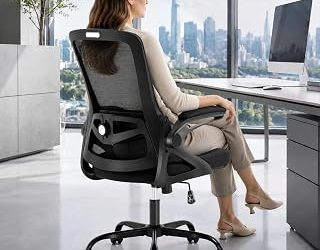
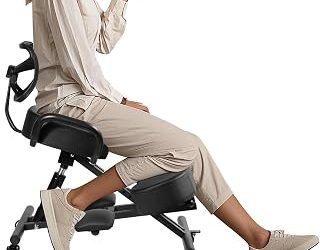
Drafting Chair with Flip-up Armrests and Adjustable Footrest Ring
This is the well-rounded pick: real lumbar support, arms that fold flat, and a footrest ring you can set to your own leg length rather than the manufacturer’s guess. The black finish stays visually quiet, so it doesn’t compete with whatever lighting scheme you’ve built around the desk.
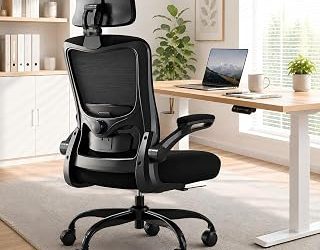
High-Back Mesh Standing Desk Stool
The taller mesh back is the draw here, giving you something to lean into during long stretches at a raised desk. Worth noting that the height of that back means it will throw a shadow if your primary light comes from behind, so pair it with a desk-level lamp.
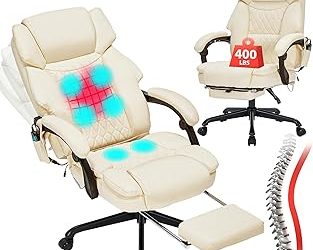
Executive Office Chair with Adjustable Lumbar Support, 400 lbs
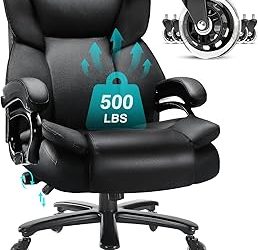
Built heavier than the rest, with a 400-pound rating and lumbar support you can position rather than just accept. The breathable mesh keeps it from feeling like a wall of upholstery in a small room, and the flip-up arms let it tuck under a raised surface.
Ergonomic Standing Desk Chair with Flip-Up Arms and Lumbar Support
A counter-height option that hits the sweet spot for desks in the low-40s range, with a footrest that adjusts and arms that get out of the way. Straightforward, no wasted features, and it looks unremarkable in the best sense.
Armless Drafting Chair with Footrest and Wheels
Skipping the arms entirely gives you the widest range of motion and the smallest visual footprint, which helps in a room where the chair sits in a window’s line. Best for people who rest their forearms on the desk rather than the chair.
Frequently Asked Questions
How high should my chair be for a standing desk?
Set the seat so your elbows rest at roughly 90 degrees when your hands are on the keyboard, then adjust the footrest to meet your feet. For most standing desks that means a seat somewhere between 26 and 34 inches, which is well outside the range of a standard task chair.
Do I still need to stand if I have a tall chair?
Yes. A drafting chair makes the seated intervals comfortable at desk height rather than replacing standing entirely. Think of it as removing the friction that keeps people from adjusting their desk at all.
Are flip-up armrests actually useful?
They are, for two reasons: they let the chair slide close when the desk is high, and they open up your shoulders for tasks like sketching or handwriting. If your desk has a thick apron or a keyboard tray, they become essential.
Will a tall chair look out of place in a home office?
Less than you’d expect, particularly in matte black. The bigger consideration is scale — a high mesh back is a tall object in the room, so keep it away from the path between your window and your desk surface if daylight is your main working light.
Final Thoughts
For most setups, the Drafting Chair with Flip-up Armrests and Adjustable Footrest Ring is the sensible default: it adjusts where it needs to and stays out of the way visually. Choose the Executive Office Chair with 400 lbs capacity if you want more substantial construction and positionable lumbar support, or the Armless Drafting Chair if your desk sits in bright, directional light and you’d rather keep the sightlines clear.