Our Top Picks
Pros & cons
- 2000 lumens across six bars brightens an entire counter
- Included rotary dimmer allows stepless 0 to 100 percent control
- Can be hardwired by an electrician for a built-in look
- Dimming only works with the included dimmer, not wall switches
- Plug-in cable setup needs a nearby outlet unless hardwired
 Armacost Lighting 421502 Ribbon Flex Home LED Tape3000K White (AC Dimmable)197 x 0.3 x 0.06 inches1 PoundsCheck on Amazon
Pros & cons
- UL Listed for recognized electrical safety compliance
- Can be cut and reconnected to fit odd cabinet layouts
- Works as either a simple plug-in or a direct-wired install
- Total run cannot be extended past the included 16 feet
- AC dimming requires a compatible dimmer switch, sold separately
Pros & cons
- RF remote offers timing, dimming, and dynamic lighting modes
- Screw-free adhesive install protects cabinets from drilling
- CRI over 82 renders counter colors fairly accurately
- 24W adapter limits total strip length to about 23 feet
- Remote relies on an RF signal rather than a wall switch
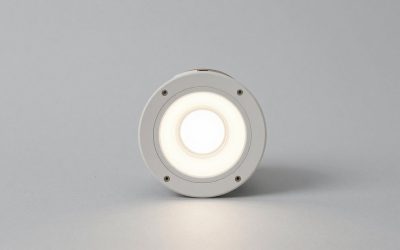
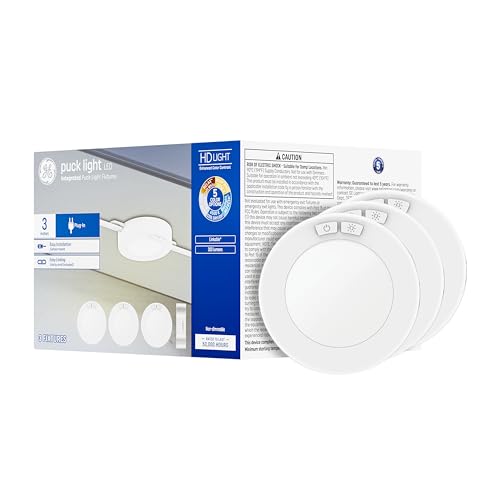 Best puck lightsGE LED HD+ Under Cabinet Puck LightsPuck Light - 3 Pack2.99 x 2.99 x 0.63 inches0.3 PoundsCheck on Amazon
The best under cabinet lights of 2026 for most kitchens are integrated LED strip systems delivering at least 200 lumens per linear foot at 3000K with a CRI of 90+, mounted in a profile under 0.5 inches so the diffuser tucks fully behind a standard 0.75-inch face frame or cabinet lip. Which specific option wins depends on whether you’re wiring a full 14-foot run during a remodel or sticking battery pucks under a rental’s cabinets, so here’s how the main contenders stack up on the numbers that actually matter.
Updated October 2026 — The best under cabinet lights for most kitchens are linkable LED bars or continuous strips that deliver 200–400 lumens per foot at 2700K–3000K with a CRI of 90 or higher. Our top three picks are the Litever 6-Bar LED Kit (best overall, plug-in or hardwired), the Ansen 24-Inch Hardwired Fixture (best color accuracy, CRI above 92) and the WOBANE Dimmable Strip Kit (best budget plug-in). Renters with no outlet should start with the MCGOR 10-Inch Rechargeable Motion Lights.
Best Under Cabinet Lights at a Glance
- Best overall: Litever 6-Bar LED Kit · six 12-inch bars · 2,000 lm total · plug-in or hardwired
- Best for food prep color: Ansen 24-Inch Hardwired · 1,237 lm · CRI above 92 · R9 above 90 · 5 color temps
- Best premium hardwired: NSL Task Star Pro 24-Inch · 12W · 650–700 lm · 90+ CRI · edge-lit
- Best plug-in bar with 5 color temps: Enbrighten 18-Inch One-Touch Sync · about 1,245 lm · 92 CRI
- Best continuous strip: Armacost Ribbon Flex Home 16 ft · 300 LEDs · 3000K · AC dimmable
- Best budget plug-in: WOBANE Dimmable Strip Kit · RF remote · adhesive mount
- Best COB strip (no visible dots): WOBANE COB 9.8 ft · 1,500 lm · CRI 90+ · 24W adapter
- Best puck lights: GE LED HD+ Puck Lights 3-Pack · 5 color temps · linkable
- Best smart option: Cync GE Reveal HD+ 24-Inch · app and voice control
- Best for renters: MCGOR 10-Inch 2-Pack · rechargeable · motion sensor · magnetic plate
What to measure before you shop
Spec sheets list total lumens, but that number is meaningless until you divide it by the strip’s length. A fixture claiming “800 lumens” sounds bright until you learn it’s spread across 6.6 feet, which works out to barely 120 lumens per foot — too dim for chopping vegetables. Look for 180-250 lumens per linear foot for task lighting over counters; anything above 300 starts to feel like an operating room.
Three other numbers matter more than brand name:
- Profile height: the strip plus diffuser channel should sit under 0.5 inches tall. Many cabinet lips overhang the cabinet bottom by about 0.75 inches (measure yours), so a profile under that height hides the hardware when you look up from below.
- CRI (Color Rendering Index): 90+ is the threshold where chopped herbs and raw meat look their actual color instead of washed out. Budget strips often sit at 80 CRI, which is fine for ambient light but noticeably flat for food prep.
- Driver coverage: a single 60W driver typically powers 16-20 feet of standard-density LED strip, but corner connectors, dimmers, and color-temperature switches all draw a bit of headroom. Plan for 80% of the rated max.
The 7 types of under cabinet lights, ranked by typical listed output
These are ranked by typical listed lumens-per-foot at 3000K, profile height, and realistic run coverage per driver or battery pack — not by price or brand recognition. The figures are ranges taken from manufacturer listings, not our own measurements.
1. Hardwired LED tape in an aluminum channel (best overall for remodels)
Aluminum channel systems from lighting-specific brands (not big-box tape-only kits) typically list 220-240 lumens per foot at 90+ CRI, with a channel height of 0.4 inches that disappears behind any standard lip. One 60W driver covers a 14-foot L-shaped run comfortably, with about 20% headroom left for a dimmer. This is the category to choose if you’re already opening up cabinets or doing an electrical rough-in.
2. Puck-style LED under cabinet lights, hardwired (best for strong task lighting over small zones)
Pucks list higher lumens per fixture (around 200 lumens each) but lower lumens per linear foot once spaced out, because they’re point sources, not continuous strips — expect 150-180 lumens per foot in a typical 3-puck, 3-foot span. Profile height runs 0.6-0.75 inches, right at the edge of what a standard lip hides, so measure your cabinet overhang before buying these for an open-shelf look.
3. Plug-in LED strip kits with inline dimmer (best for renters who can still access an outlet)
These match hardwired strip performance (200+ lumens/foot, 90 CRI) but run on a plug-in transformer instead of a hardwired driver. One transformer typically covers 10 feet before voltage drop dims the far end noticeably. For a 14-foot run you’ll want two transformers plugged into separate outlets, which gets visually messy with cords.
4. Rechargeable battery-powered LED bars (best for renters with no outlet access)
Battery bars typically list a respectable 150-180 lumens per foot but trade runtime for cordlessness. Runtime depends heavily on brightness, so check the maker’s listed charge time and runtime for the mode you will actually use. Covering a 10-foot run needs 2-3 bars with magnetic or adhesive mounts, and you will recharge them on a regular schedule.
5. Motion-sensor battery pucks (best for pantries and corner cabinets, not main task lighting)
Individual pucks here typically list around 100-120 lumens per foot equivalent and are built for convenience, not CRI accuracy (most sit at 80 CRI). They’re the right call for a dark cabinet corner you walk past, not the stretch of counter where you’re reading recipes.
6. RGBW smart strips with tunable white (best for mixed task + mood lighting)
Smart strips sacrifice a bit of peak output for flexibility: expect 180-200 lumens per foot in pure white mode, with CRI dropping slightly (85-88) when color channels are active, since RGBW diodes split their die space with the white emitter. Profile height matches standard aluminum channel strips at 0.4-0.5 inches. One hub typically drives 16 feet.
7. Linkable fluorescent-replacement LED bars (best for legacy installs needing a direct swap)
If you’re replacing old fluorescent under-cabinet fixtures without rewiring the junction box, these linkable bars typically list 140-170 lumens per foot — lower than strip systems because the housing is bulkier and less diode-dense — and the housing itself runs 0.75-1 inch thick, which can peek below a shallow cabinet lip. Confirm your lip depth before choosing this route.
Specific Under Cabinet Lights Worth Buying in 2026
The seven categories above tell you which style of fixture fits your kitchen. The models below are current, widely available examples of those styles, chosen to cover every budget from a two-bar renter fix to a full hardwired remodel. Specs come from each manufacturer’s published listing, so use the lumen and CRI figures as a starting point and run them through the lumens-per-foot math from the top of this guide before you order.
Litever 6-Bar LED Kit — Best for Most Kitchens

Under Cabinet LED Lighting Kit Plug in or Hardwired, 6 pcs 12 Inches Light Strips, 2000 Lumen, Super Bright, for Kitchen Counter, Closet, Shelf Lights, 31W, Warm White (6 Bars)
Chosen because it lists an explicit depth/thickness.
View on AmazonThis is the kit to start with if you have a standard 10 to 14 feet of upper cabinets and want one box that handles the whole job. You get six 12-inch light bars rated at 2,000 lumens combined and 31 watts in warm white, and the power adapter can either plug into an outlet or be hardwired, so it works for renters now and remodelers later.
The lumen math is favorable. Six feet of bars at 2,000 lumens works out to roughly 330 lumens per foot of fixture, so even after you spread the bars with small gaps across a 10-foot counter, you still land in the 180–220 lumens-per-foot task range. Linkable bars also make it easy to skip the section over the range hood or sink.
Pros
- Plug-in or hardwired power gives you a clean upgrade path
- Enough total output to light a typical L-shaped kitchen
- Rigid bars are easier to mount straight than loose tape
Cons
- Visible gaps between bars if you stretch them too far apart
- Confirm whether your variant includes a dimmer before ordering
Ansen 24-Inch Hardwired Fixture — Best for High-CRI Food Prep

Ansen Hardwired Under Cabinet Lighting, 24in 18W LED Light for Kitchen/Closet, 1237lm, CRI>92, R9>90, 5 Color Temperature, Dimmable, 2700K-5000K(Warm White, Cool White, Daylight)
Chosen because it adds cooling or gel-infused layers.
View on AmazonIf color accuracy at the cutting board matters to you, this direct-wire fixture is the standout spec sheet in the group. The 24-inch model is rated at 18 watts and 1,237 lumens, with CRI above 92 and R9 above 90. R9 measures how faithfully saturated reds render, which is exactly what makes raw meat, tomatoes, and peppers look true rather than brownish under budget LEDs.
A switch selects five color temperatures from 2700K to 5000K, and the fixture is dimmable, so you can install it once and fine-tune the look afterward. Because it is hardwired, plan on a junction box or an electrician unless you are comfortable with line-voltage work. Ansen sells the same design in 12- to 48-inch lengths, so you can match each cabinet run.
Pros
- CRI above 92 with a high R9 rating for accurate food color
- Five selectable color temperatures in one fixture
- Multiple lengths let you fit each cabinet section
Cons
- Requires hardwiring, which renters usually cannot do
- Very high output per foot, so plan to use the dimmer
Armacost Ribbon Flex Home 16 ft Tape Kit — Best for Long Continuous Runs
Armacost Lighting 421502 Ribbon Flex Home LED Tape Light Kit, 16 ft, AC Dimmable (3000K) 300 LED Lights
One of the home product options compared in this guide.
View on AmazonThis is a ready-made version of the aluminum-channel approach that tops our category list. The kit includes 16 feet of LED tape with 300 diodes in 3000K warm white, and it is listed as AC dimmable, meaning brightness is controlled on the 120-volt side by a compatible dimmer rather than by a battery remote.
Sixteen feet covers a typical L-shaped run with one product, and continuous tape avoids the shadow gaps you get with separate bars or pucks. For the cleanest look, stick the tape inside an aluminum channel with a frosted diffuser so individual diodes do not show as dots on a polished countertop. Check the dimmer compatibility notes before you buy a wall control.
Pros
- One continuous 16-foot run with no gaps between fixtures
- Dims with a compatible AC dimmer instead of a remote
- Warm 3000K suits most wood and painted cabinets
Cons
- Looks best with a channel and diffuser, which add cost
- Tape installs take more planning than snap-in bars
WOBANE Dimmable Strip Kit — Best Budget Plug-In Option
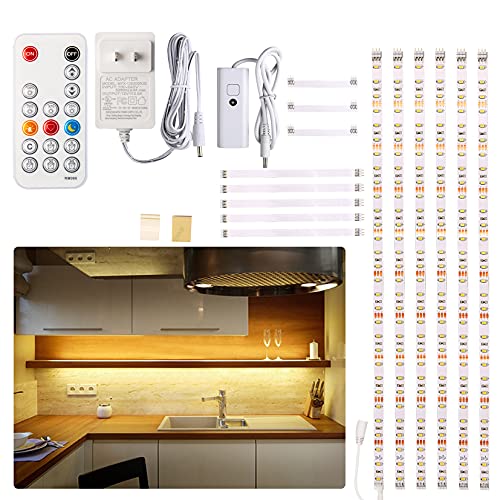
WOBANE Under Cabinet LED Lighting Kit,Dimmable Strip Lights with RF Remote
One of the home product options compared in this guide.
View on AmazonFor a fast, low-cost upgrade, this kit uses slim adhesive strip lights powered from an outlet, with an RF remote for on/off and dimming. Because the remote works by radio rather than infrared, it does not need line of sight to a receiver tucked behind the cabinet lip.
It belongs in the plug-in strip category from our ranking: good for renters with an outlet nearby, and best on runs of about 10 feet or less, where one adapter can power everything without the far end dimming. Budget strips like this rarely publish CRI figures, so treat it as a solid general-purpose light rather than a color-critical prep light.
Pros
- Lowest cost of entry in this group
- RF remote dims without line of sight
- No wiring required beyond a nearby outlet
Cons
- Color rendering is not specified, so food color may look flatter
- Adhesive mounting can loosen near stove heat
GE LED HD+ Puck Lights, 3-Pack — Best Puck Lights
GE LED HD+ Under Cabinet Puck Lights, Linkable Plug-in, 5 Color Temps 3Pk | Plug-in, no hardwire, linkable puck lights, 5 color temperatures, HD+ clarity, kitchen task & counter lighting, Non-Dimmable
One of the home product options compared in this guide.
View on AmazonPucks are the right choice when your cabinets have a visible underside, such as open shelving or a glass-front display, where a round fixture looks intentional. This GE set includes three linkable plug-in pucks with five selectable color temperatures, so you can match warm cabinet lighting to cooler ceiling fixtures.
As the ranking above explains, pucks are point sources, so they create pools of light rather than an even wash. Space them about 12 to 18 inches apart over the zone you work in most, and keep them toward the front edge of the cabinet to reduce scalloped shadows on the backsplash. Being plug-in and linkable, three pucks can share one cord to the outlet.
Pros
- Five color temperatures in one product
- Linkable plug-in design keeps cord clutter down
- Brand-name build at a moderate price
Cons
- Uneven light compared with continuous strips
- Thicker profile than bars, so check your cabinet lip depth
Cync GE Reveal HD+ Smart Light Bar, 24-Inch — Best Smart Option

Cync GE Reveal HD+ Smart LED Under Cabinet Light Bar, 24in | Color changing, tunable white 2000K–7000K, plug-in or direct wire, no hub, works with Alexa & Google Home
One of the home product options compared in this guide.
View on AmazonIf you want under-cabinet lighting that follows a schedule, responds to voice commands, or shifts from bright prep light to a dim evening glow, this smart bar is a simpler route than an RGBW strip with a separate hub. It is controlled through the Cync app, and the Reveal HD+ line is built around a color-enhancing spectrum intended to make food and finishes look closer to daylight.
Each 24-inch bar is a standalone fixture, so you buy one per cabinet section. That makes a full kitchen more expensive than a single tape kit, but it also means you can start with the prep zone and add bars later. Check which voice assistants and hubs the current version supports before you commit.
Pros
- Schedules, scenes, and dimming from an app
- Color-enhanced spectrum aimed at kitchen tasks
- Expand one bar at a time
Cons
- Per-bar pricing adds up over a long run
- Relies on an app and network for its best features
MCGOR 10-Inch Rechargeable Motion Lights, 2-Pack — Best for Renters and Dark Corners

MCGOR 10inch Under Cabinet Lighting, 2 Pack Rechargeable Motion Sensor Light Indoor, 5 Levels Dimmable Magnetic Closet Lights, Wireless Under Counter Lights for Kitchen, Stairs
Chosen because it lists an explicit depth/thickness.
View on AmazonThese cordless bars cover the battery-powered and motion-sensor categories from our ranking. Each 10-inch bar is rechargeable, snaps onto a magnetic mounting plate, and offers five dimming levels with a motion sensor that switches the light on when you walk up.
The magnetic plate is the key renter feature: the bar lifts off for charging without disturbing the mount, and nothing is screwed into the cabinet. Two 10-inch bars will not light a full counter to task level, so use them for a coffee station, a pantry shelf, or a dark corner, and expect to recharge more often if you leave motion mode set to bright.
Pros
- No wiring and no visible cords
- Motion activation for hands-full trips to the counter
- Magnetic mount makes charging easy
Cons
- Not bright enough to replace a full task-lighting run
- Battery life shrinks over a couple of years of charge cycles
The seven picks above cover the main categories. These five fill the gaps: a premium edge-lit hardwired bar, a plug-in bar with five color temperatures, a dot-free COB strip, a tool-free motion bar kit and a better-specified rechargeable bar.
NSL Task Star Pro 24-Inch — Best Premium Hardwired Fixture

NSL LED Under Cabinet Lighting Hardwired - 24 Inch White
Chosen because it lists an explicit depth/thickness.
View on Amazon- Output: 12 watts, 650–700 lumens, 90+ CRI
- Color: three selectable temperatures from 2700K to 4000K; hi-low rocker switch
- Install: hardwire with the included Romex connector or plug in with the 6-ft cord; links up to 400 watts
- Build: aluminum housing, 1 inch tall, edge-lit polycarbonate diffuser; ETL and Energy Star listed
- Dimming: works with most ELV wall dimmers
The NSL Task Star Pro is the contractor-style choice. Its edge-lit design spreads light through the lens rather than showing a row of diodes, which is why it reflects as a smooth band on polished granite or quartz instead of dots. At about 325–350 lumens per foot of fixture, the 24-inch bar sits at the bright end of the task range, so pair it with an ELV dimmer. It comes in 9- to 40-inch lengths and four finishes.
Pros: no hot spots on glossy counters; plug-in or hardwired from one box; long linking capacity. Cons: costs more per foot than tape or bars; 1-inch height can show under a shallow lip.
Skip it if… you rent; the hardwire benefits are wasted on a plug-in install.
Enbrighten 18-Inch One-Touch Sync — Best Plug-In Bar With Five Color Temperatures

Enbrighten 18 Inch Plug in Under Cabinet Light with 5 Color Temperatures | Dimmable 1245 Lumens, Soft White to Daylight Lighting, One-Touch Sync Linkable Under Cabinet Lighting for Kitchen, ETL Listed
Chosen because it lists an explicit depth/thickness.
View on Amazon- Output: about 1,245 lumens per 18-inch bar, 92 CRI
- Color: 2700K, 3000K, 4000K, 5000K or 6500K
- Control: press-and-hold dimming; linked bars change together with one press
- Install: plug-in with a 5-foot cord and 18-inch linking cords; direct-wire converter and RF remote sold separately
The Enbrighten bar is a strong middle option between the budget plug-in kits and the hardwired fixtures. One button syncs color and brightness across every linked bar, which avoids the mismatched-color problem described in our color temperature section. With roughly 830 lumens per foot of fixture, it is bright enough to space bars with short gaps.
Pros: high CRI and five color temperatures; synced linking; plug-in now, direct-wire later. Cons: remote and direct-wire kit cost extra; very bright at full output.
Skip it if… you want one continuous line of light; a strip is smoother.
WOBANE COB 9.8 ft Strip Kit — Best Dot-Free LED Strip

WOBANE Dimmable COB LED Strip with RF Remote,9.8ft Under Cabinet Lighting
One of the home product options compared in this guide.
View on Amazon- Output: 1,500 lumens across 9.8 feet (about 150 lm/ft), CRI 90+
- LEDs: 960 chip-on-board LEDs; sold in 3000K, 4000K and 6000K versions
- Power: 12V DC, 24W ETL-listed adapter, plug-in
- Control: 17-key RF remote with dimming and timer
- Indoor use only; adhesive backing
COB strips pack LEDs so densely that the light reads as one continuous line, even without a diffuser channel. That solves the dotted-reflection problem on polished stone at a budget price. At about 150 lumens per foot it is better for a softer wash or a shorter run than for a long, heavy-prep counter. Pick the 3000K version for most kitchens.
Pros: no visible dots; CRI 90+ at a budget price; remote with timer. Cons: lower lumens per foot than bars; adhesive can loosen near heat.
Skip it if… you need bright task light over a long prep counter.
PureOptics LED 3-Bar Kit (LEDUC9-3WK) — Best Tool-Free Motion Bar Kit

PureOptics LED Under Cabinet Lighting Kit, 3-Bars, 9 Inches Each, DIY Tool-Free Installation, Warm White, 2700K, 1080 Lumens, 15 Watts, Home Accent (LEDUC9-3WK)
Chosen because it lists an explicit depth/thickness.
View on Amazon- Output: 1,080 lumens total from three 9-inch bars, 15 watts
- Color: 2700K warm white (cool white version sold separately)
- Control: motion sensor and 10 dimming levels
- Install: plug-in, self-adhesive clips and jumper wires; aluminum bars
Previously sold under the BLACK+DECKER name, this PureOptics kit is for anyone who wants plug-in bars without drilling. Three 9-inch bars put about 480 lumens per foot of fixture, so they can be spaced with gaps over a 6- to 8-foot run. A newer PureOptics kit adds selectable color temperatures; this one is fixed at 2700K.
Pros: tool-free install; motion and dimming built in; warm 2700K suits wood cabinets. Cons: only three short bars in the box; fixed color temperature.
Skip it if… your ceiling lights run at 4000K or cooler; the warm color will clash.
EZVALO 10-Inch Rechargeable Motion Lights, 2-Pack — Best Battery Bar With Color Choice

EZVALO 10inch Under Cabinet Lighting, 2 Pack 2400mAh Rechargeable Wireless Motion Sensor Lights Indoor, Dimmable Magnetic Closet Lights, Under Counter Lights for Kitchen, Pantry, Stairs
Chosen because it lists an explicit depth/thickness.
View on Amazon- Battery: 2,400mAh per bar, USB-C, about 3.5 hours to charge
- Output: up to 120 lumens per bar; 10–100% dimming
- Color: 3000K, 4500K or 6500K
- Sensor: 120° motion detection up to about 12 ft; always-on, day and night modes
- Mount: built-in magnets plus adhesive strips; aluminum body about 0.5 inch tall
EZVALO’s rechargeable bar competes directly with the MCGOR pick but adds a warm 3000K setting, which blends better with most kitchen lighting. Runtime is listed at roughly 13–40 days in motion mode and about 11 hours always-on. Like any battery bar, it is a pantry, closet or coffee-station light, not full task lighting.
Pros: warm white option; thin magnetic bar; long motion-mode runtime. Cons: 120 lumens is too dim for food prep; several similar EZVALO models exist, so check the battery size.
Skip it if… you need to light a full counter; choose a plug-in kit instead.
Two more current options round out the list: a contractor-style hardwired bar for buyers who want a name-brand fixture, and a six-pack of rechargeable pucks for accent spots that no cord can reach.
Kichler 4U Series 22-Inch LED Under Cabinet Light — Best Brand-Name Hardwired Bar

Kichler 4U Series 22" 120V LED Under Cabinet Light in White, 3000K, (22" L x 4.5" W x 1"H), 4U30K22WHT
One of the home product options compared in this guide.
View on Amazon- Output: 551 lumens, about 10 watts, 3000K, CRI 94 (about 300 lumens per foot of fixture)
- Size: 22 inches long, 4.5 inches wide, 1 inch tall, frosted diffuser
- Power: 120-volt direct wire by default; a separate cord accessory is needed for plug-in use
- Dimming: dimmable with a compatible wall dimmer; check the maker’s compatibility list first
- Listing: cETLus listed, rated for dry indoor locations, about 40,000 hours
The Kichler 4U Series is the pick for a kitchen where the fixture itself will be seen, such as a bar mounted flush along the front rail of the cabinet. The frosted lens spreads light into a smooth band, so it reflects as a clean line on polished quartz or granite instead of a row of dots. At roughly 300 lumens per foot of fixture, one 22-inch bar sits comfortably inside the task-lighting range and still leaves room to dim it down in the evening.
Pros: CRI 94 for accurate food color; smooth lens with no hot spots; dimmable; recognized safety listing. Cons: costs more per foot than tape or bar kits; 1-inch height can show below a shallow lip; hardwiring is the default.
Skip it if… you rent or want a plug-in kit you can install in an afternoon; choose the Litever 6-Bar LED Kit or the Enbrighten 18-Inch One-Touch Sync instead.
EZVALO 6-Pack Rechargeable Puck Lights — Best Battery Pucks for Shelves and Display Cabinets

EZVALO LED Puck Lights, 6Pack Rechargeable Touch Light, 2.5'' Mini Tap Lights, Wireless Closet Light, Under Cabinet Lighting, 3 Color & 83 RGB, Stick On Lights for Kitchen,Pantry,Shelves
One of the home product options compared in this guide.
View on Amazon- Pack: six 2.5-inch stick-on tap lights, about 50 lumens each
- Color: three white settings (3000K, 4500K and 6500K) plus RGB color modes
- Control: tap or hold on the puck to change color temperature and brightness; remote with timers
- Power: built-in rechargeable battery, indoor use only
- Mount: adhesive backing, no wiring
These EZVALO pucks solve a different problem from the bars above: a dark spot that has no outlet and no room for a fixture, such as the inside of a glass-front cabinet, a bookshelf, a closet shelf or the underside of a hutch. At about 50 lumens each they are accent lights, not task lights, so a six-pack makes sense when you want several small pools of light placed individually. Pick the 3000K setting if the rest of the kitchen is warm white.
Pros: no cords or wiring; six units cover several cabinets; warm white option; remote and timer. Cons: far too dim for chopping or reading recipes; needs periodic recharging; adhesive can loosen near a range.
Skip it if… you need task light over a prep counter; plug-in bars or a hardwired fixture deliver several times more light per foot.
GE LED HD+ Undercabinet Light, 18-Inch Warm White — Best Low-Cost Linkable Plug-In Bar
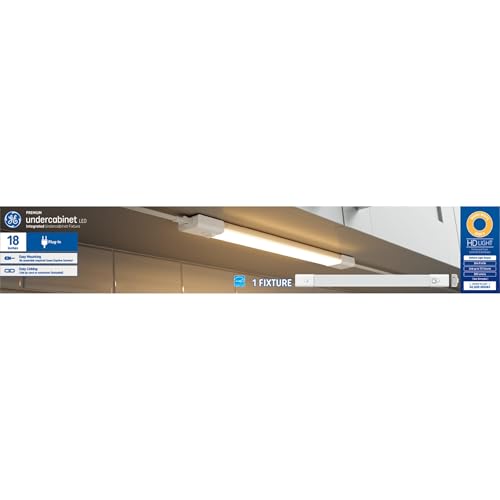
GE LED HD+ Undercabinet Light Fixture, Linkable Integrated Slim Profile Fixture for Kitchens, Warm White Color, Plug-in, 18in (1 Pack)
One of the home product options compared in this guide.
View on Amazon- Output: 800 lumens, 10 watts, 3000K, CRI 90 (about 530 lumens per foot of fixture)
- Power: plug-in cord, with a 12-inch linking cable included
- Dimming: not dimmable
- Warranty: 5 years from the maker
At about 530 lumens per foot it sits well inside the task-lighting range, but it has no dimmer, so it suits a prep zone you want fully lit rather than a space you dim in the evening. Link a second bar with the included cable if the run is longer than 18 inches.
Skip it if… you want selectable color temperature; choose the Enbrighten 18-Inch One-Touch Sync instead.
Also Consider
Philips Hue strips — the four Hue strips below (the Indoor 6-foot base kit, the OmniGlow Micro 9.8 ft, the Essential 16 ft and the Essential 16 ft Flex) are the pick if you already use a Philips Hue system and want color scenes; treat them as mood lighting rather than primary task light.

Philips Hue Indoor 6-Foot Smart LED Light Strip Base Kit with Plug - Flowing Multicolor Effect - 1 Pack - Control with Hue App - Works with Alexa, Google Assistant and Apple HomeKit
One of the home product options compared in this guide.
View on Amazon
Philips Hue OmniGlow Micro LED Strip Light, 9.8ft, 1-Pack
One of the home product options compared in this guide.
View on Amazon
Philips Hue Essential LED Strip Light, 16ft
One of the home product options compared in this guide.
View on Amazon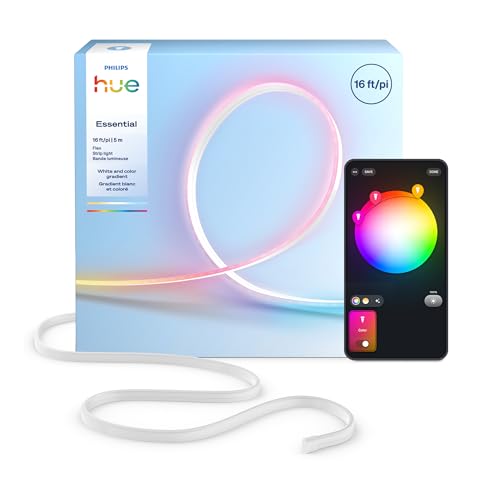
Philips Hue Essential 16 ft LED Flex Strip Light, 1-Pack
One of the home product options compared in this guide.
View on AmazonBrilliant Evolution Stick-On Push Lights, 6-Pack — battery puck lights with a remote for dark cabinet interiors and display shelves. Low output and no CRI rating, so keep them for accent use.

Brilliant Evolution Stick On Push Lights - 6 Pack Remote Controlled LED Lights Under Cabinets - DIY Stick On Lights for Closet, Counter, Kitchen - Battery Operated Puck Lighting with Remote
One of the home product options compared in this guide.
View on AmazonQuick Comparison of the Specific Picks
| Model | Category | Power | Key listed spec | Price |
|---|---|---|---|---|
| Litever 6-Bar Kit | Linkable bars | Plug-in or hardwired | 2,000 lm total, six 12-in bars | Check price |
| Ansen 24-Inch | Hardwired fixture | Hardwired | 1,237 lm, CRI above 92, R9 above 90 | Check price |
| Armacost Ribbon Flex 16 ft | LED tape | Low-voltage tape, AC dimmable | 300 LEDs, 3000K | Check price |
| WOBANE Strip Kit | Plug-in strips | Plug-in | RF remote dimming | Check price |
| GE LED HD+ Pucks | Pucks | Plug-in, linkable | 5 color temperatures | Check price |
| Cync Reveal HD+ 24-Inch | Smart bar | Wired bar, no battery | App control, color-enhanced spectrum | Check price |
| MCGOR 10-Inch 2-Pack | Rechargeable motion | Battery | 5 dimming levels, magnetic mount | Check price |
| GE LED HD+ 18-Inch | Plug-in bar | Plug-in, linkable | 800 lm, CRI 90, not dimmable | Check price |
Lumens per Foot: How the Picks Compare
Fixture output divided by fixture length shows how much light each product packs into its own footprint. Spread bars apart and the per-foot figure over your counter drops accordingly, so aim to land at 180–250 lumens per foot of counter after spacing.
| Model | Listed output | Fixture length | Lumens per foot of fixture | Listed CRI |
|---|---|---|---|---|
| Enbrighten 18-Inch One-Touch Sync | about 1,245 lm | 18 in. | about 830 | 92 |
| Ansen 24-Inch Hardwired | 1,237 lm | 24 in. | about 620 | above 92 |
| GE LED HD+ 18-Inch Warm White | 800 lm | 18 in. | about 530 | 90 |
| PureOptics LEDUC9-3WK | 1,080 lm | 3 x 9 in. | about 480 | Not listed |
| NSL Task Star Pro 24-Inch | 650–700 lm | 24 in. | about 325–350 | 90+ |
| Litever 6-Bar Kit | 2,000 lm | 6 x 12 in. | about 330 | Not listed |
| Kichler 4U Series 22-Inch | 551 lm | 22 in. | about 300 | 94 |
| WOBANE COB 9.8 ft | 1,500 lm | 9.8 ft | about 150 | 90+ |
| EZVALO 10-Inch (per bar) | up to 120 lm | 10 in. | about 145 | Not listed |
Why Other Guides Quote Higher Lumens per Foot
You will see 300–500 lumens per foot recommended in some buying guides, and 180–250 in others, including this one. Part of the gap comes from what the foot refers to. The higher figures describe the output of the fixture itself, measured along its own length, which is how most spec sheets are written. The lower figures describe the light that actually lands on each foot of counter after bars are spaced apart, diffused and partly absorbed by a dark countertop.
A practical way to reconcile the two: for a dense strip or a single long bar, a fixture rated around 300 lumens per foot will usually deliver the 180–250 you want on the counter. For widely spaced bars or pucks, work backward from your counter length and total lumens instead. A 12-foot counter that needs about 2,400 lumens is close to what the Litever 6-Bar LED Kit provides at 2,000 lumens, while a single Kichler 4U Series 22-Inch bar at 551 lumens covers a focused prep zone of about 2 to 3 feet. Use the dimmer to settle on the final level once everything is mounted.
Best Under Cabinet Lights by Budget
Best under $30
- WOBANE Dimmable Strip Kit: plug-in · adhesive strips · RF remote
- WOBANE COB 9.8 ft: 1,500 lm · CRI 90+ · no visible dots
- MCGOR 10-Inch 2-Pack: rechargeable · motion sensor · magnetic plate
- EZVALO 10-Inch 2-Pack: 2,400mAh · 3000K/4500K/6500K · up to 120 lm per bar
- GE LED HD+ 18-Inch Warm White: 800 lm · CRI 90 · plug-in · linkable
What to expect at this tier:
- Adhesive mounting that can loosen within 2 feet of a range
- CRI often unlisted on the cheapest kits; COB strips are the exception
- Remote or inline dimming rather than wall-switch control
- Battery bars bright enough for pantries, not prep counters
Best $30–$80
- Litever 6-Bar LED Kit: 2,000 lm · six 12-inch bars · plug-in or hardwired
- Ansen 24-Inch: 1,237 lm · CRI above 92 · R9 above 90 · hardwired
- Enbrighten 18-Inch: about 1,245 lm · 92 CRI · 5 color temps · synced linking
- GE LED HD+ Pucks, 3-Pack: 5 color temps · linkable plug-in
- Armacost Ribbon Flex 16 ft: 300 LEDs · 3000K · AC dimmable
What to expect at this tier:
- CRI of 90 or higher becomes common
- Selectable color temperature on most bars
- Options that plug in today and hardwire later
- Enough output to reach 200+ lumens per foot over a 10-foot run
Best $80 and up
- NSL Task Star Pro 24-Inch: edge-lit · 90+ CRI · ELV dimmable · ETL and Energy Star
- Philips Hue strips: Hue app scenes · color and white
What to expect at this tier:
- Wall-dimmer compatibility and junction-box installation
- Smooth, dot-free lenses that suit polished stone
- Smart scheduling, voice control and scenes
How We Chose These Under Cabinet Lights
This guide is research-based; the picks were not installed or measured by us. We compared manufacturer spec sheets for lumens, length, CRI, color temperature, power type and dimming, then converted total lumens into lumens per foot so fixtures of different lengths can be compared fairly. We cross-checked recommendations from home-improvement publications and contractor-written guides, kept only current, widely available models, and favored fixtures with a recognized safety listing such as ETL or UL. Where a maker does not publish a figure, such as CRI on some budget strips, we say so rather than estimate it.
Coverage by kitchen length
| Run length | Hardwired strip + driver | Plug-in strip kit | Battery bars |
|---|---|---|---|
| 8 feet | 1 driver (60W), zero gaps | 1 transformer, even brightness | 2 bars, recharge periodically |
| 10 feet | 1 driver (60W), ~15% headroom | 1 transformer, slight dimming at far end | 2-3 bars, recharge regularly |
| 14 feet | 1 driver (96W) or 2x 60W split | 2 transformers needed, visible cord run | 3-4 bars, recharge more often |
Three Sample Kitchen Layouts, Worked Out
Running the numbers on a real floor plan makes the choice much clearer. Here is how the math plays out in three common kitchens, using the 180–250 lumens-per-foot target for prep areas.
Galley kitchen, two 8-foot runs
Sixteen feet of counter at about 200 lumens per foot calls for roughly 3,200 lumens in total. Two separate runs on opposite walls usually mean two power sources, so either use two plug-in kits, one per side, or have a single hardwired circuit split to both walls during a remodel. Keep both sides at the same color temperature, because in a narrow galley you see them together.
L-shaped kitchen, 10 feet plus 4 feet
Fourteen feet at 200 lumens per foot needs about 2,800 lumens. The inside corner is the trouble spot: the two runs meet where cabinets are deepest and shadows collect. Continuous tape with a corner connector, or a bar placed within a few inches of the corner on each side, keeps that area lit. One properly sized driver can usually power the whole L if you leave about 20 percent headroom.
Short run with open shelving and a coffee station
A 6-foot run with open shelves above is a good place to mix fixture types on purpose. Use a linkable bar or strip under the closed cabinet where you prep, pucks under the open shelves where the fixture will be seen, and a rechargeable motion bar inside the coffee nook or pantry. Match the color temperature across all three so the mix reads as one design.
Matching the pick to your situation
| Your situation | Best choice | Why |
|---|---|---|
| Full kitchen remodel, 10-14 ft of cabinets | Hardwired aluminum channel strip | Highest lumens/foot, lowest profile, one driver covers the whole run |
| Renting, outlet nearby | Plug-in strip kit with dimmer | Strip-level brightness without rewiring, just manage the cord run |
| Renting, no outlet under cabinets | Rechargeable battery bars | No wiring or visible cords, accepts a weekly charging routine |
| Open shelving, want visible fixtures | Hardwired pucks | Only option with a profile short enough to look intentional when exposed |
| Dark pantry or corner cabinet only | Motion-sensor battery pucks | Convenience over color accuracy; you’re not prepping food under these |
| Want color-changing mood lighting plus task light | RGBW tunable strip | Only category offering both without swapping fixtures |
| Replacing old fluorescent bars, no new wiring | Linkable LED replacement bars | Fits existing mounting points and junction boxes |
Choosing a Color Temperature That Matches Your Kitchen
Most kitchens look best with under cabinet lights at 2700K or 3000K, but the right number depends on what is already in the room. The goal is for counter lighting to blend with the ceiling fixtures rather than create a visible band of a different color under the cabinets.
- 2700K reads warm and slightly golden. It flatters wood cabinets, cream or beige stone, and kitchens with warm incandescent-style ceiling bulbs.
- 3000K is the safe middle ground. It is warm enough to feel residential but crisp enough for prep work, and it works with white, gray, and wood finishes.
- 3500K–4000K looks clean and neutral. It suits modern white or gray kitchens with cool-white ceiling lights, but it can make warm wood look flat.
- 5000K is daylight-blue. It is bright for detail work but often feels clinical in a home kitchen at night.
If you are unsure, fixtures with selectable color temperature, like several of the picks above, let you change your mind after installation. Whatever you choose, keep every under cabinet fixture in the kitchen at the same setting; mixing 3000K bars with 4000K pucks is one of the most common reasons a finished install looks off.
Where to Mount the Fixture Under the Cabinet
Placement changes the result as much as the fixture itself. Mounting too close to the wall pushes light onto the backsplash and leaves the front of the counter dim, while mounting right at the front edge can throw glare into your eyes when you are seated at an island.
For most kitchens, aim the fixture toward the front of the cabinet bottom, roughly 1 to 2 inches behind the face frame or lip. That position puts the strongest light where your hands and cutting board are, keeps the fixture hidden from standing eye level, and still washes enough light onto the backsplash to show off tile. If your backsplash is a feature, such as handmade tile or a stone slab, a second strip near the wall can graze the texture, but treat that as accent lighting rather than task lighting.
Glossy surfaces need extra care. Polished granite, quartz, and glass backsplashes act like mirrors and will reflect individual LED dots. Choose fixtures with a frosted lens, or put tape lights inside a channel with a diffuser, so the reflection shows a smooth line instead of a row of bright points.
Installation Basics: Plug-In, Hardwired, and Battery
Plug-in systems
Plug-in kits are the easiest to install. Mount the bars or strips, route the low-voltage leads along the back of the cabinet bottom, and run the adapter cord to the nearest outlet. Plan the cord path before you stick anything down: cord clips along the underside of the cabinet and a short drop behind an appliance garage or canister usually hide it well. If an outlet is controlled by a wall switch, plugging into it gives you switch control without any wiring.
Hardwired and direct-wire fixtures
Hardwired fixtures connect to a 120-volt circuit through a junction box, usually fed from a wall switch or a dedicated dimmer. In many areas this is work for a licensed electrician, and some jurisdictions require a permit for new circuits or boxes. For low-voltage tape systems, the driver typically sits in a cabinet or above the cabinets, where it needs ventilation; do not bury a driver in insulation or a sealed space where heat builds up.
Battery and rechargeable lights
Battery units mount with adhesive or a magnetic plate and need no wiring. Clean the mounting surface with rubbing alcohol before applying adhesive, let it cure for the time listed in the instructions before attaching the light, and avoid the area directly above the range, where heat softens adhesive quickly.
Dimmers, Switches, and Smart Controls
Dimming makes under cabinet lighting far more useful: full brightness for prep, low output for a night-light effect. How you dim depends on the system.
- Inline or remote dimmers come with many plug-in kits and are the simplest option, but the control lives on a cord or a remote that can get misplaced.
- Wall dimmers work with hardwired fixtures and AC-dimmable kits, but only when the dimmer type matches the fixture or driver. Check the product’s compatibility list; mismatched dimmers cause flicker, buzzing, or a limited dimming range.
- Motion sensors suit pantries, coffee stations, and closets where you want light for a minute or two, not continuous task lighting.
- Smart control adds schedules and voice commands. It is convenient, but confirm that the app works with the ecosystem you already use before you buy.
Safety Checks Before You Buy
Look for a recognized safety listing, such as UL or ETL, on any fixture, driver, or adapter that connects to household power. Near the sink, choose fixtures rated for damp locations. Finally, check that the total wattage of linked fixtures stays within the limit printed on the adapter or driver, leaving roughly 20 percent of headroom so it runs cooler and lasts longer.
What actually fails first
On hardwired strips, the diode output degrades gradually over time rather than failing outright — expect noticeable dimming, not blackout. The driver is the more common failure point, especially in humid kitchens near a dishwasher vent. On battery units, the rechargeable cell is the wear item: expect noticeably shorter runtime after a few hundred charge cycles. Adhesive mounting tape on any style tends to loosen first near stove heat, so mechanical clips or screws are worth the extra effort within 2 feet of a range.
Running Cost and Energy Use
LED under cabinet lighting costs very little to operate. Even a long 16-foot tape run at full brightness rarely adds much to a monthly electric bill. Dimming lowers that further, and it also reduces heat at the diodes and driver, which helps them last longer. Battery units cost almost nothing in electricity; their real running cost is the cell itself, which gradually loses capacity over a couple of years.
Common Mistakes to Avoid
- Buying by total lumens. Divide by the length you are lighting. A bright-sounding kit spread too thin still leaves the counter dim.
- Ignoring the cabinet lip. Measure the overhang before ordering. A fixture thicker than the lip shows from across the room.
- Leaving gaps at corners and sinks. Plan coverage for the whole working length, including the inside corner of an L-shaped counter, where shadows are worst.
- Mixing color temperatures. Different brands at different Kelvin ratings look mismatched side by side, so keep one setting throughout.
- Overloading the driver or adapter. Add up the wattage of every linked fixture and stay comfortably below the rated limit.
- Skipping the diffuser on glossy counters. Bare LED tape reflects as a line of dots on polished stone.
Frequently Asked Questions
How many lumens do I need for under cabinet lighting?
For food prep, aim for roughly 180–250 lumens per linear foot of counter. To size a kitchen, multiply your total counter length by that range. A 12-foot run needs about 2,200–3,000 lumens in total, spread evenly. Anything under about 150 lumens per foot works as accent lighting but feels dim for chopping and reading recipes.
Is 2700K or 3000K better for kitchen under cabinet lights?
Both work well. 2700K is warmer and suits wood cabinets and warm ceiling bulbs, while 3000K is slightly crisper and is the most versatile choice for white or gray kitchens. The more important rule is to match the color temperature of your other kitchen lighting so the counters do not look like a different room.
What CRI should under cabinet lights have?
Look for a CRI of 90 or higher for task lighting, where you want food, countertops, and paint colors to look accurate. If the listing also shows an R9 value, higher is better; it measures how well saturated reds render, which affects how meat, tomatoes, and berries look.
Do I need an electrician to install under cabinet lights?
Not for plug-in or battery fixtures; most homeowners can install those in an afternoon. Hardwired fixtures that connect to a junction box or a new switch are line-voltage work, and many local codes require a licensed electrician or a permit for it. If you are remodeling, have the electrician add a switched feed during rough-in, since that is far cheaper than fishing wires later.
Can renters install under cabinet lighting without damaging cabinets?
Yes. Rechargeable bars with magnetic plates and plug-in kits with removable mounting clips leave little or no trace. Test adhesive in an inconspicuous spot first, and remove it slowly with gentle heat from a hair dryer when you move out to avoid pulling off cabinet finish.
Are puck lights or strip lights better?
Strips and linkable bars give a more even wash of light across the counter, which is better for task lighting. Pucks create pools of light with darker areas between them, which looks attractive on open shelving or display cabinets but is less practical over a long prep counter.
Can I leave LED under cabinet lights on all night?
Quality LED fixtures with a proper safety listing are designed for long run times and produce little heat, so a dimmed overnight setting is generally fine. For battery units, continuous use simply drains the cell faster. For any adhesive-mounted strip, make sure the driver or adapter has airflow around it.
How long do LED under cabinet lights last?
The diodes themselves are often rated for tens of thousands of hours and tend to dim gradually rather than fail outright. In practice, the driver or power adapter usually wears out first, so choose systems where the adapter is a separate, replaceable part rather than built into the fixture.
What are the best under cabinet lights for renters?
Plug-in kits such as the Litever 6-Bar or WOBANE strip are best if an outlet is nearby, because they give task-level light without wiring. With no outlet, rechargeable magnetic bars like the MCGOR or EZVALO 10-inch are the cord-free fallback.
Are battery-powered under cabinet lights bright enough for cooking?
Usually not. Most rechargeable bars top out around 100–150 lumens each, while food prep needs roughly 180–250 lumens per foot of counter. Use them for pantries, corners and coffee stations instead.
Can I link several under cabinet light bars to one outlet?
Yes, if the bars are sold as linkable and the total wattage stays under the adapter’s or fixture’s rated limit. The NSL Task Star Pro, for example, links up to 400 watts; budget kits often allow far less.
Do LED strips or light bars look better on a quartz or granite counter?
Bars with a frosted or edge-lit lens and COB strips look better, because they reflect as a smooth line. Standard LED tape without a diffuser shows a row of bright dots on polished stone.
How do I hide the cord on plug-in under cabinet lights?
Run the cord along the back edge of the cabinet bottom, secure it with small cord clips every 12 to 18 inches, and drop it behind an appliance garage, canister or the side of the cabinet to reach the outlet. A flat adhesive cord cover painted to match the wall hides the last stretch. Plan the path before you peel any adhesive backing.
Can I cut LED strip lights to fit under my cabinets?
Most LED tape can be cut, but only at the marked cut points, usually every few diodes. Cutting anywhere else leaves a dead section. Reconnect shortened pieces with the maker’s solderless connectors, confirm the voltage and polarity, and keep the total run within what the driver or adapter is rated to power.
What are the best battery-powered puck lights for under cabinets?
Battery pucks such as the EZVALO 6-Pack Rechargeable Puck Lights work best as accent lighting inside glass cabinets, on open shelves and in closets. At around 50 lumens each they are too dim for food prep, so pair them with a plug-in or hardwired bar over the counter.