Key takeaways
- Decide the beam’s job first: Up-and-down fixtures graze the wall for architectural drama and work beautifully in hallways and stairwells. Fabric or frosted-glass shades diffuse light outward instead, which is what you want beside a bed or sofa where people’s eyes sit at fixture height.
- Match color temperature to the room’s purpose: 2700K–3000K reads warm and restful for bedrooms, living rooms, and corridors. Step up to 4000K only where you need clarity, like a vanity or reading nook. Selectable-CCT models let you audition both after installation, which removes most of the guesswork.
- Confirm the wiring situation before anything else: Hardwired sconces need a box and, ideally, a switch loop. If you rent, live in older construction, or simply don’t want to open drywall, a rechargeable battery unit with a remote gives you placement freedom no electrician can beat.
- Plan mounting height around sightlines: Roughly 60–66 inches from the floor works for general corridor and living-room use. Flanking a mirror, aim for eye level at about 64 inches with the pair set 28–40 inches apart so light crosses the face and cancels shadows instead of casting them.
- Check dimming compatibility and finish continuity: Integrated LEDs need a driver rated for the dimmer you own, or you’ll get flicker and buzz. On finishes, keep metals consistent with nearby hardware — brushed gold near polished chrome reads as an accident rather than a choice.
What's inside
Most rooms fail at eye level. Ceiling fixtures flatten everything beneath them, and lamps only reach so far, which leaves the vertical planes of a room — the walls that actually frame how a space feels — sitting in shadow. That is the gap a sconce fills, and it is also where shoppers get tripped up. Two fixtures can look nearly identical in a product photo and behave completely differently on the wall: one throws a crisp double scallop of light up and down the plaster, the other dumps a hot glare spot straight into your line of sight.
This guide approaches sconces the way a lighting designer would — by what the light does, not just what the housing looks like. Below you’ll find picks for architectural up-and-down washes, warm decorative glow, mirror-flanking vanity light, and cordless options for walls with no junction box, plus the specs worth checking before you commit to drilling.
As an Amazon Associate we earn from qualifying purchases at no extra cost to you. Product prices and availability are accurate as of the date shown and are subject to change.




![[Hardwired] Wall Sconces Set of Two, Brushed Gold Bathroom Sconces with Clear Glass, Modern Wall Light Fixtures for Bathroom Mirror Vanity, Living Room, Bedroom, Hallway, Stairway, Cabinet, Foyer](https://m.media-amazon.com/images/I/617V7vuedbL._AC_UL320_.jpg)
🛒 Best Price Today on Amazon
Prime members get fast, free shipping on everything above, plus member-only deals. New members get a 30-day free trial — cancel anytime.
How to Choose a Wall Sconce (2026)
- Decide the beam’s job first: Up-and-down fixtures graze the wall for architectural drama and work beautifully in hallways and stairwells. Fabric or frosted-glass shades diffuse light outward instead, which is what you want beside a bed or sofa where people’s eyes sit at fixture height.
- Match color temperature to the room’s purpose: 2700K–3000K reads warm and restful for bedrooms, living rooms, and corridors. Step up to 4000K only where you need clarity, like a vanity or reading nook. Selectable-CCT models let you audition both after installation, which removes most of the guesswork.
- Confirm the wiring situation before anything else: Hardwired sconces need a box and, ideally, a switch loop. If you rent, live in older construction, or simply don’t want to open drywall, a rechargeable battery unit with a remote gives you placement freedom no electrician can beat.
- Plan mounting height around sightlines: Roughly 60–66 inches from the floor works for general corridor and living-room use. Flanking a mirror, aim for eye level at about 64 inches with the pair set 28–40 inches apart so light crosses the face and cancels shadows instead of casting them.
- Check dimming compatibility and finish continuity: Integrated LEDs need a driver rated for the dimmer you own, or you’ll get flicker and buzz. On finishes, keep metals consistent with nearby hardware — brushed gold near polished chrome reads as an accident rather than a choice.
The Best Wall Sconces (2026) Reviewed
Joosenhouse Modern LED Up and Down Sconces, Set of 2
This pair delivers the twin-cone effect designers use to give long hallways rhythm, and the fixed 3000K output stays warm enough to feel residential rather than commercial. Buying as a set makes spacing consistent, which matters more than most people expect once you have three or four along a corridor.
ASD 10-Inch Bronze LED Sconce, Selectable CCT
The adjustable 3000K/4000K/5000K switch is the standout here, letting you tune the wash after the fixture is up and the wall color is doing its thing. ETL-listed and genuinely dimmable, with a bronze finish that softens the contemporary form for transitional interiors.
Brushed Gold Clear-Glass Sconces, Set of Two
Clear glass and exposed lamping give you sparkle and a visible light source, which is exactly right flanking a bathroom mirror where you want dimension, not a flat panel of output. Pair with a warm, low-glare bulb since clear shades hide nothing.
Battery Operated Rechargeable Gold Sconces, Set of 2
A 10400mAh cell, remote dimming, and ten color options make this the practical answer for rental walls, alcoves, and gallery corners with no wiring nearby. Treat the color modes as accent scenes and keep the warm white as your daily setting.
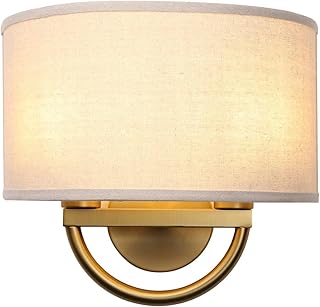
Industrial 2-Light Sconce with Linen Shade
Twin linen shades scatter light broadly and gently, which suits bedside and stairway placement where a hard beam would feel severe. Because it takes standard bulbs, you retain full control over brightness and warmth for years.
Frequently Asked Questions
How high should a wall sconce be mounted?
Sixty to sixty-six inches from the finished floor covers most applications. Beside a mirror, align the light source with eye level; above a headboard, drop it to about 30 inches over the mattress so it lands on the page, not your face.
Do I need an electrician?
For any hardwired fixture, yes, unless you’re confident working with an existing box and your local code permits homeowner work. Battery-powered sconces sidestep the question entirely.
Are up-and-down sconces too dim for a whole room?
Alone, usually. They’re accent and circulation lighting by design. Layer them with a table lamp or recessed fixtures for a room you actually work in.
Can sconces go in bathrooms?
Only with a damp-location rating, and never inside a shower zone without a wet rating. Check the listing before purchase.
Final Thoughts
For corridors and stairwells, the Joosenhouse up-and-down set gives you the cleanest architectural effect for the money, while the ASD bronze sconce is the smarter buy when you want to fine-tune color temperature after the fact. If your wall has no wiring, the rechargeable gold set removes the last excuse for leaving a dark corner dark.