Featured image: AI-generated editorial illustration. It does not show a tested product or document a real-world example.
Key takeaways
- Keep beds no wider than 4 feet if reachable from both sides, or 2 to 2.5 feet if against a wall or fence. This is the dimension that determines whether a bed is pleasant or annoying to maintain, and it holds regardless of how the…
Raised bed layout is usually treated as a decorating question and it is really an access question. Every dimension in a good layout comes from one constraint: you should be able to reach the center of any bed from a path without stepping into the soil. Once that rule is applied, most of the appealing layouts resolve themselves, and most of the layouts that look good in a rendering but frustrate people in practice — wide beds, beds pushed against fences, paths narrow enough that a wheelbarrow will not fit — get eliminated automatically.
This covers the layout patterns that work for flower beds specifically, the dimensions behind them, how bed height and material affect what you can grow, and how to position beds for the sun exposure your plants need. Planting itself is governed by your USDA hardiness zone and local frost dates rather than by any calendar, and raised beds add one wrinkle worth knowing about: because they are exposed on all sides, their soil warms earlier in spring and also freezes harder in winter than in-ground soil, which shifts both timing and overwintering in ways that matter in cold zones.

Rakukiri Raised Garden Bed GRS Certified Galvanized Planter Box Outdoor, 5ft Oval Rot-Resistant Metal Garden Bed Planter, Recycled Material Planter for Vegetables Flowers Herbs (Silver)
Selected for "raised flower bed layout ideas": this listing is a general product (Rakukiri Raised Garden Bed GRS Certified Galvanized Planter Box Outdoor, 5ft Ova), matching the product category this article compares.
View on Amazon
Land Guard 2 Pack 6×3×2 ft Galvanized Metal Raised Garden Bed, 2FT Deep Root Elevated Planter Box Steel Large Vegetable Flower Bed Kit, Silver
Selected for "raised flower bed layout ideas": this listing is a general product (Land Guard 2 Pack 6×3×2 ft Galvanized Metal Raised Garden Bed, 2FT Deep Root Ele), matching the product category this article compares.
View on Amazon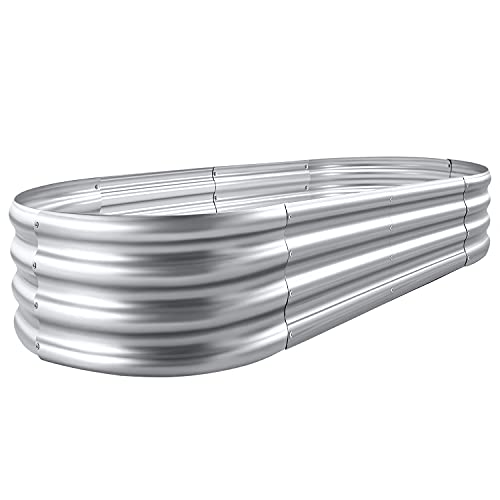
Land Guard Galvanized Raised Garden Bed Kit, Galvanized Planter Garden Boxes Outdoor, Oval Large Metal Raised Garden Beds for Vegetables…………
Selected for "raised flower bed layout ideas": this listing is a general product (Land Guard Galvanized Raised Garden Bed Kit, Galvanized Planter Garden Boxes Out), matching the product category this article compares.
View on Amazon
Yaheetech Raised Garden Bed Wooden Planter Box for Vegetables/Flowers, Wood
Selected for "raised flower bed layout ideas": this listing is a general product (Yaheetech Raised Garden Bed Wooden Planter Box for Vegetables/Flowers, Wood), matching the product category this article compares.
View on AmazonQuick Verdict
Keep beds no wider than 4 feet if reachable from both sides, or 2 to 2.5 feet if against a wall or fence. This is the dimension that determines whether a bed is pleasant or annoying to maintain, and it holds regardless of how the layout looks.
Leave paths at least 2 feet wide, and 3 feet on at least one main run. Two feet is walkable; three feet accommodates a wheelbarrow, a kneeling pad, and turning around with an armful of cuttings.
For flowers specifically, height is a design tool, not just an ergonomic one. Varying bed heights within a layout creates visual layers that a flat arrangement of identical beds cannot. Kits range from roughly $19.99 for a small 4x2x1 to $63.99 to $79.99 for large 8x4x2 beds, so mixing sizes is affordable.
Orient long beds so they do not shade each other. In most of the US, running long axes roughly east to west and placing the tallest plants on the north side keeps shorter plants in the sun.
| Layout | Typical Bed Size | Path Width | Space Needed | Best For |
|---|---|---|---|---|
| Single long border bed | 2-2.5 ft x 8+ ft | 2-3 ft on one side | Narrow strips | Fence lines, side yards |
| Parallel rows | 4 ft x 8 ft each | 2-3 ft between | Medium to large | Cutting gardens, production |
| U-shape / horseshoe | 3-4 ft wide sections | 3 ft interior | Roughly 12 x 12 ft | Enclosed garden feel |
| Keyhole | 4 ft wide around a notch | 2 ft entry notch | Roughly 8 x 8 ft | Maximum planting per footprint |
| Four-square with center feature | 4 ft x 4 ft each | 2-3 ft cross paths | Roughly 12 x 12 ft | Formal, symmetrical design |
| Tiered / stepped heights | Varying, 1-2.5 ft tall | 2 ft | Any, including slopes | Slopes, layered flower display |
| L-shape corner | 3-4 ft wide legs | 2-3 ft | Corner of a yard | Awkward corners, small lots |
| Island bed (all-around access) | 4-5 ft wide, any length | 3 ft perimeter | Open lawn | Viewed from all sides |
| Oval or curved bed | 2-5 ft wide | 2-3 ft | Any | Softening rectangular yards |
How to Choose
Set bed width from your own reach
Kneel down and measure how far you can comfortably reach into an imaginary bed without putting a hand on the soil. Most people land somewhere around 24 inches. Doubled, that gives the familiar 4-foot bed reachable from both sides. If a bed backs onto a fence, wall or hedge, it can only be worked from one side, so cap it at roughly 2 to 2.5 feet. Beds wider than these numbers get walked in, and walked-in raised bed soil compacts, which defeats much of the reason for building the bed.
Design the paths before the beds
Sketch where you will walk, then fill the leftover space with beds. Doing it the other way around produces layouts where every path is a dead end. At least one route through the garden should be 3 feet wide so a wheelbarrow can get to every bed, and every bed should touch a path on at least one long side. Path surface matters more than it seems: bare soil becomes mud, grass paths need mowing in strips too narrow for a mower, and gravel or wood chips over landscape fabric stay usable year-round for very little money.
Choose height by what you are growing and how you want to work
Roughly 6 to 12 inches suits most annual flowers and shallow-rooted perennials, provided the ground underneath is workable soil that roots can penetrate. Twelve to 24 inches gives deeper root room and less bending. Anything above about 24 inches becomes a standing-height bed, which is the right choice for anyone with mobility or back issues but requires a great deal of fill material. Kit dimensions reflect this: compact kits start around $19.99, with a 4x2x1 bed at $23.99, mid-size beds around $25.99 to $42.99, and full 8x4x2 beds roughly $63.99 to $79.99.
Place tall plants where they will not shade the rest
Sun moves across the sky to the south across the continental US, so the north side of a bed is where tall plants belong. In a multi-bed layout, running the long axis of each bed roughly east to west means a bed casts its shadow along its own length rather than across the next bed. On a north-south run, plan for the eastern bed to shade the western one in the afternoon and plant accordingly — that shaded strip is an opportunity for part-shade plants rather than a problem.
Vary heights deliberately in flower layouts
A layout of four identical beds reads as utilitarian. The same four beds at two or three different heights reads as designed, because the differing edge heights create layers even before anything is planted. Stepping beds down a slope is the most natural application, but tiering works on flat ground too. Combining a 1-foot bed in front with a 2-foot bed behind gives you a built-in front-to-back structure that makes the planting easier to plan.
Account for the material you build in
Galvanized steel kits are the cheapest route to a durable bed and go together without tools in most cases. They conduct heat, which warms soil earlier in spring — useful in cold zones, less so in hot southern ones where a light-colored or wood bed may be kinder to roots in midsummer. Untreated cedar and redwood resist rot without chemical treatment but cost considerably more. Concrete block and stone last indefinitely and give a wide flat top edge that doubles as seating, at the cost of a much larger footprint per bed.
Check drainage underneath before you build
A raised bed placed on ground that holds standing water can still become waterlogged, because water has nowhere to go once it reaches the bottom. Dig a test hole a foot deep, fill it with water twice, and time the second drain. If water is still sitting after 12 to 24 hours, either pick a different location, build higher, or break up the compacted layer underneath before filling.
Filling, Planting and Seasonal Reality
A raised bed is only as good as what goes in it. The standard approach is a blend of roughly equal parts topsoil and compost, which drains well and holds nutrients. Filling large beds entirely with bagged mix is expensive — an 8-by-4-by-2-foot bed holds a substantial volume — so bulk-delivered soil is significantly cheaper, and filling the bottom third with coarse organic material such as logs, branches and leaves reduces the volume of purchased soil needed while decomposing into more soil over time. Expect the level to drop in the first year as organic matter settles, and plan to top up with compost annually.
The timing side is where raised beds genuinely differ from in-ground planting, and it is worth being precise about. Because a raised bed is exposed to air on all sides, its soil warms noticeably earlier in spring than surrounding ground. In cool and cold zones, roughly 3 through 6, that is a real advantage: cool-season flowers can often go in earlier than they could in-ground, and warm-season annuals reach the 60°F soil temperature threshold sooner. The same exposure works against you in winter. Soil in a raised bed freezes harder and deeper than in-ground soil, and perennials that would reliably overwinter at your hardiness zone in the ground may not survive in a bed raised well above grade. A common working adjustment is to treat a tall raised bed as one zone colder than your map zone for the purposes of choosing perennials, and to mulch heavily over winter.
Raised beds also dry out faster, for the same reason. A bed that needed watering twice a week in-ground may need it every day or two in high summer, particularly a metal bed in a hot climate. Drip irrigation or a soaker hose under mulch is worth planning into the layout from the start, which is another argument for deciding the path and bed positions before building anything.
On plant selection, the honest guidance is to work in categories and check specifics locally. Full-sun annuals grown from seed fill a new bed cheaply in the first season. Perennials are a multi-year commitment to a fixed position and should be chosen against your zone, with the raised-bed cold adjustment noted above. Mature sizes, bloom times and sun requirements vary substantially between cultivars and regions, so the plant tag and your state extension service’s recommended plant lists are more reliable than general advice.
One thing to avoid deliberately: filling a new bed with a cheap generic wildflower mix. Some contain species that are invasive in parts of the US — dame’s rocket in Midwest and Northeast mixes, oxeye daisy in several western states — and a raised bed full of an aggressive spreader is a problem you will be undoing for years. Mixes with a printed species list, or single-species packets, avoid this entirely. The same caution applies to a handful of popular ornamentals, including periwinkle and butterfly bush, which are listed as invasive in some regions; a quick check against your state’s noxious weed list takes a minute.
Related guides: backyard landscaping ideas on a budget, best beginner flowers for a cutting garden, flower garden ideas for beginners, best at home gel nail kits, french tip variations for 2026
FAQ
How wide should a raised flower bed be?
Four feet if you can walk around both long sides, so you can reach the center from either direction. Two to 2.5 feet if the bed sits against a fence or wall and can only be worked from one side. These numbers come from average reach, so adjust them to your own if you are notably taller or shorter than average.
How deep does a raised flower bed need to be?
Six to 12 inches is adequate for most annual flowers and many perennials, as long as roots can grow down into decent soil beneath the bed. If the bed sits on concrete, compacted fill, or heavy clay that roots cannot penetrate, go to at least 18 inches. Standing-height beds at 24 to 30 inches are about comfort rather than plant need.
Do raised beds change when I should plant?
Somewhat. Raised bed soil warms earlier in spring, which in cooler zones can move sowing and transplanting a week or two ahead of in-ground timing. The deciding factor is still soil temperature and your local last frost date, not the calendar — a soil thermometer is the accurate way to know, with most warm-season annuals wanting soil at or above about 60°F.
Will perennials survive winter in a raised bed?
Sometimes, but not as reliably as in the ground. Raised bed soil is exposed on all sides and freezes harder, so a practical approach in cold zones is to choose perennials rated one zone colder than your USDA zone, and to mulch heavily over the bed once the ground has frozen. In mild zones this is rarely an issue.
What is the cheapest way to build a layout of several beds?
Galvanized steel kits are currently the lowest-cost durable option, with small kits starting around $19.99 (a 4x2x1 bed runs $23.99) and larger 8-foot beds around $25.99 for shallow ovals up to $63.99 to $79.99 for full 8x4x2 sizes. Buying bulk soil by the cubic yard rather than in bags, and partially filling the base of deep beds with coarse organic material, cuts the fill cost substantially, which is usually the larger expense.