Key takeaways
- The Primary Function of the Room: Ask yourself whether the space is dedicated to tasks where color accuracy is critical (such as a kitchen prep island, a bathroom vanity where you apply makeup, or an art studio) or if it is a transition space (like a hallway, laundry room, or closet) where basic visibility is all that matters. High-CRI bulbs are essential for task areas but can be a luxury in transition spaces.
- Your Color Temperature Preference (Kelvin): Color Rendering Index is not the same as color temperature. You must decide whether you want a warm, relaxing atmosphere (typically 2700K to 3000K Warm White) or a crisp, energizing daylight environment (5000K to 6500K Daylight). A bulb can have a high CRI at either end of this spectrum, but you must choose the temperature first.
- Your Dimming Requirements: Not all high-quality LED bulbs are dimmable. If you plan to use the bulbs in a dining room, living room, or bedroom with a dimmer switch, you must verify that the bulb circuitry supports dimming, and ideally, that it is compatible with modern LED-rated wall dimmers to prevent buzzing and flickering.
For years, shopping for light bulbs was simple: you grabbed a 60-watt or 100-watt incandescent bulb, screwed it in, and enjoyed a warm, familiar glow. The transition to LED technology promised massive energy savings, but it also introduced a frustrating side effect that many homeowners still struggle with today: clinical, lifeless interior lighting.
The most common mistake people make when buying LED bulbs is focusing entirely on brightness (lumens) and power consumption (wattage equivalents) while completely ignoring color quality. You might buy a bright, energy-efficient bulb only to find that it turns your beautiful hardwood floors a sickly gray, makes your kitchen countertops look muddy, and leaves your skin looking pale and washed out. This “zombie effect” is the direct result of a low Color Rendering Index (CRI). As we look at home design trends in 2026, the interior design world has shifted focus away from raw brightness and toward light quality, making CRI the single most important specification you need to understand before upgrading your fixtures.
Our top picks


As an Amazon Associate we earn from qualifying purchases at no extra cost to you.
Decide These 3 Things First
Before you begin comparing technical spec sheets and buying multi-packs of LED bulbs, you must establish three foundational parameters for your space. These decisions will narrow your options and ensure you do not waste money on incompatible or poorly suited lighting.
- The Primary Function of the Room: Ask yourself whether the space is dedicated to tasks where color accuracy is critical (such as a kitchen prep island, a bathroom vanity where you apply makeup, or an art studio) or if it is a transition space (like a hallway, laundry room, or closet) where basic visibility is all that matters. High-CRI bulbs are essential for task areas but can be a luxury in transition spaces.
- Your Color Temperature Preference (Kelvin): Color Rendering Index is not the same as color temperature. You must decide whether you want a warm, relaxing atmosphere (typically 2700K to 3000K Warm White) or a crisp, energizing daylight environment (5000K to 6500K Daylight). A bulb can have a high CRI at either end of this spectrum, but you must choose the temperature first.
- Your Dimming Requirements: Not all high-quality LED bulbs are dimmable. If you plan to use the bulbs in a dining room, living room, or bedroom with a dimmer switch, you must verify that the bulb circuitry supports dimming, and ideally, that it is compatible with modern LED-rated wall dimmers to prevent buzzing and flickering.
Bulb Size and Base Compatibility (A19 vs. E26)
When shopping for standard household light bulbs, you will almost always encounter the terms “A19” and “E26.” These alphanumeric codes are not technical jargon; they are standard physical measurements that dictate whether a bulb will physically fit into your lamp or fixture.
The term A19 refers to the classic pear-like shape of the bulb. The “A” stands for “Arbitrary,” while the “19” indicates the diameter of the bulb at its widest point in eighths of an inch. Therefore, an A19 bulb is exactly 2.375 inches (or about 60 millimeters) wide, with a standard length of 4.13 to 4.4 inches. This size is designed to fit almost all standard table lamps, floor lamps, pendant lights, and ceiling fans.
The term E26 refers to the metal base of the bulb. The “E” stands for “Edison screw,” and the “26” indicates a base diameter of 26 millimeters. This is the standard medium screw base used in the vast majority of light fixtures across North America. When buying LED replacements, ensure both measurements match your existing fixtures. High-CRI bulbs are engineered to fit these exact dimensions, generally weighing between 1.2 and 2.2 ounces, ensuring they do not make lightweight desk lamps top-heavy.
Material Quality and Thermal Dissipation
Unlike incandescent bulbs that emit heat forward as infrared radiation, LED bulbs generate heat at the back of the light-emitting diode chip. This heat is the number-one enemy of LED longevity and color stability. If an LED bulb runs too hot, its color output will degrade, and its lifespan will drop from decades to mere months.
When selecting a high-CRI bulb, look closely at the materials used in its construction:
- Aluminum-Core PCBs: Premium and mid-range bulbs mount their LED chips on an aluminum-core printed circuit board. Aluminum conducts heat away from the sensitive diodes much faster than cheap fiberglass boards.
- Thermal Plastics and Ceramic Liners: The outer housing of a quality bulb uses specialized flame-retardant thermal plastics or ceramic materials. These materials feel solid and slightly heavy in the hand, which is a good sign of proper heat sinking.
- Polycarbonate Globes: The frosted dome of the bulb should be made of high-impact, optical-grade polycarbonate. This material resists yellowing over time, ensuring the color quality (CRI) remains consistent throughout the bulb’s lifespan. Avoid ultra-cheap, thin plastics that can warp under continuous heat.
Construction and Driver Quality
The driver is the brain of the LED bulb. It converts the alternating current (AC) of your home’s 120V electrical system into the direct current (DC) required by the LED chips. The quality of this internal circuit board determines whether your bulb will flicker, buzz, or interfere with your home’s Wi-Fi and smart devices.
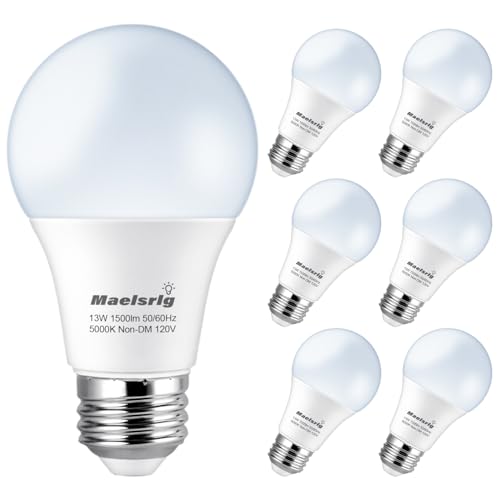
A high-quality driver features an integrated circuit (IC) that stabilizes the current. This is particularly important for dimmable bulbs, such as the 3000K Warm White Maelsrlg 60-watt equivalents. Cheap drivers cut corners by using simple capacitor-drop circuits, which produce a rapid, invisible 120Hz flicker. While you might not see this flicker consciously, it can cause eye strain, fatigue, and headaches over several hours of exposure. Look for bulbs that explicitly list “flicker-free” technology, which indicates a robust driver design capable of handling voltage fluctuations without dropping light quality.
Visual Comfort and Performance (CRI vs. R9)
Color Rendering Index (CRI) is measured on a scale from 0 to 100, with 100 representing natural daylight. Standard LED bulbs typically have a CRI of 80. While this is acceptable for hallways and garages, it makes colors look dull and unnatural inside living spaces. High-CRI bulbs, classified as having a CRI of 90 or higher, bring out the rich, natural tones in your furniture, paint, and food.
However, the standard CRI measurement (known as Ra) only averages the first eight color samples (R1 through R8), which are all pastel shades. It completely ignores saturated colors, most notably R9 (saturated red). Red is the most critical color for rendering warm wood tones, fabrics, meats, and human skin tones. Cheap bulbs claiming “90 CRI” can actually have an R9 value close to zero.
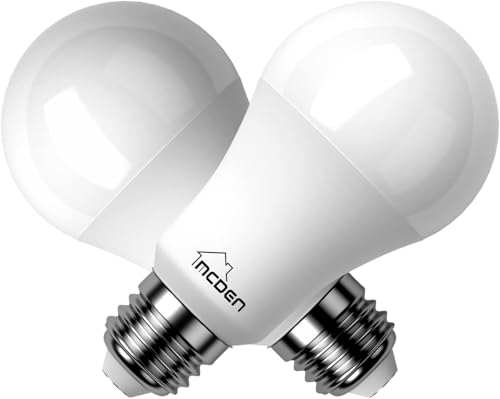
To achieve true visual comfort, look for full-spectrum bulbs, such as the McDen 97 CRI Sunlight Bulbs. These premium bulbs utilize specialized blue LED chips coated with a broad-spectrum red and green phosphor blend. This engineering feat results in a high R9 value (often 90+), allowing you to experience the vibrant, energizing qualities of natural sunlight indoors. This level of performance is particularly beneficial in windowless home offices or during dark winter months.
Price Tiers and Value Pack Math
The cost of LED bulbs has dropped significantly, but there remains a clear price distinction based on CRI performance, dimming capabilities, and pack sizes. Understanding these tiers helps you budget for a whole-house upgrade without overspending.
- Budget Tier ($1.50 – $1.80 per bulb): Standard 80 CRI bulbs, usually sold in 6-packs or 12-packs (such as basic evelor daylight bulbs). These are non-dimmable and best suited for utility rooms, closets, and outdoor garage fixtures where color accuracy is irrelevant.
- Mid-Range Tier ($1.60 – $2.50 per bulb): This is the sweet spot for most homes. Here you will find 90 CRI bulbs sold in multi-packs, like the Maelsrlg 90 CRI series. At around $1.66 per bulb for a non-dimmable 100W equivalent pack or $1.87 per bulb for a dimmable 60W equivalent pack, you get excellent color rendering, robust construction, and dimming capabilities without a premium price tag.
- Premium Tier ($8.00 – $10.00 per bulb): These are specialized full-spectrum bulbs, like the McDen 97 CRI 2-pack. They utilize advanced phosphor formulas to mimic natural sunlight almost perfectly. While expensive, they are worth the investment for high-use task areas like kitchen islands, vanity mirrors, and home offices.
Warranty and Lifespan Realities
Most LED bulbs advertise a lifespan of 15,000 to 25,000 hours, which equates to roughly 13 to 22 years based on 3 hours of daily use. While the LED chips themselves can last this long, the internal driver components often fail much sooner due to heat stress.
When purchasing bulbs, look for a manufacturer’s warranty of at least 2 to 3 years. A longer warranty is a strong indicator that the manufacturer has used high-quality capacitors and solid thermal management in the bulb’s construction. Keep in mind that using non-dimmable bulbs on a dimmer circuit, or installing standard bulbs in fully enclosed glass fixtures (which trap heat), will void your warranty and drastically reduce the bulb’s operating life.
Spec Checklist
Use this quick-reference table to compare technical specifications across different budget and performance tiers when shopping for LED bulbs.
| Specification | Budget (Standard) | Mid-Range (High-CRI) | Premium (Full-Spectrum) |
|---|---|---|---|
| CRI (Ra) Rating | 80 or lower | 90 to 92 | 95 to 98 |
| R9 (Red) Value | Under 10 | 50 to 70 | 90+ |
| Dimming Support | Usually Non-Dimmable | Dimmable options available | Highly compatible / Dimmable |
| Typical Wattage (Draw) | 8W (60W Equiv.) / 13W (100W Equiv.) | 8W (60W Equiv.) / 13W (100W Equiv.) | 13W (100W Equiv.) |
| Rated Lifespan | 10,000 – 15,000 Hours | 15,000 – 22,000 Hours | 25,000+ Hours |
| Average Cost per Bulb | $1.50 – $1.80 | $1.60 – $2.50 | $8.00 – $10.00 |
Red Flags
When shopping online or in home improvement centers, watch out for these deceptive marketing practices and quality shortcuts:
- “Daylight” Used to Hide Low CRI: Many manufacturers use the term “Daylight” (which refers only to the cool 5000K blue-white color temperature) to trick buyers into thinking the bulb renders colors naturally. A 5000K bulb with an 80 CRI will make your home look like a cold, clinical warehouse. Always verify the actual CRI number, not just the color temperature name.
- Ultra-Lightweight Bulbs: If a bulb feels incredibly light or hollow, it lacks the necessary aluminum heat sinking. These bulbs will run hot, degrade in color quality quickly, and likely fail within a year.
- Unlabeled CRI Ratings: If a product listing or box packaging does not proudly display the CRI rating (usually found in the “Lighting Facts” label on the back), assume it is a low-quality 80 CRI (or lower) bulb.
- Generic “Dimmable” Claims: Bulbs that claim to be dimmable but do not list compatibility with major dimmer brands (like Lutron or Leviton) often suffer from severe buzzing or drop-off when dimmed below 50% brightness.
FAQ
What is the difference between CRI and Kelvin?
Kelvin (K) measures the color temperature of the light source itself—whether the light looks warm and yellow (2700K) or cool and blue (5000K). CRI (Color Rendering Index) measures how accurately that light reveals the true colors of objects around it. You can have a warm 3000K bulb with a high 90 CRI, and you can also have a cool 5000K bulb with a low 80 CRI.
Is a 90 CRI bulb worth the extra cost over an 80 CRI bulb?
Yes, absolutely. The price difference between standard 80 CRI and high-quality 90 CRI bulbs (like the Maelsrlg multi-packs) has shrunk to pennies per bulb. The improvement in visual comfort, paint color accuracy, and overall home warmth is highly noticeable and well worth the minimal extra investment.
Why do some high-CRI LED bulbs flicker or buzz when dimmed?
This is almost always caused by an incompatibility between the bulb’s internal driver and the wall dimmer switch. Older dimmers designed for incandescent bulbs cut the voltage in a way that starves LED drivers, causing them to flicker or hum. Installing a modern, LED-compatible ELV (Electronic Low Voltage) dimmer switch will solve this issue.
Does a high CRI mean the bulb uses more electricity?
No. High-CRI LED bulbs are highly efficient. For example, a 90 CRI bulb and an 80 CRI bulb that both output 1500 lumens (a 100-watt equivalent) will both draw approximately 13 watts of power. The difference lies entirely in the quality of the phosphor coating on the LED chips, not the amount of electricity consumed.