Key takeaways
- Surface sheen over surface color: Satin and matte tops scatter light softly; high-gloss laminates act like mirrors and will reflect your ceiling fixture straight into your sightline. If you can only check one spec, check the finish.
- Depth for lamp geometry: A task lamp needs roughly 8–10 inches of real estate behind your work zone to sit at the right angle. Anything shallower than about 22 inches forces the lamp into your elbow room or onto a shelf where it stops doing its job.
- Contrast, not brightness: A dark walnut or black top gives white paper and a keyboard crisp definition, which means you can run lower ambient light and still see clearly. Pale gray and oak tops need warmer, dimmer lighting to avoid feeling clinical.
- Where the power lives: Built-in outlets and USB ports let you run a lamp, a bias light behind your monitor, and a charger without a visible cable run. Retrofitting that later almost always looks worse than it needs to.
- The silhouette after dark: Open-leg frames let floor uplight pass through and keep a small room breathing. Full pedestal bases block that light and read heavier, which is exactly right in a large room and exactly wrong in a 9×10 bedroom.
What's inside
Most desk shopping goes wrong in the same quiet way. You measure the wall, you check the drawer count, you click buy — and then you sit down at 7 p.m. and discover that the top throws a hot white smear back into your eyes, that your lamp has nowhere to stand, and that the whole corner reads flat and lifeless once the sun leaves. I spend my working life balancing light in rooms, and I can tell you that a desk is a lighting fixture in disguise. Its finish decides how much glare bounces up at your face, its depth decides whether a lamp can sit far enough back to be useful, and its color decides how the paper in front of you reads against it.
This guide looks at six writing desks through that lens: reflectance, lamp clearance, cable and outlet placement, and how each piece behaves after dark. Everything here is judged on how it holds light and how it anchors the mood of a room, not just on storage volume. The picks below span solid walnut, powder-coated steel, and a no-assembly folding option, so there’s something for a sunlit study and something for a windowless spare bedroom.
As an Amazon Associate we earn from qualifying purchases.



🛒 Best Price Today on Amazon
Prime members get fast, free shipping on everything above, plus member-only deals. New members get a 30-day free trial — cancel anytime.
How to Choose a Writing Desk (2026)
- Surface sheen over surface color: Satin and matte tops scatter light softly; high-gloss laminates act like mirrors and will reflect your ceiling fixture straight into your sightline. If you can only check one spec, check the finish.
- Depth for lamp geometry: A task lamp needs roughly 8–10 inches of real estate behind your work zone to sit at the right angle. Anything shallower than about 22 inches forces the lamp into your elbow room or onto a shelf where it stops doing its job.
- Contrast, not brightness: A dark walnut or black top gives white paper and a keyboard crisp definition, which means you can run lower ambient light and still see clearly. Pale gray and oak tops need warmer, dimmer lighting to avoid feeling clinical.
- Where the power lives: Built-in outlets and USB ports let you run a lamp, a bias light behind your monitor, and a charger without a visible cable run. Retrofitting that later almost always looks worse than it needs to.
- The silhouette after dark: Open-leg frames let floor uplight pass through and keep a small room breathing. Full pedestal bases block that light and read heavier, which is exactly right in a large room and exactly wrong in a 9×10 bedroom.
The Best Writing Desks (2026) Reviewed
SEDETA Farmhouse 70.9″ Executive Desk
The black-and-brown two-tone does something clever: the dark upper surface keeps veiling glare down while the warmer wood tones catch a lamp’s spill and give the corner some depth. At nearly 71 inches you get proper lamp real estate off to one side, and the integrated power outlet means your light source plugs in where it stands rather than trailing across the floor.
Need 47″ Folding Computer Desk
Rustic brown in a low-sheen finish is a forgiving surface under overhead light, and the no-assembly frame means you can trial three positions in a room before committing to where your light falls. BIFMA certification tells you the structure is sound, which matters more than it sounds when you’re clamping a lamp to the edge.
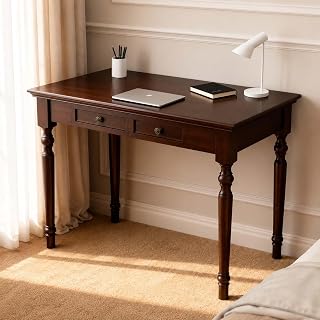
Solid Wood Vintage Writing Table, 45″ Walnut
Real walnut has a grain that reads differently at 2700K than it does at noon, and that shift is what makes a room feel lived in rather than staged. At 45 inches it suits a single warm task lamp and a small accent light, which is the classic two-source setup for a reading and writing nook.
Global Industrial 60″ Steel Teacher’s Desk
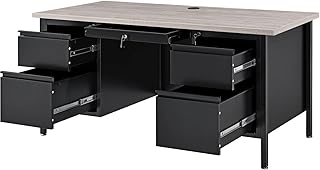
The gray top on a black frame is a neutral canvas, and that’s the point — it won’t tint your light or fight a colored accent wash. Be aware that painted steel is more reflective than wood, so aim your task lamp across the surface rather than down onto it, and the four locking drawers stay genuinely useful.
Lufeiya 47″ Reversible Desk with File Cabinet
The reversible layout is the quiet hero for lighting: you can put the cabinet on whichever side keeps your writing hand out of its own shadow, which is a decision most desks make for you. Matte black absorbs stray light and makes a small workspace feel contained rather than cramped.
Frequently Asked Questions
Does a dark desk top make a room feel darker?
It absorbs more light, yes, but it also raises contrast where you actually need it. Pair a dark top with a warm task lamp and a low wall wash and the room reads intimate, not gloomy.
Where should my desk lamp sit?
Opposite your writing hand, set back far enough that the shade sits above your eyeline when seated. That single change eliminates most hand shadow and most direct glare.
Is solid wood worth it over laminate?
For light behavior, often yes — options like the 47″ French Country walnut desk have grain and sheen that shift pleasantly through the day. For pure durability under a monitor arm, good laminate holds up fine.
Do I need a desk with built-in outlets?
Only if you plan on more than one light source. Once you’re running a task lamp plus a bias light, integrated power is the difference between a clean setup and a cable nest.
Final Thoughts
For a room you want to feel warm after sunset, the SEDETA Farmhouse 70.9″ gives you scale, storage, and onboard power in one piece. The Solid Wood Vintage 45″ Walnut is the better choice for a small, lamp-lit writing corner where the material does the atmospheric work, and the Lufeiya 47″ Reversible earns its place in tight spaces where you need to control which side your shadows fall on.