Key takeaways
- Verify true clearance, not marketing clearance: “Zero clearance” models like the EONIX line genuinely operate within a few inches of drywall, while some chairs labeled wall hugger still want 6–8 inches. Measure from the baseboard, and remember your baseboard itself eats depth.
- Plan the power run before you plan the seat: Electric recliners need an outlet, and a transformer box dangling behind the chair will telegraph itself the moment you switch on a lamp beside it. Look for models with integrated USB and USB-C ports so device charging happens at the armrest instead of via a second cable snaking across the floor.
- Match upholstery sheen to your light sources: Faux and genuine leather bounce specular highlights, which looks striking under a directional reading lamp and terrible under a bare bulb. Chenille and woven fabrics diffuse light softly and photograph beautifully in low-Kelvin ambient settings.
- Check headrest adjustability if you read: A power headrest lets you set the head angle independently, which is the difference between your lamp illuminating the page and illuminating your forehead. This is the most underrated feature in the category.
- Weigh frame rating against footprint: Compact wall huggers can be built to serious standards — a 400 lb tested frame in a small chair is a better long-term buy than a wide chair with vague specs. Confirm seat width separately, since 39″ models need real wall length.
What's inside
Most recliner shopping goes wrong at the wall. You measure the seat, you measure the doorway, and you forget that a traditional recliner needs a foot of breathing room behind it — which is exactly where your floor lamp, your sconce throw, or your carefully aimed wall wash already lives. I spend my working hours placing light in rooms, and the single most common thing I have to undo is a chair that got shoved forward to recline, dragging its occupant out of the pool of warm light and into the middle of the room where the overhead fixture glares off the page they’re trying to read.
A wall hugger recliner solves that geometry problem. It pivots the seat forward on its base instead of pushing the backrest rearward, so the chair can sit two to four inches off the baseboard and stay there, fully reclined. That means your lamp keeps its position, your cord run stays short and hidden, and the light you designed stays pointed where you designed it. Below I’ve looked at six current wall huggers through that lens: clearance, cable management, upholstery sheen, and how each one behaves under real evening light.
As an Amazon Associate we earn from qualifying purchases.


🛒 Best Price Today on Amazon
Prime members get fast, free shipping on everything above, plus member-only deals. New members get a 30-day free trial — cancel anytime.
How to Choose a Wall Hugger Recliner (2026)
- Verify true clearance, not marketing clearance: “Zero clearance” models like the EONIX line genuinely operate within a few inches of drywall, while some chairs labeled wall hugger still want 6–8 inches. Measure from the baseboard, and remember your baseboard itself eats depth.
- Plan the power run before you plan the seat: Electric recliners need an outlet, and a transformer box dangling behind the chair will telegraph itself the moment you switch on a lamp beside it. Look for models with integrated USB and USB-C ports so device charging happens at the armrest instead of via a second cable snaking across the floor.
- Match upholstery sheen to your light sources: Faux and genuine leather bounce specular highlights, which looks striking under a directional reading lamp and terrible under a bare bulb. Chenille and woven fabrics diffuse light softly and photograph beautifully in low-Kelvin ambient settings.
- Check headrest adjustability if you read: A power headrest lets you set the head angle independently, which is the difference between your lamp illuminating the page and illuminating your forehead. This is the most underrated feature in the category.
- Weigh frame rating against footprint: Compact wall huggers can be built to serious standards — a 400 lb tested frame in a small chair is a better long-term buy than a wide chair with vague specs. Confirm seat width separately, since 39″ models need real wall length.
The Best Wall Hugger Recliners of 2026, Reviewed
KISLOT Faux Leather Power Wall Hugger Recliner
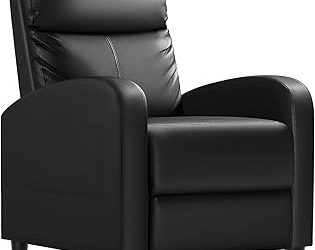
A sensible entry point for RVs, media rooms, and bedrooms where the chair has to live tight against a wall and near an outlet. The faux leather reads warm under 2700K light and the built-in USB ports keep the armrest area free of clutter, though the surface does pick up highlights from any hard-edged downlight overhead.
EONIX Zero Clearance Power Recliner (Small, Cream White)
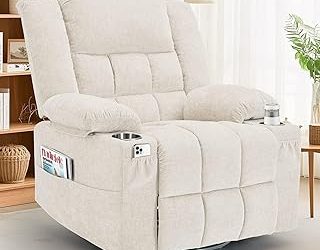
The smartest choice for genuinely tight rooms: one-button synchronized backrest and footrest movement, a compact footprint, and a 400 lb tested frame that belies its size. Cream white upholstery acts almost like a soft reflector, gently lifting ambient light in darker corners rather than swallowing it.
EONIX Dual Motor Zero Clearance Wall Hugger Recliner
My pick overall. Dual motors separate the backrest and footrest, and the adjustable power headrest lets you dial in a reading angle that actually cooperates with a task lamp. Breathable upholstery plus USB and USB-C charging make it the most complete package for compact rooms and RVs.
Watson & Whitely Genuine Leather Power Recliner
The upgrade option, and the one that ages best. Genuine leather in cream develops a soft patina that flatters warm, layered lighting, and the power headrest with USB/Type-C ports means the chair functions as its own little control station.
Massage Recliner with Heat, Leather (39″ Wide, Grey)
A manual, overstuffed lounger with heat and massage, best suited to rooms where the chair is the anchor rather than a supporting piece. At 39″ wide it needs wall length, and the grey leather sits comfortably under cooler ambient temperatures where cream would feel out of place.
Frequently Asked Questions
How much space does a wall hugger recliner actually need?
Typically two to four inches from the wall, versus roughly 12 inches for a conventional recliner. Zero clearance models sit closest, but always measure from the face of your baseboard rather than the drywall itself.
Are power or manual wall huggers better?
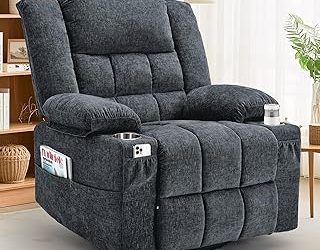
Power gives you infinite positioning and independent headrest control, which matters for reading. Manual models such as the Chenille massage recliner with cup holders and side pockets need no outlet at all, making them easier to place in rooms with awkward electrical layouts.
Will an electric recliner interfere with my lighting setup?
Only if you ignore the cable. Route the power lead along the baseboard toward the same outlet feeding your lamp, and use the chair’s onboard USB ports for phones so you’re managing one cord instead of three.
Which upholstery works best in a dim room?
Light-toned fabric or cream leather, both of which return ambient light back into the space. Dark chenille absorbs it, which is lovely in a dedicated media room but can make a small living room feel closed in.
Final Thoughts
For most rooms the EONIX Dual Motor Zero Clearance recliner is the one I’d specify first, thanks to its independent headrest and genuinely wall-tight operation. If budget is the priority, the KISLOT power recliner covers the fundamentals well, and if you want a chair that looks better in five years than it does today, the Watson & Whitely genuine leather model is worth the step up.