Key takeaways
- Headboard height and shadow: A tall upholstered headboard absorbs light and softens it, which flatters a bedside lamp but eats brightness if that lamp is your only source. Low or open frames let wall light wash down freely — better for rooms lit from a ceiling fixture or sconce.
- Somewhere to put the lamp: Shelf headboards and wide top rails give you a light source at pillow height, roughly 12 to 18 inches above the mattress, which is the sweet spot for reading without spill onto a sleeping face. Frames without any ledge commit you to a nightstand you may not have room for.
- Under-bed clearance as a light channel: Six inches of clearance reads as a dark seam; 12 to 14 inches lets you tuck an LED strip underneath for a low floor wash that doubles as a night light. Storage drawers fill that channel, so decide which you want more.
- Built-in LED quality, not just presence: RGB strips are common now and easy to oversell. Look for dimming and a warm white option — an undimmable cool-blue strip is closer to a monitor bezel than to ambient light, and blue-heavy output near bedtime works against you.
- Surface finish and reflectance: Matte black metal swallows light and disappears at night, which suits a room where you want the bed to recede. Natural pine and pale linen bounce it back, keeping a small twin room from going cavelike under a single lamp.
What's inside
Most twin bed frames get chosen in the daylight, on a screen, next to a mattress spec sheet. But a bed is a night object. It lives in the last twenty minutes before sleep and the first ten after waking, which means the things that actually matter are the ones a product photo can’t show: whether the headboard casts a hard shadow across a page, whether the frame gives you anywhere to set a warm lamp that isn’t the floor, whether a built-in light glows or glares. Buyers end up with a structurally sound frame that makes the room feel like a waiting area after dark.
This guide reads six current twin frames the way a lighting designer would walk a room — sightlines, shadow behavior, surface height, and how each frame handles the small pools of light that make a small space feel settled rather than institutional. Storage, charging ports, noise, and assembly are all here too, but framed by how they affect the atmosphere you’ll actually live in at 11 p.m.
As an Amazon Associate we earn from qualifying purchases.



🛒 Best Price Today on Amazon
Prime members get fast, free shipping on everything above, plus member-only deals. New members get a 30-day free trial — cancel anytime.
How to Choose a Twin Bed Frame (2026)
- Headboard height and shadow: A tall upholstered headboard absorbs light and softens it, which flatters a bedside lamp but eats brightness if that lamp is your only source. Low or open frames let wall light wash down freely — better for rooms lit from a ceiling fixture or sconce.
- Somewhere to put the lamp: Shelf headboards and wide top rails give you a light source at pillow height, roughly 12 to 18 inches above the mattress, which is the sweet spot for reading without spill onto a sleeping face. Frames without any ledge commit you to a nightstand you may not have room for.
- Under-bed clearance as a light channel: Six inches of clearance reads as a dark seam; 12 to 14 inches lets you tuck an LED strip underneath for a low floor wash that doubles as a night light. Storage drawers fill that channel, so decide which you want more.
- Built-in LED quality, not just presence: RGB strips are common now and easy to oversell. Look for dimming and a warm white option — an undimmable cool-blue strip is closer to a monitor bezel than to ambient light, and blue-heavy output near bedtime works against you.
- Surface finish and reflectance: Matte black metal swallows light and disappears at night, which suits a room where you want the bed to recede. Natural pine and pale linen bounce it back, keeping a small twin room from going cavelike under a single lamp.
The Best Twin Bed Frame (2026)s Reviewed
Fluest Twin Bed Frame with Storage Drawer
The button-tufted upholstered headboard is the best light-diffuser in this group — fabric plus tufting breaks up a lamp’s hotspot into something genuinely soft, and the integrated charging station means your bedside light and phone share one cord run. All-metal structure underneath keeps it quiet, though the drawer claims the under-bed space, so plan your ambient lighting above mattress level.
PHGLL Twin Bed Frame with 2-Tier Storage Headboard
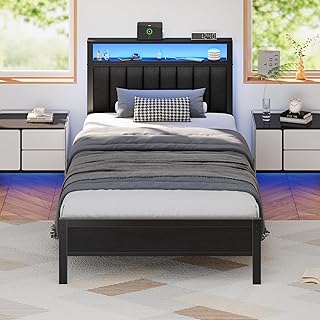
This is the most lighting-aware frame here: the two-tier headboard gives you real shelf depth for a small lamp or candle, and the RGB LED strip handles low-level orientation light so you’re not hunting for a switch at 3 a.m. Set it to a warm amber rather than the demo colors and it earns its keep; the 3-in-1 charging station and two drawers make it the pick for a room doing double duty as a study.
LIFEMENT Signature Wood Platform Bed Frame
A restrained wood frame with a solid headboard that reads calm rather than furniture-showroom, and the black finish absorbs enough light to let a single bedside source define the whole corner. Under-bed storage stays open, which is exactly where a hidden LED strip belongs if you want a floating effect.
NEW JETO Metal Bed Frame, 14 Inch
Fourteen inches of clearance is the most usable light channel in this roundup — enough to conceal a strip or a plug-in puck without any visible hardware. Headboard-free and heavy duty, so it leans on your existing wall lighting rather than adding its own, which is ideal if you already have sconces or a good floor lamp.
Mellow Naturalista Classic 12-Inch Solid Wood Platform Bed
Natural pine is the highest-reflectance surface here, quietly amplifying whatever light you give it and keeping a windowless twin room from feeling closed in. Twelve inches of clearance and open slats mean it stays visually light, and it’s the easiest of these to pair with layered warm-toned lamps.
Frequently Asked Questions
Are built-in RGB LEDs actually useful or just a gimmick?
Useful if they dim and can go warm. Their real job is low-level orientation light — enough to find the door without waking fully. Treat them as a floor-level utility, not room lighting.
Does a twin frame need a box spring?
None of these do. All six use slats or a metal platform designed to support a mattress directly, which also keeps the profile lower and the under-bed area more usable.
Storage drawers or under-bed lighting?
You can rarely have both. Drawers win in small rooms with no closet; open clearance of 12 inches or more wins if you want the bed to visually float and the room to feel larger after dark.
Will a metal frame squeak?
The noise-free designs here use interlocking joints and dense support bars instead of a few wide rails. Squeaks almost always come from loose bolts, so retighten everything after the first two weeks.
Final Thoughts
For a room that needs to work as a bedroom and a workspace, the PHGLL frame’s shelf headboard and dimmable LED give you the most control over how the space feels at night. The Fluest is the better choice if soft, diffused reading light matters most, and the Mellow Naturalista is the one to pick when you want pale wood doing the quiet work of making a small twin room feel open.