Key takeaways
- Fabric sheen and reflectance: Velvet has directional pile that catches raking light and glows near a window; chenille diffuses softly and hides shadow lines; flat linen weaves absorb the most. In a north-facing or single-window room, lean lighter and softer-textured to reclaim bounced light.
- Back height under 33 inches: A low back lets lamp light and daylight travel over the sofa instead of stopping at it. Anything taller behind a window creates a visible dead zone in the corner.
- Reversible chaise orientation: Being able to flip the chaise left or right decides where your floor lamp, side table, and outlet access land. Test both layouts before assembly.
- Leg clearance: Raised legs let light slip underneath, which reads as extra floor and extra room. Skirted or floor-hugging bases visually anchor and shrink.
- Seat depth versus walkway: Deep 24-inch cloud seats are luxurious but need at least 30 inches of clear path in front. Measure the walkway first, then pick the depth.
What's inside
Small rooms rarely fail because of square footage. They fail because of light. Drop a bulky sectional into a 12-by-13 living room and you have not just eaten floor area, you have built a wall that blocks your lamp glow, casts a hard shadow across the rug, and swallows the daylight that used to bounce off the far corner. I spend my working hours measuring how surfaces receive and return light, and upholstery is the single largest light-absorbing object most people own. Choose it badly and the whole room reads dim, flat, and smaller than it is.
This guide looks at compact L-shaped sectionals through that lens: how the fabric handles a warm 2700K bulb, whether the back height clears your sightlines, how a reversible chaise changes where you can place a floor lamp, and which pieces keep a small space feeling open after dark. Every model below sits under 84 inches wide, which is the practical ceiling for apartments, studios, and bonus rooms.
As an Amazon Associate we earn from qualifying purchases.


🛒 Best Price Today on Amazon
Prime members get fast, free shipping on everything above, plus member-only deals. New members get a 30-day free trial — cancel anytime.
How to Choose a Sectional Sofa For Small Spaces (2026)
- Fabric sheen and reflectance: Velvet has directional pile that catches raking light and glows near a window; chenille diffuses softly and hides shadow lines; flat linen weaves absorb the most. In a north-facing or single-window room, lean lighter and softer-textured to reclaim bounced light.
- Back height under 33 inches: A low back lets lamp light and daylight travel over the sofa instead of stopping at it. Anything taller behind a window creates a visible dead zone in the corner.
- Reversible chaise orientation: Being able to flip the chaise left or right decides where your floor lamp, side table, and outlet access land. Test both layouts before assembly.
- Leg clearance: Raised legs let light slip underneath, which reads as extra floor and extra room. Skirted or floor-hugging bases visually anchor and shrink.
- Seat depth versus walkway: Deep 24-inch cloud seats are luxurious but need at least 30 inches of clear path in front. Measure the walkway first, then pick the depth.
The Best Sectional Sofa For Small Spaces (2026)s Reviewed
73.6″ Convertible Sectional with Reversible Ottoman
At just over six feet wide, this is the easiest fit for a genuinely tight room, and the mid-grey fabric holds its color under warm bulbs instead of going muddy. The reversible ottoman means you can decide late in the game which side your reading lamp lives on.
Flamaker 72″ L-Shaped Convertible Sectional
The narrowest pick here and the most forgiving in a studio, though the dark grey linen absorbs a fair amount of light, so pair it with a bright rug or a second lamp. The removable ottoman doubles as a spare seat when you rearrange for guests.
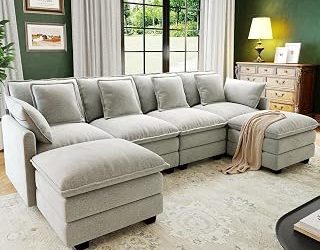
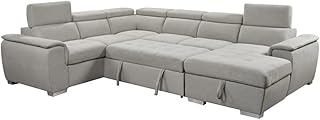
76.7″ Small Modular Cloud Sectional, Beige
Chenille in beige is the most light-friendly combination in this roundup; it scatters illumination back into the room and keeps evening shadows soft rather than graphic. The deep seat is the tradeoff, so confirm your walkway clearance before committing.
3-Seat Reversible Sectional with Convertible Ottoman
The ribbed fabric is the interesting one for ambience: those vertical channels create fine micro-shadows that give the piece depth under a single overhead source, where flat upholstery would look dull. Tool-free assembly is a real advantage in a walk-up apartment.
Welzona 83″ Velvet L-Shaped Sectional
The largest footprint here and the best choice if your room is small but not cramped, since velvet’s pile catches directional light and gives a small space genuine warmth after sunset. Grey velvet also shifts tone through the day, which keeps the room from feeling static.
Frequently Asked Questions
What size sectional actually fits a small living room?
Aim for a total width under 80 inches and leave 30 to 36 inches of walkway on the open side. Tape the footprint on your floor and live with it for a day before ordering.
Does a dark sofa make a small room look smaller?
It reduces bounced light, which reads as smaller. You can offset it with a light rug, a pale wall behind the sofa, and a second light source at seated height rather than relying on one ceiling fixture.
Is velvet or chenille better for a compact space?
Chenille diffuses light evenly and hides wear well, making it the safer everyday pick. Velvet delivers more visual richness and depth under lamplight, which suits rooms you mostly use in the evening.
Are convertible ottomans worth it?
Yes, in small rooms especially. Being able to reposition the chaise lets you adapt to outlet placement, window position, and traffic flow instead of building your layout around a fixed corner.
Final Thoughts
For the tightest rooms, the 73.6″ Convertible Sectional gives you the most flexibility for the least floor area. If you want the room to feel brighter after dark, the 76.7″ Beige Cloud Sectional returns the most light of anything here, while the Welzona 83″ Velvet is the pick when you have a few extra inches and want real evening warmth.