Key takeaways
- Wall-hugger travel: Standard recliners need 8 to 14 inches behind them. Wall-hugger mechanisms cut that to roughly 3 to 4 inches, which is often the difference between keeping a floor lamp in the corner and relocating your entire lighting scheme.
- How the fabric reads under warm light: Chenille and flannel have visible nap that scatters light softly and hides the shadow lines a low lamp casts. Leathaire and faux leather bounce more, so a single bright bulb will produce a hot streak across the seat cushions. Pair slick surfaces with diffused shades or a dimmer.
- Reclined eye height: Sit, lean back fully, and note where your eyes land. Most loveseat recliners put a reclined head between 24 and 30 inches off the floor, which means your table lamp shade bottom should sit around 26 to 28 inches to keep the bulb out of view.
- Console and onboard features: A flip-up console adds 12 to 15 inches of width but gains you a landing spot for a remote and a phone. Built-in USB, outlets, and speakers reduce cord runs across the floor, which matters when your only outlet is behind the sofa.
- Total open depth: Compact models expand from about 36 inches closed to 60 or more fully extended. Measure to your coffee table, not just to the wall, and leave a 14-inch walking lane so nobody trips in low light.
What's inside
Small living rooms punish two things: bulk and bad light. A reclining sofa is usually guilty of the first, and it quietly sabotages the second. Once a seat back drops fifteen degrees, your eye line falls with it, and the table lamp you positioned so carefully now aims its shade straight into your face while the wall behind you goes flat and dim. Add a recliner’s rearward travel and you lose the wall real estate where a floor lamp or sconce used to live. The result is a room that reclines comfortably but reads like a waiting area after dark.
This guide approaches compact reclining sofas the way I’d approach a lighting plan: by measuring clearances, tracking sightlines at seated and reclined height, and judging how each upholstery surface handles a warm 2700K glow. Below you’ll find six loveseat-scale recliners worth considering in 2026, a selection framework built around footprint and ambience, reviews of the strongest options, and answers to the questions that come up most once the tape measure is out.
As an Amazon Associate we earn from qualifying purchases.


🛒 Best Price Today on Amazon
Prime members get fast, free shipping on everything above, plus member-only deals. New members get a 30-day free trial — cancel anytime.
How to Choose a Reclining Sofa For Small Spaces (2026)
- Wall-hugger travel: Standard recliners need 8 to 14 inches behind them. Wall-hugger mechanisms cut that to roughly 3 to 4 inches, which is often the difference between keeping a floor lamp in the corner and relocating your entire lighting scheme.
- How the fabric reads under warm light: Chenille and flannel have visible nap that scatters light softly and hides the shadow lines a low lamp casts. Leathaire and faux leather bounce more, so a single bright bulb will produce a hot streak across the seat cushions. Pair slick surfaces with diffused shades or a dimmer.
- Reclined eye height: Sit, lean back fully, and note where your eyes land. Most loveseat recliners put a reclined head between 24 and 30 inches off the floor, which means your table lamp shade bottom should sit around 26 to 28 inches to keep the bulb out of view.
- Console and onboard features: A flip-up console adds 12 to 15 inches of width but gains you a landing spot for a remote and a phone. Built-in USB, outlets, and speakers reduce cord runs across the floor, which matters when your only outlet is behind the sofa.
- Total open depth: Compact models expand from about 36 inches closed to 60 or more fully extended. Measure to your coffee table, not just to the wall, and leave a 14-inch walking lane so nobody trips in low light.
The Best Reclining Sofa For Small Spaces (2026)s Reviewed
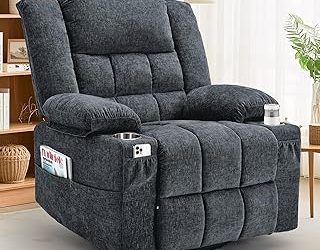
GUEAPY 55″ Chenille Reclining Loveseat
At 55 inches, this is the narrowest genuinely comfortable option here, and the chenille is the most forgiving surface in the group under directional light: the nap absorbs glare instead of throwing it back at you. Wide armrests double as a stable perch for a small accent lamp, and the side storage keeps clutter off the surfaces you actually want to light.
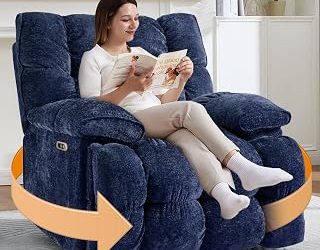
Redlife Power Loveseat Recliner with Heat & Massage
Power adjustment means you can stop at any angle, which is genuinely useful when you’re dialing in a viewing position relative to a screen or window glare. The soft flannel in blue drinks up warm light beautifully, though budget a nearby outlet, since the power cord dictates placement more than the recliner mechanism does.
68″ Wall Hugger Loveseat with Flip-Up Console
The wall-hugger frame recovers nearly a foot of floor space behind the sofa, which is where I’d put a slim uplight to wash the wall and visually raise a low ceiling. The velvet has a directional sheen that shifts as you cross the room, so keep your key light off-axis rather than head-on.
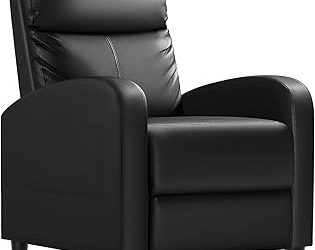
Redlife Leathaire Loveseat with Console & Bluetooth
This one consolidates the most infrastructure: USB, a power outlet, Bluetooth speakers, and a storage drawer, so a single wall socket can feed both your charging and your lamp. Leathaire is reflective, so a dimmable warm bulb and a fabric shade will do far more for the look than a bright overhead fixture.
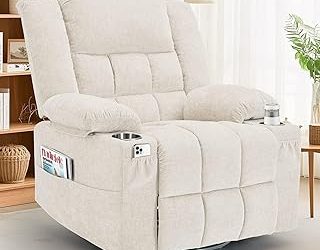
Manual Massage Loveseat Recliner, No Console
Skipping the console keeps the width tight while still delivering cup holders, storage, and USB charging, making it the efficiency pick for narrow rooms and RVs. The wall-hugger action holds it close enough to the wall that a plug-in sconce stays reachable and unobstructed.
Frequently Asked Questions
How much clearance does a wall-hugger recliner really need?
Plan on 3 to 4 inches for most wall-hugger loveseats, versus 8 to 14 for conventional mechanisms. Add an inch of tolerance for baseboards and any cord routing behind the frame.
Does a reclining loveseat fit a room under 120 square feet?
Yes, if you stay at or below 58 inches wide and confirm the fully open depth. Float the sofa a few inches off the wall so light can wrap behind it, which makes tight rooms feel deeper.
Manual or power for a small room?
Manual frees you from outlet placement, so you can position the sofa purely by sightline and lamp geometry. Power is worth the cord if you want precise stops or plan to use built-in USB and speakers.
Which fabric looks best under warm lighting?
Chenille and flannel diffuse warm light and read cozy at low levels. Leathaire and velvet are more reflective, so use dimmers, shades, or indirect placement to avoid hot spots.
Final Thoughts
For the tightest floor plans, the GUEAPY 55″ chenille loveseat is the easiest to light well and the least demanding on space. If you want precise recline control and a soft, glare-free surface, the Redlife Power Loveseat with heat and massage is the stronger choice, while the Redlife Leathaire model with console, USB, outlet, and Bluetooth is the pick for anyone consolidating power and ambience into one piece of furniture.