Key takeaways
- Frame Material: Look for kiln-dried hardwood (birch, maple, or oak) or solid wood construction. Avoid frames described only as “engineered wood” or left unspecified — these tend to flex under sustained load and accelerate joint fatigue.
- Seat Depth and Height: Deeper seats (24 inches-plus) distribute weight over a larger surface area, reducing pressure on any single foam zone. Pair that with a seat height above 18 inches for easier ingress and egress, especially important if the sectional doubles as a sleeper.
- Modular Connector Quality: Individual modules that use interlocking steel brackets or heavy-duty hook-and-loop fasteners stay aligned under movement. Cheap plastic clips or friction-fit connectors will drift and gap with regular use by heavier individuals.
- Fabric Durability and Hand Feel: Chenille and tightly woven polyester resist pilling and maintain a soft hand after repeated compression. Corduroy offers excellent grip and a textured surface that catches directional light beautifully — useful if your sectional sits near a window or under adjustable floor lamps.
- Weight Rating Transparency: The best manufacturers publish per-seat and overall weight capacities. If a listing avoids these numbers entirely, treat the omission as a data point. Reputable brands stand behind their specs.
What's inside
Most sectionals labeled “heavy-duty” lean on marketing buzzwords while sidestepping the engineering that actually matters: reinforced joinery, solid hardwood subframes, and seat-deck construction that distributes weight across multiple contact points rather than concentrating it at the seams. Buyers seeking a sectional for heavier daily use often find themselves replacing cushions within a year, tightening loosened modular connectors, or discovering that “sturdy frame” translates to a thin layer of plywood over softwood brackets. The search is made harder by the fact that most retailer photography uses bright, shadowless staging that obscures the structural details worth scrutinizing.
This guide focuses on six modular sectionals that address load capacity with real construction choices — kiln-dried hardwood, reinforced steel brackets, high-resilience foam — while also considering how each piece shapes a room’s spatial flow. As someone who evaluates furniture partly through the way it interacts with ambient and task lighting, I pay close attention to fabric texture, seat depth, and silhouette proportion, because these factors determine whether a large sectional anchors a room gracefully or overwhelms it. Below you’ll find a selection framework, honest mini-reviews, and guidance to help you commit with confidence.
As an Amazon Associate we earn from qualifying purchases.


🛒 Best Price Today on Amazon
Prime members get fast, free shipping on everything above, plus member-only deals. New members get a 30-day free trial — cancel anytime.
How to Choose a Sectional Sofa for Heavy Person (2026)
- Frame Material: Look for kiln-dried hardwood (birch, maple, or oak) or solid wood construction. Avoid frames described only as “engineered wood” or left unspecified — these tend to flex under sustained load and accelerate joint fatigue.
- Seat Depth and Height: Deeper seats (24 inches-plus) distribute weight over a larger surface area, reducing pressure on any single foam zone. Pair that with a seat height above 18 inches for easier ingress and egress, especially important if the sectional doubles as a sleeper.
- Modular Connector Quality: Individual modules that use interlocking steel brackets or heavy-duty hook-and-loop fasteners stay aligned under movement. Cheap plastic clips or friction-fit connectors will drift and gap with regular use by heavier individuals.
- Fabric Durability and Hand Feel: Chenille and tightly woven polyester resist pilling and maintain a soft hand after repeated compression. Corduroy offers excellent grip and a textured surface that catches directional light beautifully — useful if your sectional sits near a window or under adjustable floor lamps.
- Weight Rating Transparency: The best manufacturers publish per-seat and overall weight capacities. If a listing avoids these numbers entirely, treat the omission as a data point. Reputable brands stand behind their specs.
The Best Sectional Sofa for Heavy Person (2026) Reviewed
Modular Sectional Sleeper with Pull Out Bed (108″, Chenille)
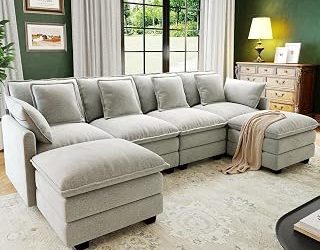
Among the six models evaluated, this U-shaped sleeper stands out for combining a reclining backrest, built-in USB charging, and a pull-out bed into a single cohesive platform. The chenille fabric has a subtle nap that catches warm evening light without appearing slick or overly formal, making it ideal for living rooms that transition from bright daytime use to softer ambient setups. Its 7-seat configuration also provides generous spacing between seat modules, which reduces lateral pressure on any single section — a detail that matters more over time than most spec sheets acknowledge.
EEASE Moose Oversized Modular Sofa
The Moose distinguishes itself with a solid wood frame — no engineered composites — and removable, washable covers that simplify long-term maintenance. Its oversized seat depth pushes past typical sectional proportions, creating a low-slung silhouette that reads as grounded and substantial under recessed ceiling lighting. If your room skews minimal, this sofa’s broad, shadow-casting profile provides visual weight without clutter. The trade-off is a firm initial sit that softens gradually, which suits heavier users who want consistent support rather than plush give.
Oversized Modular Cloud Sectional (Camel, V-Shaped)
Available in camel rather than the standard grey palette, this V-shaped sectional brings warmth to rooms dominated by cool-toned lighting. The two movable ottomans let you sculpt the seating arrangement around your space’s natural light sources — angle one toward a reading lamp, pull the other away to open a walkway. Chenille upholstery and deep seat cushions handle heavier daily use comfortably, and the 7-seater footprint makes it a natural centerpiece for open-concept living areas or dedicated home theater rooms.
Legend Vansen Oversized Modular Sectional (U/L-Shaped)
This reversible design offers rare flexibility: configure it as an L-shape facing a window wall or flip to a U-shape that cocoons the seating area under pendant lighting. The plush polyester fabric has a matte finish that absorbs rather than reflects overhead light, which creates a calmer visual atmosphere in bright rooms. Its included ottoman adds a footrest or extra seating module, and the 7-seater capacity uses reinforced base rails that resist the lateral shifting common in budget modulars.
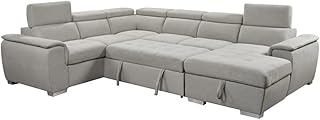
108″ L-Shaped Modular with Pull Out Bed (Corduroy)
The corduroy texture on this sleeper sectional catches ridgelines of light from nearby lamps and windows, lending a warm, tactile quality that smooth fabrics cannot replicate. Its hidden storage compartment beneath the sleeper mechanism is genuinely useful for heavier households where extra blankets and linens accumulate. Removable covers add practicality, and the L-shaped footprint fits neatly against a wall while leaving the open side free for light to pass through — a detail that prevents large sectionals from visually closing off a room.
Frequently Asked Questions
What frame material is best for a heavy person’s sectional?
Kiln-dried hardwood — particularly birch, maple, or oak — offers the strongest combination of rigidity and long-term dimensional stability. Solid wood frames, as found in the EEASE Moose, outperform engineered alternatives under sustained heavy loads because they resist warping at joint connections.
Should I choose a sleeper sectional over a standard modular?
A sleeper sectional adds functional value if the sofa serves double duty as a guest bed, but the pull-out mechanism adds mechanical complexity and a potential failure point. For heavy daily use, prioritize models where the sleeper deck itself is supported by a reinforced slat system rather than a thin plywood platform.
How important is removable fabric for long-term use?
Removable and washable covers extend the sectional’s lifespan significantly by allowing you to clean compression zones (seat cushions, armrests) without professional upholstery service. This is especially relevant for heavier users, where fabric undergoes greater friction and compression over time.
Can a modular sectional handle uneven floors without rocking?
Models with adjustable leveling feet or wide, low-profile base rails handle minor floor irregularities better than those relying on narrow legs. Look for sectionals where each module sits close to the ground — lower centers of gravity reduce wobble and improve lateral stability.
Final Thoughts
For buyers prioritizing raw structural integrity, the EEASE Moose Oversized Modular leads with its solid wood frame and no-compromise build. The Modular Sectional Sleeper with Pull Out Bed offers the best balance of features — reclining backrest, USB charging, sleeper functionality — with a chenille finish that photographs and lives well under varied lighting conditions. And for those who want a statement piece that works with warm ambient schemes rather than against them, the Oversized Modular Cloud Sectional in camel delivers both visual distinction and genuine heavy-use durability. Whichever you choose, focus on frame material and connector quality first — everything else is negotiable.